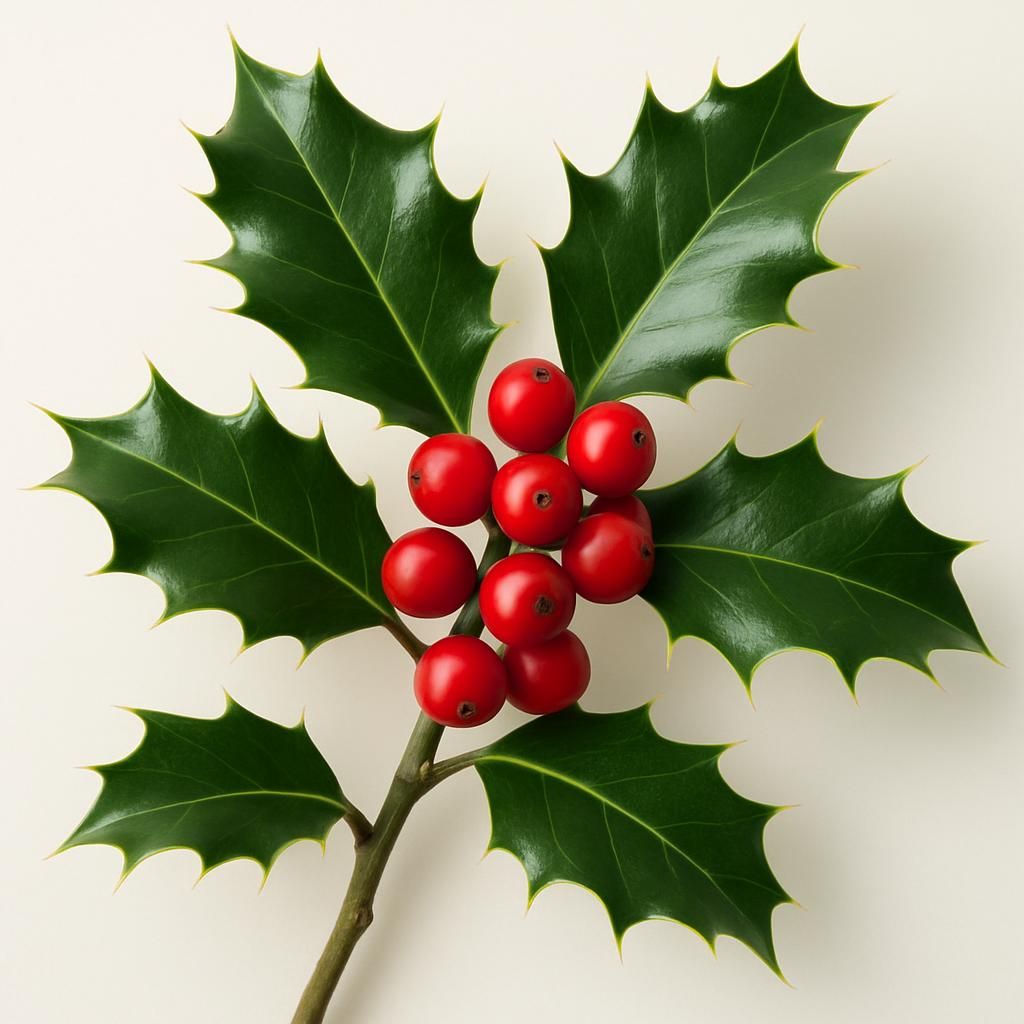
Introduction to Ilex aquifolium
Ilex aquifolium, the English holly, is one of the most iconic evergreen shrubs in temperate horticulture and small-scale agriculture. Native to western and southern Europe, northwest Africa, and southwest Asia, it has been cultivated for centuries for its striking foliage and vibrant berries. In commercial and small-farm settings, English holly is grown primarily for cut greenery, holiday wreaths, landscape hedging, and container production. Its dense growth habit and tolerance of pruning make it an excellent choice for formal gardens and windbreaks.
Professional growers appreciate Ilex aquifolium for its longevity—specimens can live for several hundred years—and its ability to thrive in a wide range of soil types once established. The plant is dioecious, meaning male and female flowers occur on separate plants, so berry production requires both sexes. Female cultivars such as ‘J.C. van Tol’ and ‘Alaska’ are popular for heavy fruiting when paired with male pollinators like ‘Silver Queen’. The glossy, dark green leaves with spiny margins provide year-round visual interest and natural deer resistance.
Beyond ornamentals, holly has minor traditional uses in herbal medicine and as a source of fine-grained wood for inlay and engraving. Modern cultivation focuses on disease-resistant cultivars, sustainable pruning regimes, and integrated pest management to maintain plant health and market-quality berries. This guide provides professional-grade advice for establishing and maintaining productive Ilex aquifolium plantings.
Botanical Profile of Ilex aquifolium
Ilex aquifolium belongs to the family Aquifoliaceae. It is a slow-to-moderate growing evergreen that reaches 10–25 feet (3–8 m) in height with a 8–15 foot (2.5–4.5 m) spread in cultivation, though wild specimens can exceed 50 feet. The alternate, leathery leaves are ovate to elliptic, 2–4 inches long, with 5–9 sharp spines on juvenile growth that become smoother on mature branches. Young stems are green and angular, maturing to gray-brown bark.
Flowering occurs in late spring to early summer. Small, white, four-petaled flowers appear in axillary clusters. Female plants produce bright red drupes (berries) ¼–⅜ inch in diameter that ripen in autumn and persist through winter. Each berry contains 2–4 hard seeds. The plant’s extensive root system is fibrous and shallow, making it moderately drought tolerant once established but sensitive to soil compaction.
Sexual dimorphism is pronounced: male plants produce more abundant flowers but no fruit, while female plants bear the characteristic berries. Several variegated and spineless cultivars exist for landscape diversity. The plant exhibits apical dominance, responding well to heading cuts that encourage dense branching.
Soil, pH, and Climate Requirements for Ilex aquifolium (MUST INCLUDE A MARKDOWN TABLE OF IDEAL CONDITIONS)
Ilex aquifolium performs best in well-drained, fertile soils with consistent moisture. It tolerates a range of textures from sandy loam to clay loam provided drainage is adequate. Heavy clay soils should be amended with organic matter to prevent waterlogging. The species is adaptable to slightly acidic to neutral conditions but will show chlorosis in highly alkaline soils.
The following table summarizes optimal growing conditions:
| Parameter | Ideal Range | Notes |
|---|---|---|
| Soil Type | Well-drained sandy loam to clay loam | Avoid waterlogged sites |
| Soil pH | 5.5 – 7.0 | Amend with sulfur if pH > 7.2 |
| Temperature Range | USDA Zones 6–9 (-10°F to 20°F min) | Protect young plants from late spring frost |
| Annual Rainfall | 30–60 inches (760–1520 mm) | Supplemental irrigation in dry periods |
| Sun Exposure | Full sun to partial shade | More sun increases berry production |
| Spacing (Hedgerow) | 4–6 ft (1.2–1.8 m) | 8–10 ft for specimen plants |
Site selection should prioritize protection from strong winter winds, which can desiccate foliage. In marginal zones, planting on south-facing slopes or using windbreaks improves survival. Soil testing prior to planting is recommended to correct nutrient imbalances.
Step-by-Step Planting & Propagation
Successful establishment begins with selecting healthy, nursery-grown plants or rooted cuttings. Bare-root stock should be planted in early spring or autumn when soils are workable. Container-grown plants can be installed year-round except during extreme heat or frozen ground.
- Site Preparation: Clear competing vegetation and incorporate 2–3 inches of well-rotted compost into the top 12 inches of soil. Conduct a soil test and adjust pH if necessary.
- Planting Hole: Dig a hole twice as wide and equal in depth to the root ball. Set the plant so the root collar is level with the surrounding soil.
- Backfill and Water: Replace soil, firm gently, and water thoroughly. Apply a 2–3 inch layer of organic mulch, keeping it 3 inches away from the stem.
- Initial Spacing: Plant females 15–20 ft apart with one male pollinator for every 5–7 females.
Propagation is most reliable via semi-ripe cuttings taken in late summer. Select 4–6 inch shoots from the current season’s growth, remove lower leaves, and dip in rooting hormone. Insert into a 1:1 peat-perlite mix under mist or in a humidity dome. Rooting occurs in 6–10 weeks. Seed propagation is possible but slow (18–24 months to germination) and produces variable offspring; cold stratification at 35–40°F for 90–120 days is required.
Grafting onto Ilex aquifolium or Ilex × altaclerensis rootstock is used for named cultivars. Whip-and-tongue grafts performed in late winter on 1-year-old understock yield high success rates.
Care & Maintenance regimes for Ilex aquifolium (MUST INCLUDE A MARKDOWN TABLE OF WATER, FERTILIZER, AND PRUNING SCHEDULES)
Once established, English holly requires minimal intervention. However, structured regimes improve berry yield, foliage quality, and plant longevity. Irrigation should be deep and infrequent to encourage deep rooting. Fertilization focuses on balanced nutrition with emphasis on nitrogen for vegetative growth and potassium for berry development.
The following table outlines recommended schedules:
| Season | Watering | Fertilizer (NPK) | Pruning |
|---|---|---|---|
| Spring | 1 inch/week if rainfall < 0.5 in | 10-10-10 or 14-14-14 at 1 lb/100 ft² | Light shaping after new growth hardens |
| Summer | Monitor for drought stress | Side-dress with compost tea | Remove dead or crossing branches |
| Autumn | Reduce to encourage hardening | 5-10-10 low-nitrogen formula | Harvest cuts for holiday greenery |
| Winter | Minimal; protect from desiccation | None | Remove snow load from branches |
Mulching annually with 2–3 inches of bark or wood chips conserves moisture and suppresses weeds. Avoid high-nitrogen fertilizers after midsummer to prevent tender growth susceptible to winter injury. Scout regularly for scale and mites, especially on stressed plants.
Pests, Diseases & Organic Management
Ilex aquifolium is generally pest-resistant but can be affected by several insects and pathogens. Common pests include scale insects, spider mites, and leafminers. Scale appears as immobile bumps on stems and leaves; horticultural oil sprays in late winter or early summer provide effective control. Spider mites cause stippling and webbing during hot, dry periods; predatory mites and periodic overhead irrigation help suppress populations.
Diseases include phytophthora root rot in poorly drained soils and leaf spot fungi. Improve drainage and avoid overhead irrigation to reduce foliar diseases. Anthracnose may cause twig dieback; prune affected branches and dispose of debris. Maintain plant vigor through proper nutrition and spacing to minimize disease pressure.
Organic management emphasizes cultural practices: proper site selection, resistant cultivars, and beneficial insect habitat. Neem oil and insecticidal soaps offer additional control when populations exceed thresholds. Regular monitoring and early intervention prevent outbreaks from becoming economically damaging.
Harvesting, Curing & Optimal Storage
Berries are typically harvested in late autumn once fully colored but before heavy frost. Cut branches with sharp, sterilized pruners, selecting stems 12–24 inches long with uniform berry clusters. For cut foliage, harvest in early morning when turgor is highest.
Curing involves placing cut stems in buckets of cool water in a shaded location for 24–48 hours. This allows leaves to rehydrate and reduces wilting. Store finished wreaths or boughs in a cool (35–45°F), humid environment with good air circulation. Avoid ethylene-producing fruits during storage to prevent premature berry drop.
For long-term preservation, berries can be dried at low temperature (90–100°F) or preserved in glycerin solutions for craft use. Fresh greenery retains quality for 3–6 weeks under refrigeration. Commercial producers often vacuum-cool harvested material before packing to extend shelf life.
Companion Planting for Ilex aquifolium
English holly integrates well into mixed plantings that enhance biodiversity and provide microclimate benefits. Understory companions such as ferns and shade-tolerant perennials thrive beneath mature specimens. Spring bulbs like daffodils and snowdrops provide early-season color before holly foliage fully shades the ground.
Nitrogen-fixing shrubs such as clover or hairy vetch can be grown in alleys between rows to improve soil fertility. Aromatic herbs including rosemary and thyme deter certain insects and provide beneficial insect habitat. Avoid planting shallow-rooted competitors directly under the drip line.
In hedgerow systems, pairing holly with hawthorn or privet creates dense wildlife corridors while maintaining visual screening. Monitor for shared pests such as aphids and maintain diverse plantings to support natural enemy populations.