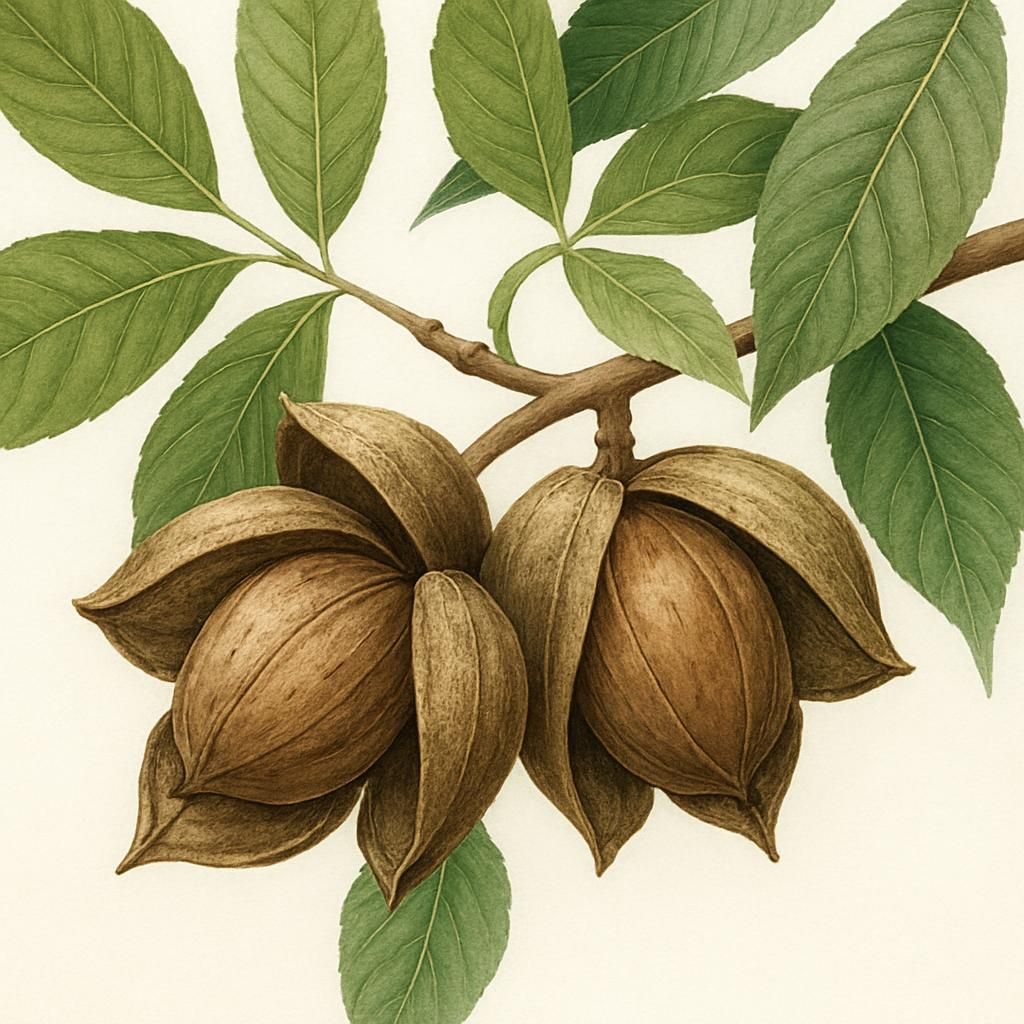
Introduction to Hickory (Shellbark)
Shellbark hickory (Carya laciniosa) is one of the most valuable native nut trees in eastern North America. Known for producing the largest hickory nuts with exceptionally thick shells and sweet, high-quality kernels, it has been a staple food source for centuries. The tree also yields dense, shock-resistant wood used historically for tool handles, wagon parts, and smoking meats. Modern growers value shellbark hickory for sustainable agroforestry systems, wildlife plantings, and specialty nut production.
Botanical Profile of Hickory (Shellbark)
Shellbark hickory belongs to the Juglandaceae family. Mature trees reach 60–90 feet in height with a straight trunk and broad, rounded crown. The bark is light gray and peels in long, loose plates giving the species its common name. Leaves are pinnately compound with 5–9 leaflets, turning brilliant golden-yellow in autumn. The tree is monoecious, producing male catkins and female flowers on the same individual. Nuts develop inside a thick, four-winged husk that splits at maturity. Shellbark hickory is slower growing than pecan but can live 200–300 years.
Soil, pH, and Climate Requirements for Hickory (Shellbark)
Shellbark hickory thrives in deep, fertile, well-drained soils with good moisture retention. It performs best on bottomland sites but tolerates upland conditions when organic matter is high.
| Parameter | Ideal Range | Notes |
|---|---|---|
| Soil Type | Loam to clay loam | Avoid compacted or shallow soils |
| Soil pH | 6.0–7.2 | Slightly acidic to neutral |
| Drainage | Good to moderate | Standing water reduces root health |
| USDA Hardiness Zones | 5–8 | Cold hardy to -20 °F |
| Annual Rainfall | 35–50 inches | Supplemental irrigation in drought years |
| Temperature Range | -20 °F to 95 °F | Requires 140–160 frost-free days |
Step-by-Step Planting & Propagation
- Site Selection: Choose full-sun locations with deep soil and protection from strong winds. Space trees 40–50 feet apart.
- Soil Testing: Conduct a comprehensive soil test and amend with lime or sulfur to reach pH 6.0–7.2. Incorporate 2–3 inches of well-rotted compost.
- Propagation Methods: Most commercial plantings use grafted seedlings on Pecan or shellbark rootstock for earlier bearing. Stratify nuts for 90–120 days at 35–40 °F before planting.
- Planting Time: Plant bare-root or container trees in early spring while dormant. Dig holes twice the width of the root ball.
- Initial Care: Water thoroughly after planting and apply 3–4 inches of organic mulch, keeping it away from the trunk.
Care & Maintenance regimes for Hickory (Shellbark)
Consistent care during the first five years establishes a strong framework. Mature trees require less intervention but benefit from periodic monitoring.
| Task | Frequency | Details |
|---|---|---|
| Watering | Weekly first 2 years | 1 inch per week; reduce after establishment |
| Fertilizer | Early spring years 1–5 | 10-10-10 NPK at 0.5 lb per inch trunk diameter; mature trees 2–3 lbs |
| Pruning | Late winter dormant season | Remove dead/diseased wood; train central leader; thin crossing branches |
| Mulching | Annual spring renewal | Maintain 3–4 inch layer in 3-foot radius |
| Pest Scouting | Bi-weekly May–September | Monitor for hickory shuckworm and aphids |
Pests, Diseases & Organic Management
Shellbark hickory faces fewer serious pests than many fruit trees, but vigilance is required.
Common pests include hickory shuckworm, pecan weevil, and aphids. Apply kaolin clay or spinosad sprays at first sign of larval entry into husks. Pecan nut casebearer may also attack; use pheromone traps for timing. Diseases are rare but include anthracnose and leaf spot; improve airflow and remove fallen debris. Beneficial insects and birds provide natural control when habitat is preserved.
Harvesting, Curing & Optimal Storage
Nuts ripen in September–October when husks split and nuts drop. Collect daily to prevent mold and wildlife loss. Remove remaining husk fragments and spread nuts in a single layer in a dry, well-ventilated area for 2–3 weeks. Store cured nuts in mesh bags or sealed containers at 32–40 °F with 60–70 % humidity for up to two years. For longer storage, freeze at 0 °F.
Companion Planting for Hickory (Shellbark)
Plant nitrogen-fixing species such as clover or hairy vetch beneath young trees to improve soil fertility. Avoid shallow-rooted crops that compete for moisture. Understory plantings of blackberry or blueberry can increase biodiversity while providing additional income. Tall companions like corn are unsuitable due to shading and root competition.