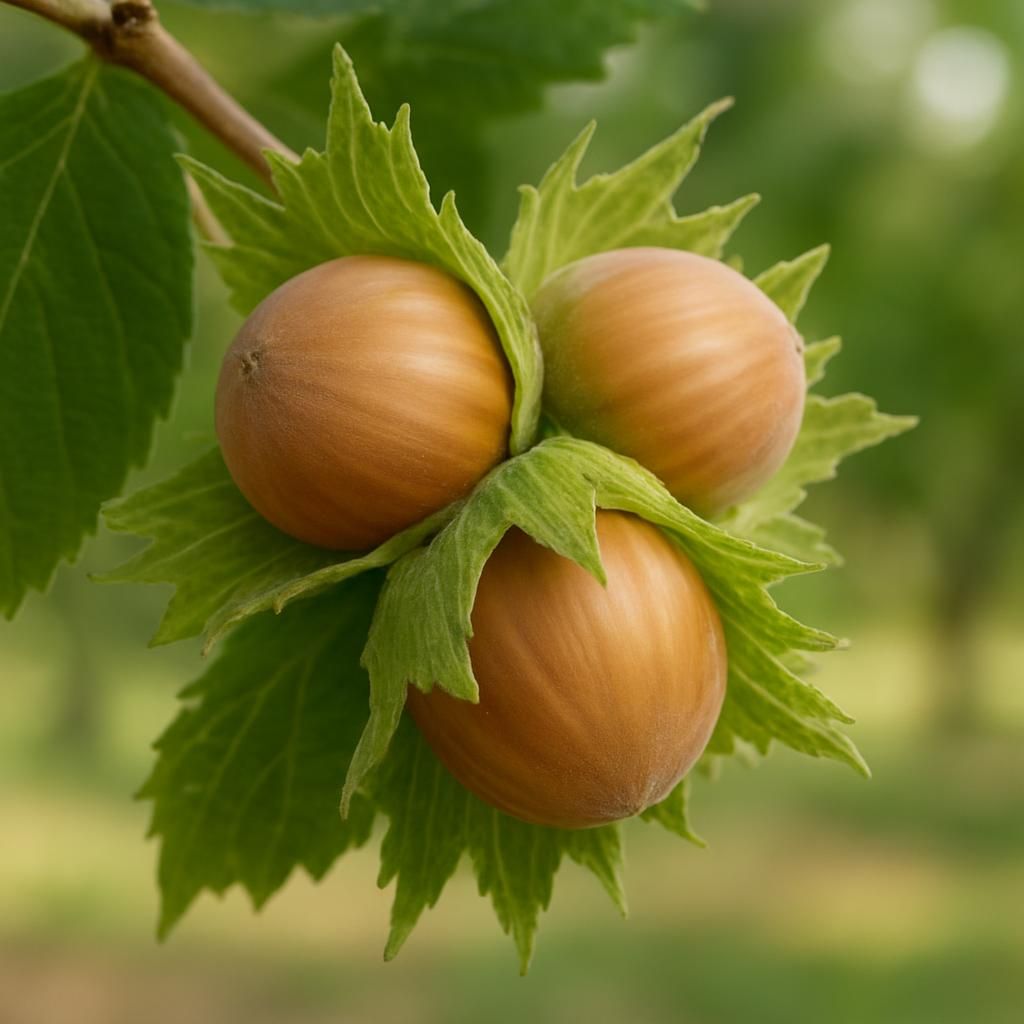
Introduction to Hazelnut (Casina)
Hazelnut (Casina) is a compact, high-productivity cultivar of the European hazelnut that delivers reliable yields and excellent kernel quality in temperate climates. Developed for commercial orchards, Casina offers early-season harvest, uniform nut size, and strong tolerance to common fungal pressures. Growers seeking a low-maintenance yet profitable option increasingly choose Casina over older varieties such as Barcelona Hazelnut.
Botanical Profile of Hazelnut (Casina)
Casina belongs to the birch family (Betulaceae). The plant forms a multi-stemmed shrub or small tree reaching 4–6 m in height with a rounded canopy. Leaves are broadly ovate, doubly serrate, and deep green. Male catkins appear in late winter, while inconspicuous female flowers emerge in early spring. Nuts develop inside a leafy involucre (husk) and mature by late summer to early autumn. The cultivar is partially self-fertile but benefits from cross-pollinators such as Butler Hazelnut.
Soil, pH, and Climate Requirements for Hazelnut (Casina)
Casina performs best on deep, well-drained loams with moderate fertility. Avoid heavy clays or poorly drained sites that promote root diseases.
| Parameter | Ideal Range | Notes |
|---|---|---|
| Soil Type | Loam to sandy loam | Good structure and aeration |
| Soil pH | 6.0–7.0 | Slightly acidic to neutral |
| Organic Matter | 3–5 % | Improves moisture retention and fertility |
| Annual Rainfall | 750–1,200 mm | Supplemental irrigation in dry periods |
| Temperature Range | −20 °C to 32 °C | Requires 800–1,200 chill hours |
| USDA Hardiness Zones | 5–8 | Best in regions with distinct winters |
Step-by-Step Planting & Propagation
- Site Preparation: Clear competing vegetation and rip soil to 60 cm depth. Incorporate 5–8 cm of well-rotted compost.
- Spacing: Plant trees 4–5 m apart in rows 5–6 m wide to allow mechanical access.
- Propagation: Use one-year-old bare-root or container-grown plants grafted onto disease-resistant rootstocks. Plant in late autumn or early spring while dormant.
- Planting Depth: Set the graft union 5 cm above soil level. Backfill and firm soil to eliminate air pockets.
- Initial Irrigation: Provide 20 L water per plant immediately after planting.
Care & Maintenance regimes for Hazelnut (Casina)
Consistent moisture, balanced nutrition, and annual pruning maintain tree health and maximize kernel fill.
| Season | Water Schedule | Fertilizer (N-P-K) | Pruning Action |
|---|---|---|---|
| Spring | 25–40 mm/week until flowering ends | 50 g N + 30 g P + 40 g K per tree | Remove dead wood; open canopy |
| Summer | 30–50 mm/week during nut fill | 30 g N + 20 g P + 30 g K per tree | Tip-prune vigorous shoots to encourage laterals |
| Autumn | Reduce to 15 mm/week after harvest | 20 g N only if leaf analysis indicates | Thin crowded interior branches |
| Winter | Dormant irrigation if soil is dry | None | Structural pruning; remove suckers |
Pests, Diseases & Organic Management
Key threats include Eastern Filbert Blight caused by Anisogramma anomala, filbertworm, and aphids. Monitor catkins in late winter for blight cankers and remove infected wood 30 cm below visible symptoms. Apply copper-based sprays at bud swell and repeat every 10–14 days during wet springs. Deploy pheromone traps for filbertworm from June onward. Encourage beneficial insects by planting flowering strips of Thyme and Yarrow. Maintain orchard sanitation by collecting fallen husks and leaves.
Harvesting, Curing & Optimal Storage
Casina nuts ripen in late August to mid-September when the involucre begins to dry and nuts fall freely. Shake trees or use mechanical sweepers to collect. Dry nuts to 8–10 % moisture within 48 hours using forced-air dryers at 32–35 °C. Store in-shell at 0–5 °C and 60–65 % relative humidity for up to 18 months. For longer-term storage, vacuum-seal kernels at −18 °C.
Companion Planting for Hazelnut (Casina)
Interplant nitrogen-fixing Clover between rows to supply 40–60 kg N/ha annually and suppress weeds. Tall Comfrey (new_internal_link) acts as a dynamic accumulator, drawing minerals from deep soil layers. Low-growing Nasturtium repels aphids while providing edible flowers. Avoid planting shallow-rooted vegetables directly under the drip line to prevent competition for moisture.