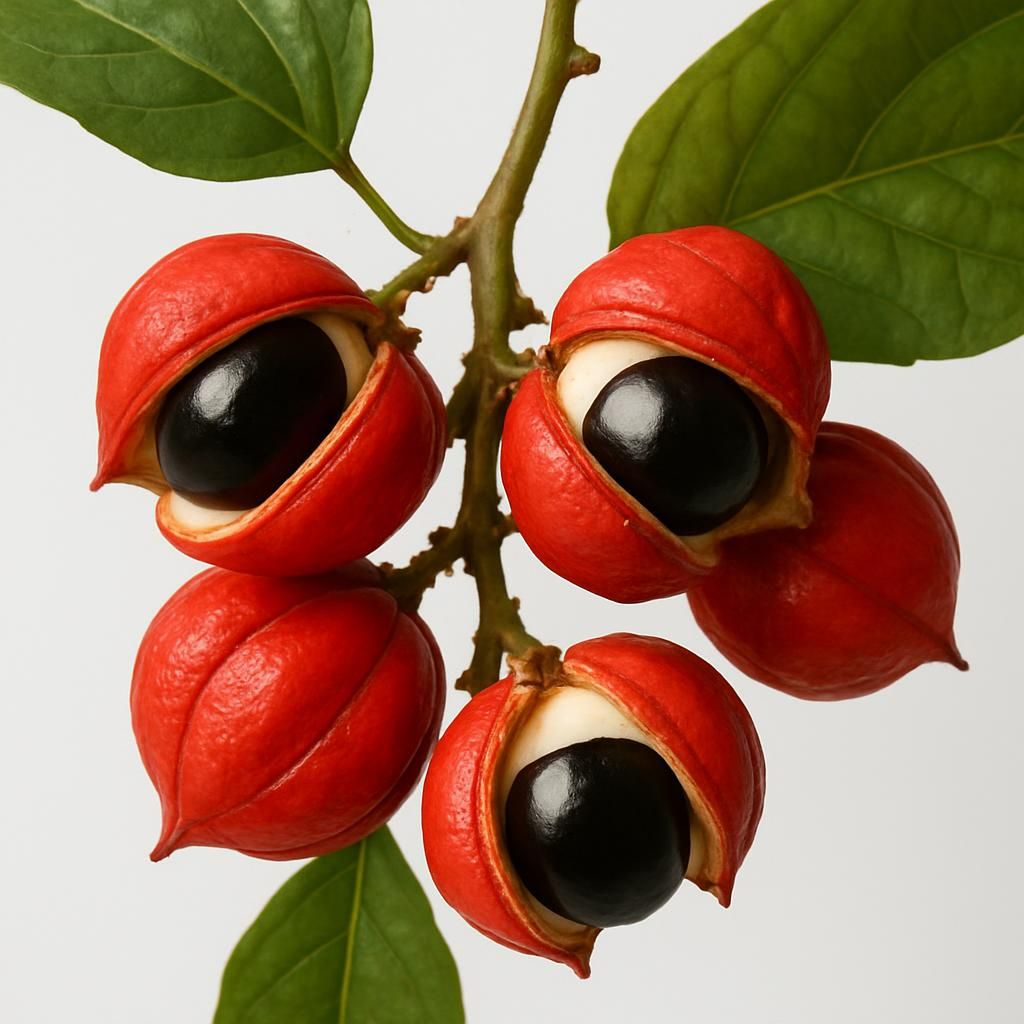
Introduction to Guarana (Paullinia cupana)
Guarana (Paullinia cupana) is a perennial woody liana native to the Amazon rainforest, where indigenous peoples have cultivated it for centuries. The plant produces small red fruits containing black seeds that are exceptionally rich in caffeine—up to four times the concentration found in coffee beans. Today, guarana seeds supply the global energy-drink and supplement industry while supporting smallholder farmers in Brazil, Venezuela, and Colombia. This guide delivers professional-grade agronomic advice for successful commercial or home-scale production.
Botanical Profile of Guarana (Paullinia cupana)
Guarana belongs to the Sapindaceae family. It is a vigorous evergreen climber that can reach 10–12 m in length when supported by trees or trellises. The compound leaves consist of five leaflets with serrated margins. Small white flowers appear in axillary panicles during the dry season, followed by dehiscent capsules that split to reveal one to three glossy black seeds encased in white arils. The seeds contain 2–8 % caffeine along with theobromine, theophylline, tannins, and saponins. Because it is a tropical understory vine, guarana thrives in filtered light and high humidity.
Soil, pH, and Climate Requirements for Guarana (Paullinia cupana)
Guarana performs best on well-drained, fertile soils with high organic matter. The following table summarizes ideal growing conditions:
| Parameter | Ideal Range | Notes |
|---|---|---|
| Soil Type | Loamy to sandy loam | Avoid heavy clay; raised beds improve drainage |
| Soil pH | 5.5–6.5 | Slightly acidic; lime only if below 5.0 |
| Temperature | 22–32 °C daytime | Frost sensitive; minimum 15 °C |
| Annual Rainfall | 1,500–2,500 mm | Even distribution preferred |
| Relative Humidity | 70–90 % | Shade cloth or intercropping helps |
| Light | 30–50 % shade | Full sun reduces leaf size and yield |
| Elevation | 0–600 m | Higher altitudes slow growth |
Step-by-Step Planting & Propagation
- Seed Collection & Preparation: Harvest fully ripe fruits, remove the white aril, and wash seeds. Soak in warm water for 24 hours to soften the hard seed coat.
- Germination: Sow seeds 2 cm deep in a sterile, well-draining mix (50 % peat, 30 % perlite, 20 % compost). Maintain 28 °C bottom heat and 80 % humidity; germination occurs in 20–45 days.
- Seedling Care: Transplant seedlings at the two-leaf stage into 15 cm pots. Provide 40 % shade and daily misting.
- Vegetative Propagation (optional): Take 15 cm semi-hardwood cuttings in early wet season; treat with 3,000 ppm IBA and root in perlite under intermittent mist.
- Field Planting: Space plants 2 m × 3 m on 1.5 m trellises or living supports such as Gliricidia. Plant at the start of the rainy season.
Care & Maintenance regimes for Guarana (Paullinia cupana)
The following table outlines seasonal water, fertilizer, and pruning schedules for mature vines:
| Season | Irrigation | Fertilizer (per vine/year) | Pruning |
|---|---|---|---|
| Wet (Nov–Apr) | 25–30 L/week if <20 mm rain | 150 g 10-10-10 + 50 g K2SO4 split in 3 apps | Remove dead wood; tip-prune laterals |
| Dry (May–Oct) | 40–50 L/week | 100 g 15-5-20 + micronutrient foliar | Thin canopy 20 % to improve airflow |
| Post-harvest | Reduce to 15 L/week | 50 g organic compost tea | Heavy structural prune every 3 yrs |
Mulch with 10 cm of leaf litter or wood chips to conserve moisture and suppress weeds. Monitor leaf color; yellowing indicates magnesium deficiency—apply 20 g Epsom salts per vine.
Pests, Diseases & Organic Management
Common pests include Aphids, Mealybugs, and Spider mites. Scout weekly; release lady beetles or apply neem oil (0.5 % solution) at first sign of infestation. Fungal issues such as Anthracnose and Phytophthora are managed by ensuring good drainage and removing infected material. Copper-based sprays are permitted in organic systems when disease pressure is high. Root-knot nematodes can be suppressed with marigold borders and solarization before planting.
Harvesting, Curing & Optimal Storage
Fruits ripen 6–7 months after flowering. Pick when capsules turn bright red and begin to split. Ferment seeds 48 hours in shaded bins, then wash and sun-dry to 12 % moisture. Store in airtight containers at 15 °C and <60 % RH. Properly cured seeds retain caffeine content for up to two years.
Companion Planting for Guarana (Paullinia cupana)
Guarana benefits from nitrogen-fixing support trees such as Gliricidia and Pigeon pea. Understory herbs like Thai Basil and Nasturtium deter aphids. Avoid planting near Banana because of shared nematode susceptibility. Interplant with Coffee at 3 m spacing for mutual shade and diversified income.