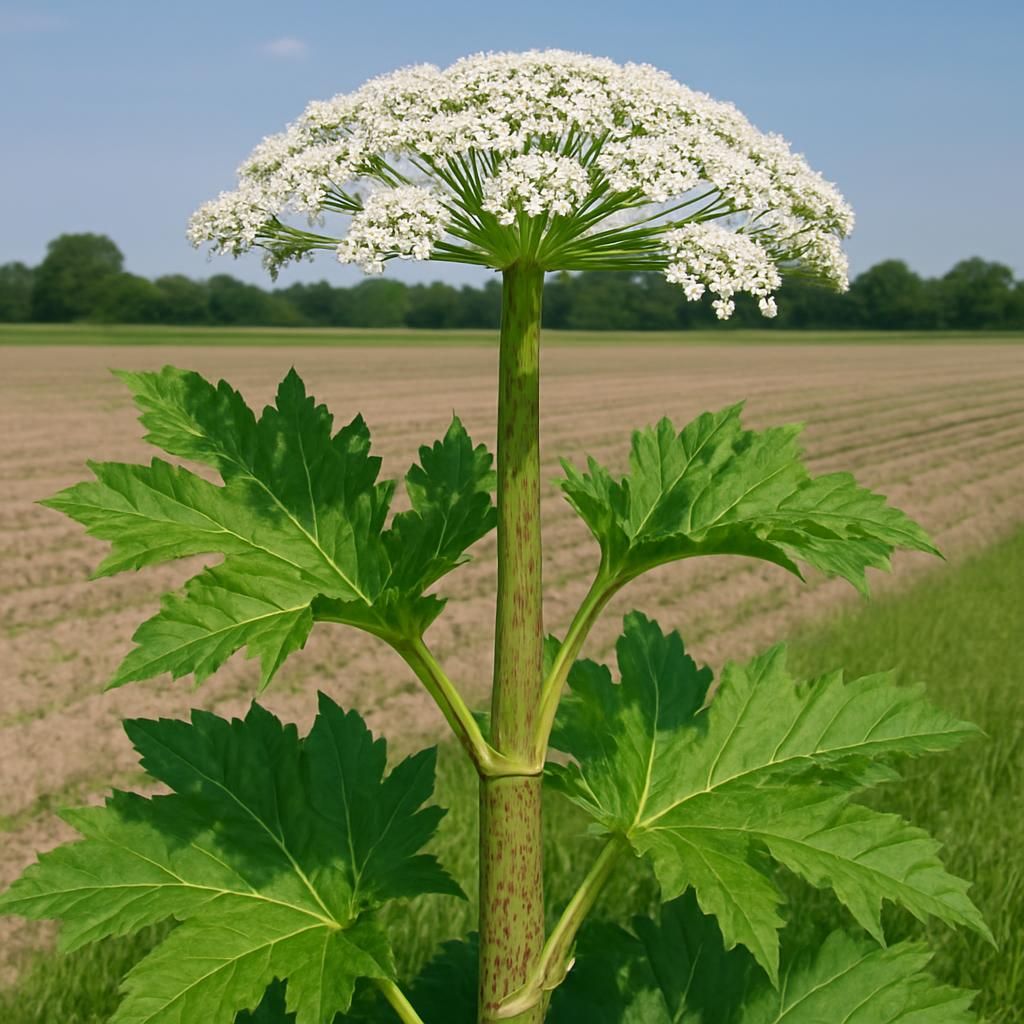
Introduction to giant hogweed
Giant hogweed (Heracleum mantegazzianum) is a towering member of the Apiaceae family originally native to the Caucasus region. It was introduced to North America and Europe as an ornamental plant but has since become one of the most problematic invasive species in temperate agricultural zones. The plant can reach heights of 2.5–5 meters, forming dense stands that outcompete native vegetation and crops. Its sap contains furanocoumarins that cause severe phytophotodermatitis in humans and livestock upon exposure to sunlight, making it both an agronomic and public-health concern. Effective management requires understanding its lifecycle, triggers, and integrated control methods.
Identifying Symptoms & Damage
Early detection is critical because giant hogweed rapidly colonizes disturbed soils along field margins, ditches, and riparian zones. The plant produces large, deeply lobed leaves up to 1.5 m wide with coarse, bristly hairs on the underside and petioles. Stems are hollow, ridged, and marked with distinctive purple blotches and stiff hairs. White, umbrella-shaped flower heads (umbels) reach 0.8–1.5 m across and appear from June to August. Damage to agricultural systems includes shading out desirable vegetation, reducing biodiversity, and creating hazardous conditions for workers. Contact with sap followed by UV exposure results in painful blisters, long-term scarring, and potential blindness if sap reaches the eyes. Livestock grazing near infestations may suffer similar dermal injuries.
Lifecycle and Progression of giant hogweed (MUST INCLUDE A MARKDOWN TABLE OF LIFECYCLE STAGES)
Giant hogweed is a monocarpic perennial that typically completes its life cycle over 2–5 years before flowering and dying. Seeds are the primary means of spread, with each plant capable of producing 20,000–120,000 viable seeds that remain dormant in the soil seedbank for up to 15 years.
| Lifecycle Stage | Timing | Key Characteristics | Management Window |
|---|---|---|---|
| Seed Germination | March–May | Rosette formation begins; seedlings have kidney-shaped cotyledons | Early spring mechanical removal or mulching |
| Vegetative Rosette | Year 1–4 | Large basal leaves accumulate energy; no flowering stalk | Repeated cutting or grazing before stem elongation |
| Stem Elongation | April–June (Year 2–5) | Rapid vertical growth up to 5 m; purple-spotted stems develop | Pre-flowering cutting or targeted herbicide application |
| Flowering & Seeding | June–August | Massive white umbels produce thousands of seeds | Immediate removal of flower heads before seed set |
| Senescence & Seed Dispersal | August–October | Plant dies after seeding; seeds spread by wind, water, and machinery | Post-harvest sanitation and equipment cleaning |
Environmental Triggers & Risk Factors
Giant hogweed thrives in moist, nutrient-rich soils with pH ranging from 5.5 to 7.5. Optimal temperatures for growth are 15–25 °C, although established plants tolerate light frost. High light availability along forest edges, roadsides, and field margins accelerates development. Disturbance from tillage, flooding, or construction creates ideal colonization sites. Seeds require cold stratification and moisture for germination, making riparian corridors and poorly drained fields particularly vulnerable. Climate change projections indicate expanded northern ranges as winters become milder.
Organic Control & Treatment Plans (MUST INCLUDE A MARKDOWN TABLE OF TREATMENT OPTIONS AND FREQUENCIES)
Integrated organic management focuses on preventing seed production and exhausting the seedbank over multiple seasons. Always wear full protective clothing, gloves, and eye protection when handling the plant.
| Treatment Option | Method Description | Frequency & Timing | Notes |
|---|---|---|---|
| Manual Removal | Dig out entire root crown 10–15 cm below soil surface | 2–3 times per season (spring & early summer) | Bag and dispose of plant material off-site; repeat for 5+ years |
| Repeated Cutting | Cut flowering stems at base before seed set; mow regrowth | Every 2–3 weeks from May–August | Prevents seed production; combine with mulching |
| Smothering with Tarps | Cover infested patches with heavy-duty black plastic or landscape fabric for 2 growing seasons | Apply in early spring; leave in place 18–24 months | Effective for small patches; monitor edges for escapes |
| Mulching & Solarization | Apply 15–20 cm organic mulch after cutting; use clear plastic for solarization in hot climates | Renew mulch annually; solarize for 4–6 weeks in peak summer | Improves soil health while suppressing seedlings |
| Grazing Management | Use goats or sheep in rotational grazing systems | 3–4 grazing periods per season starting at rosette stage | Animals must be protected from sap exposure; monitor for regrowth |
| Biological Agents | Limited options; research ongoing for host-specific insects | Monitor extension service updates | Not currently approved in most regions |
Preventing giant hogweed in the Future
Prevention centers on seed exclusion and early detection. Clean all machinery, vehicles, and footwear after working in infested areas. Establish competitive cover crops such as Clover or perennial grasses on disturbed soils. Maintain wide, mowed buffer strips along field edges and waterways. Educate farm staff on identification and safe handling protocols. Report new infestations to local agricultural authorities for coordinated regional control.
Crops Most Affected by giant hogweed
While giant hogweed does not directly parasitize crops, its presence severely impacts production of Potato, Corn, Wheat, Soybeans, and vegetable rotations by shading, allelopathy, and creating unsafe working conditions. Riparian vegetable farms growing Tomato and Cucumber are especially at risk due to proximity to water-dispersed seeds. Orchards and berry plantings suffer reduced light penetration and increased labor costs for monitoring and removal.