Definitive Diagnostic and Management Guide for Esca
Introduction to Esca
Esca represents one of the most destructive trunk diseases impacting Grapes (crop) worldwide, particularly in mature vineyards. This complex disease syndrome involves multiple fungal pathogens that colonize the woody tissues of grapevines (Vitis vinifera), leading to progressive decline, reduced yields, and eventual vine death. First documented in ancient Roman texts, esca continues to challenge viticulturists in major wine-producing regions like Europe, California, South America, and Australia.
The name 'esca' derives from the Latin word for 'food,' reflecting how the decayed wood serves as nourishment for the fungi. Unlike foliar diseases such as powdery mildew or downy mildew, esca targets the permanent vascular structure, making recovery difficult once established. Annual global losses exceed millions in vineyard replacements and forgone production, with incidence rates climbing to 10-20% in some old vineyards.
Understanding esca requires recognizing its polycyclic nature: over 20 fungal species contribute, but three dominate—Phaeomoniella chlamydospora (Pa), Phaeoacremonium minimum (Pm), and Fomitiporia mediterranea (Fm). Pa and Pm cause 'black measles' or Petri disease in young vines, while Fm drives white rot in mature ones. Symptoms manifest sporadically, often triggered by environmental stress, complicating timely diagnosis. This guide provides professional-grade diagnostic criteria, lifecycle insights, organic management protocols, and prevention strategies tailored for sustainable viticulture. For small farms optimizing vineyard health, check this Soil Health Mastery blog post on building resilient soils.
Identifying Symptoms & Damage
Esca symptoms appear in two primary forms: internal wood decay and external foliar expressions. Accurate diagnosis hinges on observing a combination of signs across vine age groups.
Foliar Symptoms (Apoplexy or Black Measles): Sudden wilting of leaves on one or more arms, turning chlorotic then necrotic with dark margins. Affected leaves exhibit 'tiger stripes'—linear, dark brown stripes along veins, progressing to full scorching. Berries on symptomatic shoots shrivel, blacken, and acquire a mealy texture, resembling bird shot damage. This acute phase, known as 'apoplexy,' can kill entire arms overnight, often post-veraison or during hot, dry spells.
Chronic Symptoms: Interveinal chlorosis and necrosis scattered across canopy, creating a mottled 'bird's eye' or 'marbled' appearance. Yield reduction averages 20-50% in expressing vines, with berries delayed in ripening and reduced sugar content.
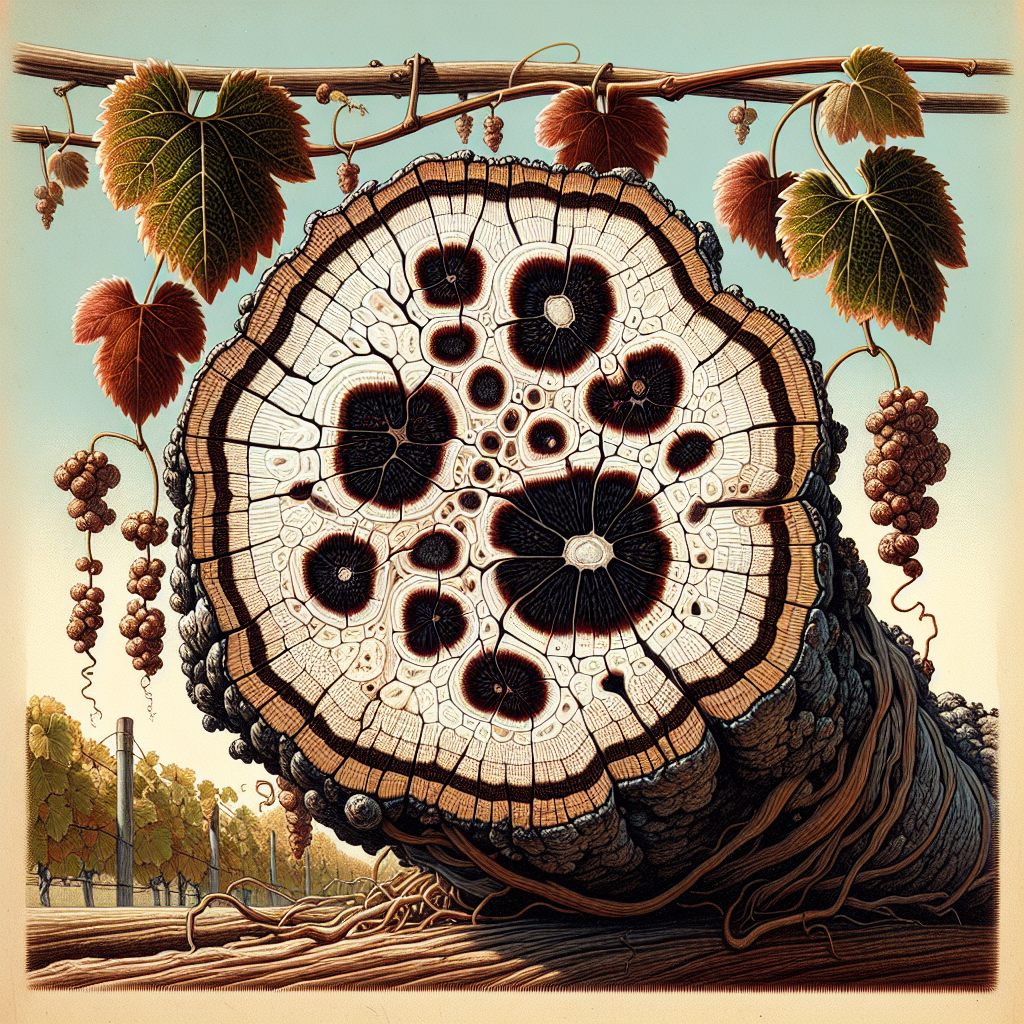
Wood Symptoms (Confirmed Diagnosis): Cross-section trunk or cordon reveals dark brown-black necrotic sectors (Pa/Pm necrosis) interspersed with white, spongy rot (Fm). Black dehiscent streaks ('esca streaks') ooze dark liquid under bark. In advanced cases, fruiting bodies (pycnidia or basidiocarps) emerge from pruning wounds.
Damage quantification: Infected vines show 30-70% wood necrosis by year 10 post-infection, with mortality rates of 1-5% annually in unmanaged blocks. Differentiate from Eutypa dieback by absence of wedge-shaped cankers and cream-colored sporulation; esca lacks the duckbill-shaped sectoring of eutypa. Lab confirmation via isolation on PDA media reveals characteristic conidia. Economic impact includes vine replacement costs ($50-100/vine) and 2-3 years lost production.
Lifecycle and Progression of Esca
Esca fungi are opportunistic endophytes entering via pruning wounds, mechanical injuries, or graft unions. Infection occurs year-round but peaks during wet, cool periods (10-25°C) when wounds remain susceptible for 2-4 weeks post-pruning.
Pathogen Establishment: Pa and Pm spores germinate in xylem vessels, producing toxins (e.g., phenylacetic acid) that induce tylosis and gel plug formation, blocking water transport. Fm mycelium spreads systemically from bark into heartwood over 5-10 years.
Progression Phases:
- Latent (Years 1-5): Asymptomatic colonization; 20-40% wood affected.
- Chronic Expression (Years 5-15): Foliar symptoms in 10-30% of seasons; vine vigor declines.
- Acute Apoplexy (Years 10+): Sudden arm death; white rot expands rapidly.
- Terminal Decline: Full vine girdling; basidiocarps form under loose bark.
Fungi persist saprophytically in dead wood, sporulating from pycnidia (Pa/Pm) or basidiocarps (Fm) to infect neighboring vines via rain splash or tools. Disease incidence rises exponentially after age 15, with 50% vineyard infection by year 25 in susceptible sites. Unlike annual pathogens like Botrytis, esca is polycyclic but slow-moving, allowing intervention windows.
Environmental Triggers & Risk Factors
Esca thrives in Mediterranean climates with wet winters and dry summers, but triggers vary:
- Wound Susceptibility: Dormant pruning (winter) in rain (>10mm post-cut) increases infection 5-fold.
- Soil and Water Stress: Clay soils with poor drainage promote Fm; drought stresses activate symptoms.
- Cultivar Susceptibility: V. vinifera hybrids more tolerant than vinifera; rootstocks like 101-14 MgT reduce incidence.
- Management Practices: High shoot density (>8 shoots/m cordon), late pruning, and contaminated tools amplify spread.
- Climate Change Impact: Warmer springs extend wound windows; erratic rains boost sporulation.
Risk mapping: Vineyards >15 years old on own-rooted vines in high-rainfall (>600mm) areas face 3x higher incidence. Armillaria root rot co-infection accelerates decline.
Organic Control & Treatment Plans
No curative organic treatments exist; focus on delaying progression and reducing inoculum.
Immediate Infected Vine Management: Sever and burn symptomatic arms at 20-30cm below necrosis (double pruning). Apply organic wound protectants like lime sulfur (10-20% v/v) or biofungicides (Trichoderma harzianum, Bacillus subtilis) within 48 hours. Avoid systemic chemicals.
Integrated Organic Protocol:
- Pruning Hygiene: Disinfect shears with 70% ethanol between vines; prune in dry weather.
- Trunk Injections: Annual injections of potassium phosphite (3-5%) or citric acid (10%) slow Pa/Pm (efficacy 40-60%; EU-approved organic).
- Biological Agents: Spray arbuscular mycorrhizae or Trichoderma-enriched compost teas on wounds.
- Vineyard Floor Management: Cover crops (e.g., clover) reduce soil splash; mulch trunks to 30cm.
- Nutritional Support: Foliar calcium and potassium boost vine resilience.
Monitoring: Annual trunk tomography or resistography detects early necrosis. Remove >50% necrotic vines to curb spread. Success rates: 70% symptom remission in young vines with aggressive management.
Preventing Esca in the Future
Prevention outperforms control by 90% in longevity.
- Site Selection: Avoid heavy clay, waterlogged sites; test for Fm prior planting.
- Resistant Varieties: Plant interspecific hybrids (e.g., Regent, Phoenix) or grafted vinifera on tolerant rootstocks (110R, 140Ru).
- Pruning Protocols: Early dormant pruning (leaf fall); use pre-pruning sprays of lime sulfur.
- Tool Sterilization: Dedicated shears per row or bleach dips (10%).
- Vineyard Design: Wide row spacing (2.5m+); balanced shoot density.
- Long-term: Replant infected blocks with certified disease-free material after 2-year solarization.
Integrated prevention sustains yields 20+ years.
Crops Most Affected by Esca
Esca primarily targets Grapes (crop), with V. vinifera most vulnerable. Minor reports in Olive (crop) and Fig (crop) share Pa/Pm pathogens. No significant impact on annuals like Tomato (crop) or tree fruits like Apple (crop). Focus viticulture vigilance.