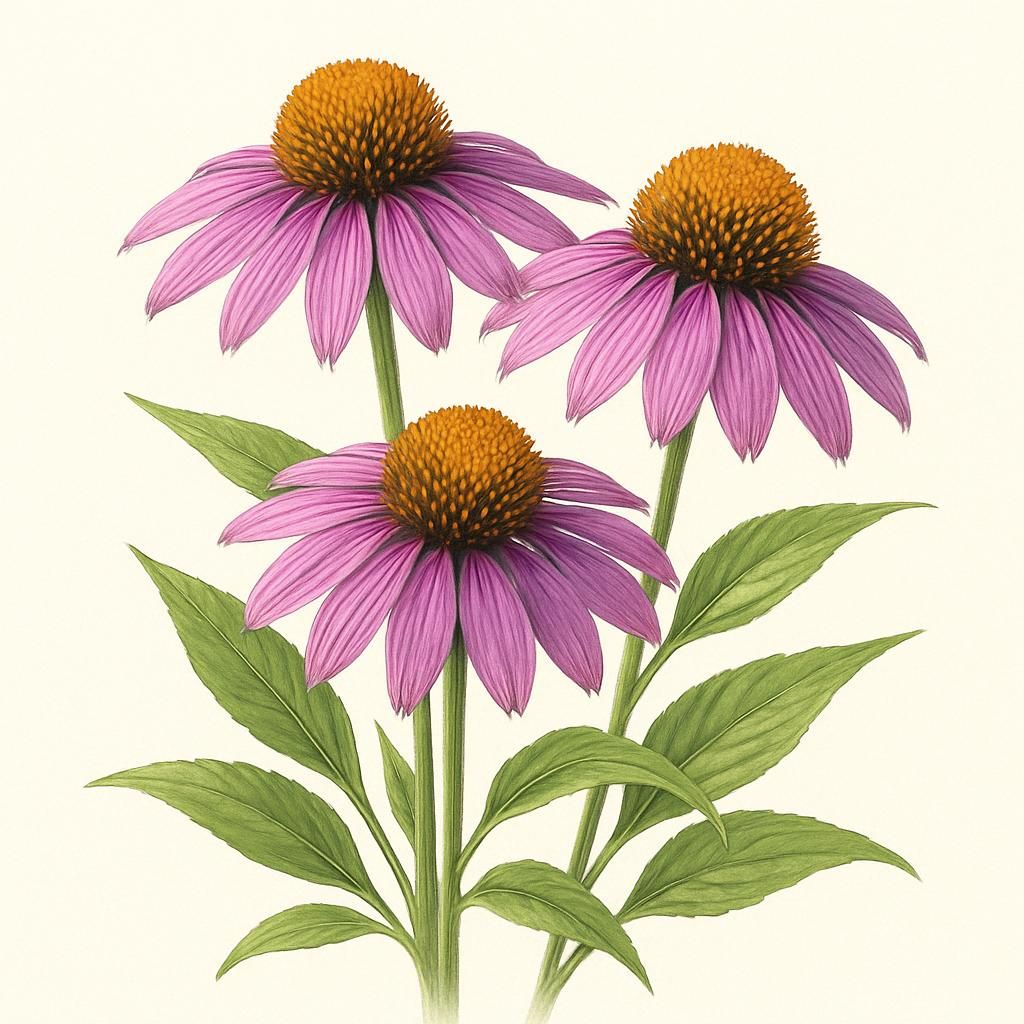
Introduction to Echinacea purpurea
Echinacea purpurea, commonly known as purple coneflower, is a native North American perennial prized for its vibrant daisy-like blooms and immune-supporting properties. Commercial growers value it for dried root and aerial-part sales to the herbal supplement industry, while landscapers appreciate its drought tolerance and pollinator appeal. With a productive lifespan of 5–10 years under good management, this crop offers reliable returns for both small-scale herb farms and larger medicinal plant operations.
Botanical Profile of Echinacea purpurea
Echinacea purpurea belongs to the Asteraceae family and features coarse, lance-shaped leaves and sturdy 2–4 ft (60–120 cm) stems topped by solitary flower heads. Each inflorescence consists of 15–20 drooping ray florets surrounding a prominent central cone of disk florets that mature from pink-purple to bronze. The plant develops a deep taproot reaching 12–18 in (30–45 cm) that stores the highest concentration of alkamides, caffeic acid derivatives, and polysaccharides responsible for its medicinal activity.
Soil, pH, and Climate Requirements for Echinacea purpurea
Successful cultivation begins with matching site conditions to the plant’s native prairie origins.
| Parameter | Ideal Range | Notes |
|---|---|---|
| Soil Type | Sandy loam to loam | Excellent drainage critical; avoid heavy clay |
| Soil pH | 6.0–7.0 | Slightly acidic to neutral; tolerate 5.5–7.5 |
| Organic Matter | 2–4 % | Compost or aged manure improves structure |
| Temperature Range | 60–85 °F (15–29 °C) daytime | Hardy to –20 °F (–29 °C) once established |
| Annual Rainfall | 20–35 in (500–900 mm) | Supplemental irrigation in dry spells |
| USDA Hardiness Zones | 3–9 | Full sun exposure (≥6 h direct) required |
Step-by-Step Planting & Propagation
- Site Preparation: Clear weeds and incorporate 2–3 in (5–7 cm) of compost. Perform a soil test and adjust pH with lime if below 5.8.
- Seed Stratification: Cold-moist stratify seed at 35–40 °F (2–4 °C) for 8–12 weeks to break dormancy.
- Direct Seeding: Sow in early spring or fall at ¼ in (6 mm) depth, 12–18 in (30–45 cm) between plants, and 24–36 in (60–90 cm) between rows.
- Transplanting: Start seedlings indoors 8–10 weeks before last frost; harden off and transplant at the 4–6 true-leaf stage.
- Division: Established clumps can be divided every 3–4 years in early spring or fall to maintain vigor.
Care & Maintenance regimes for Echinacea purpurea
Consistent cultural practices maximize root biomass and flower production.
| Task | Schedule | Details |
|---|---|---|
| Watering | Weeks 1–4 after planting: 1 in/week | Deep, infrequent watering thereafter |
| Established plants: 0.5–0.75 in/week | Avoid overhead irrigation to reduce disease | |
| Fertilizer | Early spring (pre-bloom) | ½–1 lb N/1000 ft² using balanced organic 5-5-5 |
| Mid-summer (optional light side-dress) | Only if leaf color indicates deficiency | |
| Pruning / Deadheading | Remove spent blooms weekly June–September | Encourages rebloom and reduces self-seeding |
| Cut back to 2–3 in above crown in late fall | Improves overwintering and spring emergence |
Pests, Diseases & Organic Management
Echinacea purpurea is generally pest-resistant, but monitor for Aphids, Japanese beetles, and leafhoppers. Root and crown rots caused by Pythium or Phytophthora occur in poorly drained soils. Cultural prevention—raised beds, crop rotation, and drip irrigation—remains the most effective strategy. Neem oil or insecticidal soap controls aphids; beneficial nematodes suppress soil-dwelling larvae. Remove and destroy infected plants to limit spread of fungal pathogens.
Harvesting, Curing & Optimal Storage
Harvest roots in the third or fourth year after fall dormancy begins. Lift entire plants, shake off soil, and wash gently. Slice roots into ¼–½ in (6–12 mm) pieces and dry at 95–105 °F (35–40 °C) with good airflow until brittle. Store in airtight containers away from light and moisture for up to two years. Aerial parts may be harvested at peak bloom and dried similarly for tea blends.
Companion Planting for Echinacea purpurea
Pair Echinacea purpurea with Yarrow, Thyme, and Marigold to enhance beneficial insect habitat and deter pests. Avoid planting near heavy feeders such as Corn that compete for nutrients. Interplanting with Clover as a living mulch improves soil nitrogen and suppresses weeds between rows.