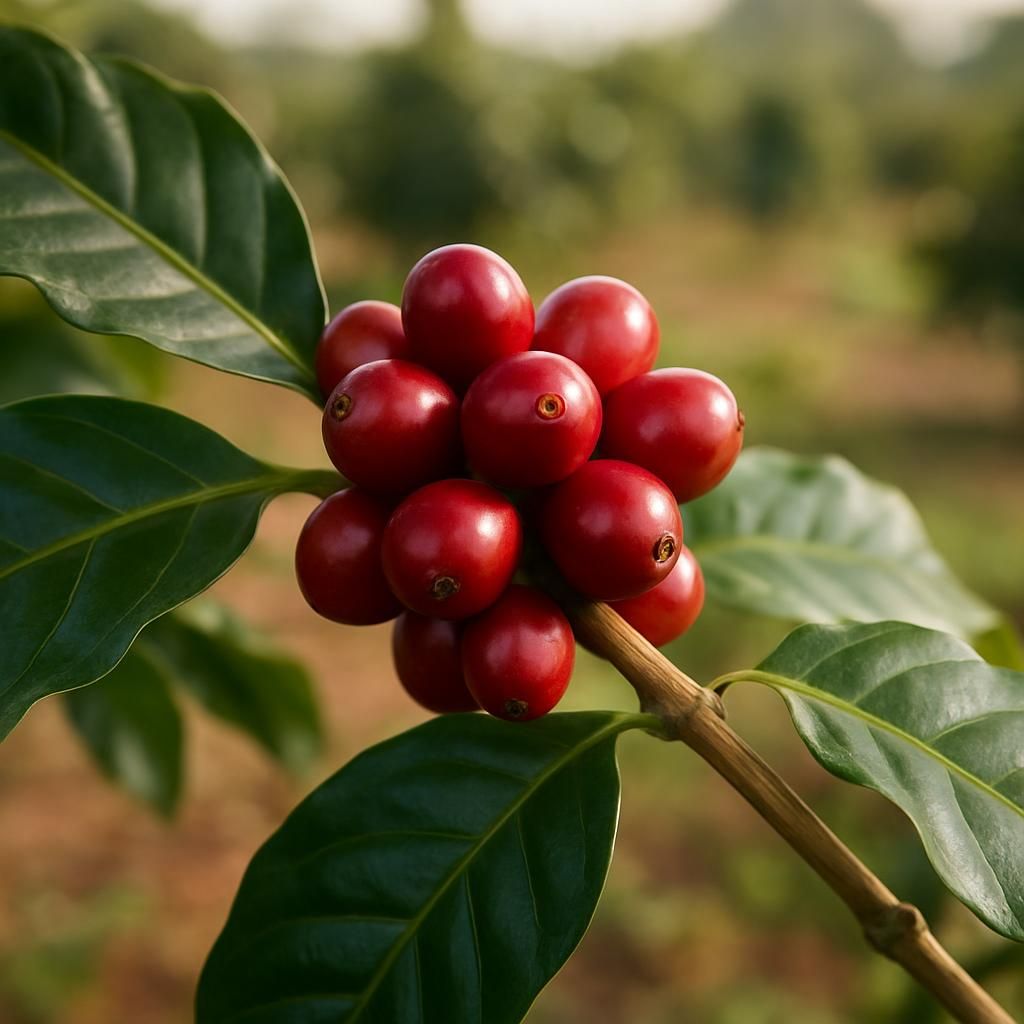
Introduction to Coffee (Arabica - SL28)
Coffee (Arabica - SL28) is a compact, high-yielding cultivar of Coffea arabica bred at the Coffee Research Station in Kenya during the 1930s. It is renowned for its bright acidity, blackcurrant and citrus notes, and superior drought tolerance compared with older varieties such as Arabica Coffee (Typica). SL28 quickly became the backbone of Kenya’s smallholder coffee sector and is now planted across East Africa, parts of Latin America, and select Asian highlands. Professional growers value its early bearing, uniform ripening, and consistent cup scores above 84 when grown and processed correctly.
Botanical Profile of Coffee (Arabica - SL28)
SL28 is a compact, upright shrub reaching 1.8–2.4 m at maturity with a single main stem and multiple plagiotropic branches. Leaves are dark green, elliptic, and glossy with prominent veins. Flowers are white, fragrant, and borne in clusters of 4–8 at each node; each flower produces a single two-seeded drupe (cherry). The cultivar is self-fertile but benefits from cross-pollination by bees. Cherries ripen from green to bright red in 7–9 months after flowering, with SL28 typically showing two main flowering flushes aligned with bimodal rainfall patterns.
Soil, pH, and Climate Requirements for Coffee (Arabica - SL28)
SL28 performs best on deep, well-structured volcanic or lateritic loams with good internal drainage and high organic matter. The following table summarises optimal conditions:
| Parameter | Ideal Range | Notes |
|---|---|---|
| Soil pH | 5.8–6.5 | Avoid below 5.0; apply lime if needed |
| Elevation | 1,200–2,000 m | Higher elevations increase acidity |
| Temperature | 15–24 °C daytime; >10 °C at night | Frost below 5 °C causes leaf scorch |
| Annual Rainfall | 1,200–1,800 mm | Even distribution; supplemental irrigation during dry spells |
| Relative Humidity | 60–80 % | High humidity increases disease pressure |
| Soil Texture | Loam to sandy loam | >1 m rooting depth required |
| Organic Matter | 3–5 % | Maintain with compost and cover crops |
Step-by-Step Planting & Propagation
- Select certified, disease-free SL28 seedlings or rooted cuttings from reputable nurseries.
- Prepare planting holes 60 cm × 60 cm × 60 cm; mix excavated soil with 10 kg well-rotted compost and 200 g rock phosphate.
- Plant at the onset of rains, spacing 2.0 m × 2.5 m (2,000 plants/ha) for single-stem or 2.5 m × 3.0 m for multi-stem systems.
- Firm soil around the root ball and water thoroughly; apply 5 cm organic mulch leaving a 10 cm gap from the stem.
- Stake young plants in windy sites and provide 30–40 % shade for the first 12 months.
Care & Maintenance regimes for Coffee (Arabica - SL28)
SL28 requires precise water, nutrition, and pruning schedules to sustain high yields and bean quality. The table below outlines seasonal regimes for a typical bimodal rainfall zone:
| Season | Irrigation | Fertilizer (per plant) | Pruning Action |
|---|---|---|---|
| Pre-flowering (dry spell) | 20–30 L/week if rainfall <15 mm | 150 g NPK 17-17-17 + 50 g CAN | Remove water shoots and basal suckers |
| Flowering & fruit set | Maintain field capacity | 100 g NPK 22-6-12 split into two applications | Light tipping at 1.8 m height |
| Cherry development | 25–40 L/week | 200 g CAN + 100 g MOP in two splits | Remove diseased or crossing branches |
| Post-harvest | Reduce to 15 L/week | 300 g compost + 50 g rock phosphate | Stumping or rejuvenation pruning every 5–6 years |
Pests, Diseases & Organic Management
Major threats include Coffee Berry Borer (not listed; new link required), Aphids, Scale insects, Coffee Leaf Rust, and Coffee Berry Disease. Implement an integrated approach: monitor weekly with pheromone traps, release predatory beetles, apply neem oil or Beauveria bassiana at economic thresholds, and maintain shade-tree diversity to reduce humidity-driven outbreaks. Copper-based sprays are permitted organically only during the rainy season and must be rotated to prevent resistance.
Harvesting, Curing & Optimal Storage
Harvest only fully ripe red cherries by selective hand-picking every 7–10 days. Process within 6–8 hours using the washed method: pulp, ferment 18–36 hours at 20–24 °C, wash until parchment is clean, and dry on raised African beds to 10–12 % moisture over 8–12 days. Store parchment coffee in clean jute bags inside ventilated warehouses at 18–22 °C and <65 % RH. Cup quality remains stable for 6–9 months when moisture is controlled.
Companion Planting for Coffee (Arabica - SL28)
Interplant nitrogen-fixing Gliricidia and Pigeon pea at 8–10 m spacing to supply 80–120 kg N/ha/year and provide light shade. Marigold borders deter nematodes, while Thyme and Nasturtium attract beneficial insects. Avoid heavy feeders such as Banana within 3 m of coffee rows to minimise competition for potassium.