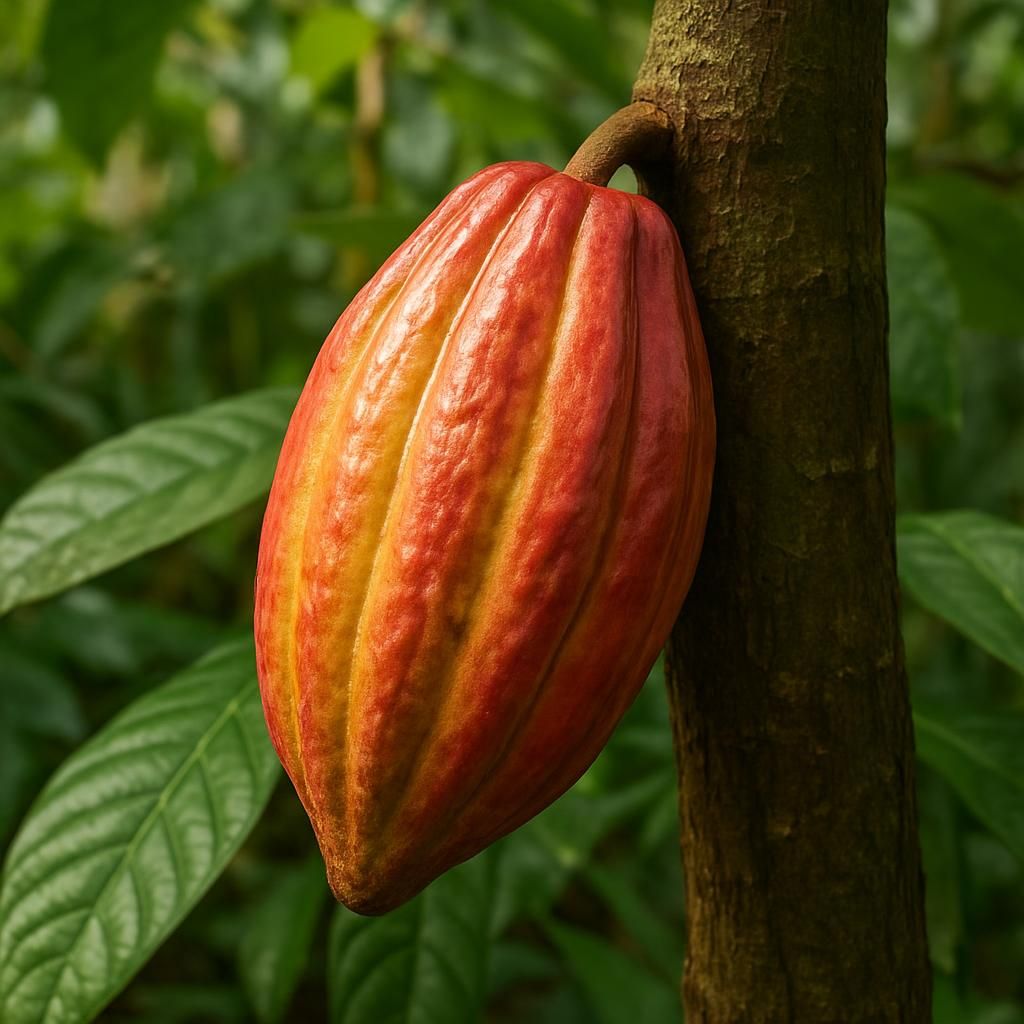
Introduction to Cocoa (Trinitario)
Trinitario cocoa (Theobroma cacao 'Trinitario') represents one of the most commercially valuable hybrid varieties in the global chocolate industry. Developed in Trinidad in the 18th century following a devastating Forastero epidemic, Trinitario combines the fine flavor and aromatic qualities of Criollo with the disease resistance and higher productivity of Forastero. Today it accounts for approximately 10-15% of world cocoa production and commands premium prices in specialty markets.
Successful commercial cultivation requires precise management of shade, humidity, soil fertility, and pest pressure. Trinitario trees typically reach 4-8 meters in height under cultivation and begin bearing pods within 3-5 years. The variety produces pods with variable coloration ranging from yellow to red-purple, containing 30-40 seeds per pod with rich, complex flavor profiles ideal for fine-flavor chocolate.
Botanical Profile of Cocoa (Trinitario)
Trinitario cocoa exhibits intermediate morphological characteristics between its parent varieties. The trees develop a dimorphic growth habit with orthotropic (vertical) and plagiotropic (horizontal) branches. Leaves are alternate, simple, and oblong-elliptic, measuring 15-30 cm in length with a glossy dark green upper surface.
Flowers are small, pinkish-white, and cauliflorous, emerging directly from the trunk and older branches. Each flower measures approximately 1-1.5 cm across. The resulting pods are 15-20 cm long, ovoid to ellipsoid, with a thick, woody husk that varies in color from yellow to red at maturity. Seeds are flattened, 2-3 cm long, and surrounded by a sweet, white mucilaginous pulp.
Soil, pH, and Climate Requirements for Cocoa (Trinitario)
Trinitario cocoa thrives in tropical lowland environments with consistent moisture and protection from direct sunlight. The crop demands well-drained, fertile soils rich in organic matter.
| Parameter | Ideal Range | Notes |
|---|---|---|
| Soil Type | Loamy, sandy loam, clay loam | Deep, well-drained with good structure |
| Soil pH | 5.5 - 7.0 | Slightly acidic to neutral |
| Temperature | 21-32°C (day); 18-24°C (night) | Frost-free; avoid temperatures below 15°C |
| Annual Rainfall | 1500-2500 mm | Evenly distributed; supplemental irrigation needed in dry periods |
| Relative Humidity | 70-90% | High humidity essential for pod development |
| Altitude | 0-600 m | Lower elevations preferred for Trinitario |
| Light | 30-50% shade | Requires shade trees or artificial shade |
Step-by-Step Planting & Propagation
Propagation of Trinitario cocoa is achieved primarily through seeds or vegetative cuttings. Seed propagation remains the most common method for establishing new plantations.
- Seed Selection and Preparation: Select fully ripe pods from high-yielding, disease-free mother trees. Extract seeds immediately and remove the surrounding pulp by fermentation or washing.
- Germination: Sow seeds in nursery beds or polybags containing a sterilized mixture of topsoil, sand, and compost (2:1:1). Maintain 70-80% shade and consistent moisture. Germination occurs in 7-14 days.
- Seedling Care: Transplant seedlings at the 4-6 leaf stage into larger containers. Provide gradual hardening off over 4-6 weeks before field planting.
- Vegetative Propagation: For clonal multiplication, use semi-hardwood cuttings treated with rooting hormone under mist propagation systems. Success rates typically range from 60-80%.
- Field Planting: Plant seedlings at 3m x 3m spacing (approximately 1100 trees/ha) under established shade. Dig planting holes 60 cm deep and wide, incorporating 10-15 kg of well-rotted manure or compost per hole.
Care & Maintenance regimes for Cocoa (Trinitario)
Ongoing orchard management focuses on maintaining optimal shade levels, nutrient balance, and canopy structure.
| Practice | Schedule | Details |
|---|---|---|
| Watering | Weekly during dry season | 20-30 liters per tree; maintain soil moisture at 60-70% field capacity |
| Fertilizer | 4 applications/year | Year 1: 100g NPK 15-15-15/tree; increase to 500g by Year 5; supplement with 5-10 kg compost/tree annually |
| Pruning | 2-3 times/year | Remove basal suckers, water shoots, and diseased branches; maintain 3-4 main stems; light structural pruning after harvest |
| Mulching | Twice yearly | Apply 10-15 cm organic mulch (cocoa husk, leaves) in 1m radius around trunk |
| Weed Control | Monthly | Manual weeding or cover crops; avoid deep cultivation near roots |
Pests, Diseases & Organic Management
Trinitario cocoa faces significant pressure from several key pests and diseases. Integrated management combining cultural, biological, and organic methods is essential.
Major insect pests include Aphids, Mealybugs, and Cocoa pod borer (though not listed, added to new_internal_links). Fungal diseases such as Phytophthora palmivora, Black pod disease, and Witches' broom can cause severe losses.
Organic management strategies:
- Regular sanitation: Remove and destroy infected pods and branches.
- Biological control: Introduce predatory ants and parasitic wasps.
- Neem-based sprays: Apply neem oil emulsions every 14-21 days during high-risk periods.
- Shade management: Maintain 30-50% shade to reduce humidity-driven disease pressure.
- Resistant rootstocks: Graft Trinitario scions onto disease-tolerant rootstocks where available.
Harvesting, Curing & Optimal Storage
Trinitario pods reach physiological maturity 5-6 months after flowering. Harvest when pods turn yellow, orange, or red depending on clone, typically indicated by a hollow sound when tapped.
Harvesting: Use a sharp knife or pod-breaking tool to cut pods from the tree without damaging the flower cushion. Collect pods every 7-14 days during peak season.
Fermentation: Break pods and heap or box the beans with pulp for 5-7 days, turning every 48 hours. Proper fermentation develops flavor precursors and reduces bitterness.
Drying: Sun-dry fermented beans on raised platforms for 5-10 days until moisture content reaches 6-8%. Turn beans regularly for even drying.
Storage: Store dried beans in jute bags or ventilated containers at 18-22°C and 60-70% relative humidity. Protect from pests and moisture re-absorption. Properly cured Trinitario beans maintain quality for 12-18 months.
Companion Planting for Cocoa (Trinitario)
Strategic companion planting enhances biodiversity, improves soil fertility, and provides additional income streams.
Recommended companions include Banana for temporary shade and wind protection, Gliricidia as a nitrogen-fixing shade tree, and Coconut for permanent upper canopy. Black Pepper can be trained on shade tree trunks for additional revenue.
Avoid planting heavy feeders or competitive grasses within the root zone. Leguminous cover crops such as Pigeon pea improve soil nitrogen while suppressing weeds. Maintain a diverse understory to support beneficial insects and reduce pest outbreaks.