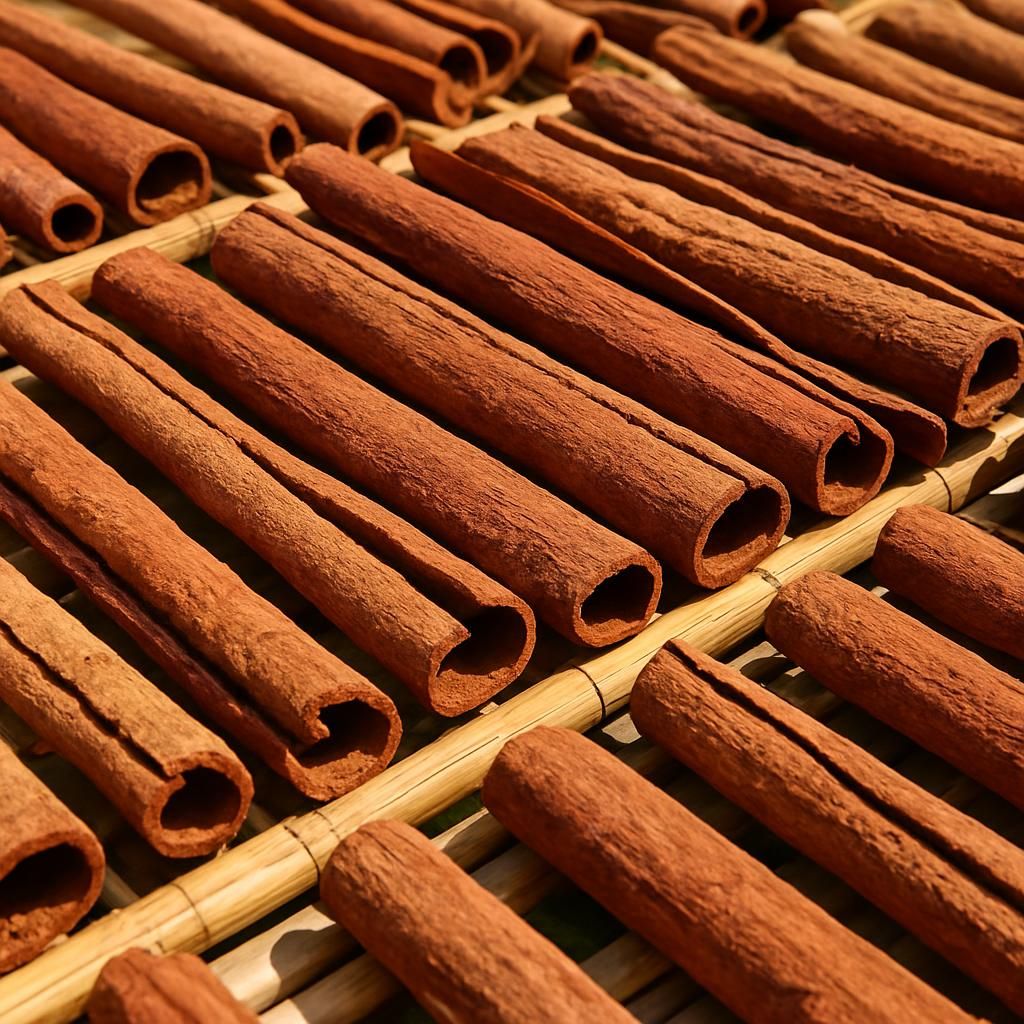
Introduction to Cinnamon (Cassia - Korintje)
Cinnamomum cassia, commonly known as Korintje cassia or Indonesian cinnamon, is one of the most widely traded spice crops in the world. Its thick, reddish-brown bark delivers a bold, sweet-spicy flavor preferred by many industrial food processors and home cooks alike. Unlike true Ceylon cinnamon (Ceylon Cinnamon), cassia bark is coarser and higher in essential oils, giving it greater pungency and longer shelf stability.
Korintje originates from the highlands of West Sumatra, Indonesia, where centuries of selective harvesting have produced trees that consistently yield thick, high-oil quills. The variety now accounts for the majority of global cassia exports. Because the tree tolerates poorer soils and variable rainfall better than many other tropical spices, it has become a reliable cash crop for smallholders across Southeast Asia.
Growing Korintje cassia requires patience—first commercial harvest occurs after seven to ten years—but the long-term returns are substantial. Mature plantations can produce for 40–60 years with proper management. This guide covers every stage from site selection to post-harvest curing so growers can maximize both yield and oil quality.
Botanical Profile of Cinnamon (Cassia - Korintje)
Cinnamomum cassia belongs to the Lauraceae family. It is an evergreen tree that reaches 10–15 m in height with a straight trunk and spreading crown. The bark is thick, grayish-brown on the outside and deep reddish-brown inside. Leaves are opposite, leathery, oblong-lanceolate, 8–16 cm long, and emit a strong cinnamon scent when crushed. Small, inconspicuous cream-colored flowers appear in axillary panicles during the dry season, followed by small dark-purple drupes containing one seed each.
The root system is shallow but extensive, making the tree moderately wind-resistant yet sensitive to waterlogging. The bark contains 1.5–4 % essential oil dominated by cinnamaldehyde (70–85 %), giving Korintje its characteristic warm aroma. Higher cinnamaldehyde content distinguishes premium Korintje grades from lower-oil cassia types.
Soil, pH, and Climate Requirements for Cinnamon (Cassia - Korintje)
Korintje cassia thrives in tropical lowland to mid-elevation climates. The following table summarizes optimal conditions:
| Parameter | Ideal Range | Notes |
|---|---|---|
| Soil Type | Sandy loam to clay loam | Well-drained; avoid heavy clay |
| Soil pH | 5.5–6.5 | Slightly acidic; liming rarely needed |
| Temperature | 20–30 °C | Minimum 15 °C; frost sensitive |
| Annual Rainfall | 1,500–2,500 mm | Even distribution preferred |
| Elevation | 0–1,200 m | Best quality at 400–800 m |
| Relative Humidity | 70–85 % | High humidity promotes growth |
| Sunlight | Full sun to partial shade | 6–8 hours direct sun for maximum bark oil |
Heavy, poorly drained soils increase the risk of Phytophthora root rot. On slopes, contour planting and cover crops help prevent erosion.
Step-by-Step Planting & Propagation
- Seed Collection & Preparation – Harvest ripe drupes from high-yielding mother trees in December–January. Remove pulp, wash seeds, and air-dry for 24 hours. Fresh seed germination exceeds 80 %.
- Nursery Sowing – Sow in raised beds or polybags filled with 1:1:1 sand-compost-topsoil mix. Sow 1 cm deep, keep moist, and provide 50 % shade. Seedlings emerge in 15–25 days.
- Seedling Care – Transplant to larger bags at the 4-leaf stage. Maintain consistent moisture and apply 5 g NPK 15-15-15 per bag monthly. Hardening begins at 8–10 months.
- Field Planting – Plant at the start of the rainy season. Recommended spacing is 2 m × 2 m (2,500 trees/ha) for high-density or 3 m × 3 m for mechanical access. Dig 60 cm³ pits, incorporate 5 kg compost and 100 g rock phosphate.
- Vegetative Propagation – Air-layering or semi-hardwood cuttings can produce true-to-type clones but success rates are 40–60 % and require mist propagation.
Care & Maintenance regimes for Cinnamon (Cassia - Korintje)
Young trees require regular attention to establish strong trunks. The following table outlines a practical annual schedule:
| Operation | Year 1–3 | Year 4–7 | Mature Trees (Year 8+) |
|---|---|---|---|
| Irrigation | 10–15 L/week during dry spells | 20 L every 10 days | Rainfed; supplemental only in drought |
| Fertilizer | 100 g NPK 15-15-15 + 2 kg compost/tree every 3 months | 300 g NPK 12-6-18 + 5 kg compost twice yearly | 500 g NPK 12-6-18 + 10 kg compost yearly; split applications |
| Pruning | Formative: remove lower branches to 1 m | Shape to single stem; tip at 2.5 m | Annual coppice after harvest; retain 3–4 shoots |
Mulch with 10–15 cm of leaf litter or Gliricidia prunings to conserve moisture and suppress weeds. Avoid deep cultivation near the trunk to protect shallow roots.
Pests, Diseases & Organic Management
Common issues include scale insects, mealybugs, and occasional leaf spot diseases. Monitor monthly. Organic controls include:
- Neem oil (0.5 %) or horticultural oil for scale and mealybugs.
- Copper hydroxide sprays (every 21 days) during wet seasons for leaf spots.
- Encourage predatory beetles and parasitic wasps by maintaining hedgerows.
- Remove and burn severely infected bark sections to limit spread of Phytophthora.
Harvesting, Curing & Optimal Storage
Trees are ready for first harvest when trunk diameter reaches 10–12 cm, typically at 7–10 years. Cut stems at 30 cm above ground during the rainy season when sap flow is high. Strip bark immediately, scrape off the outer cork layer, and roll into quills. Ferment quills 24 hours under shade, then sun-dry 4–6 days to 10–12 % moisture. Grade by thickness and oil content; store in airtight containers away from light. Properly cured Korintje retains 80 % of cinnamaldehyde for up to 24 months.
Companion Planting for Cinnamon (Cassia - Korintje)
Interplant young cinnamon rows with Black Pepper or Cardamom to maximize land use and provide partial shade. Leguminous cover crops such as Pigeon pea improve soil nitrogen and reduce erosion. Aromatic companions like Thai Basil deter aphids while Marigold roots suppress nematodes. Avoid planting near shallow-rooted vegetables that compete for surface moisture.