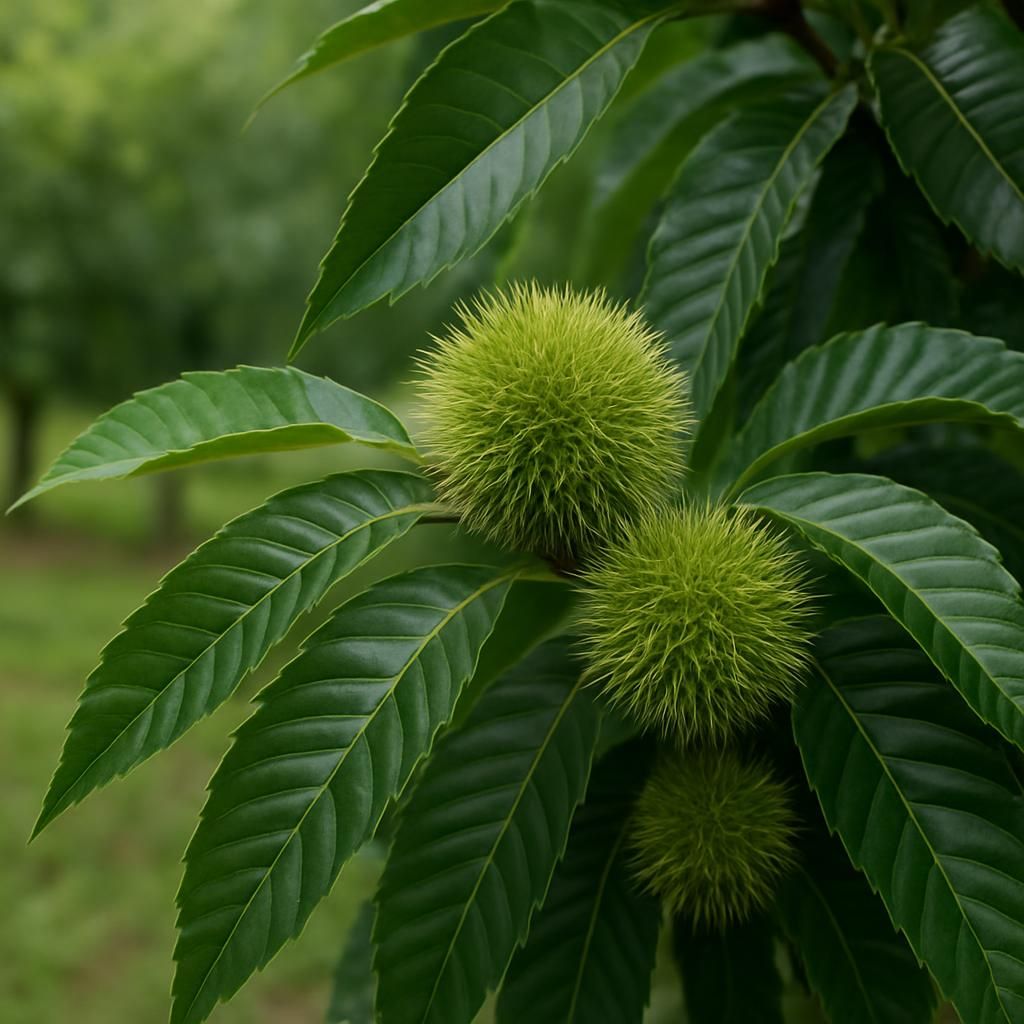
Introduction to Chestnut (Japanese - Tanzawa)
The Tanzawa cultivar of Japanese chestnut (Castanea crenata) is a compact, early-maturing selection that delivers large, sweet nuts on relatively small trees. Developed in Japan, it combines excellent eating quality with good resistance to Chestnut Blight and reliable productivity in temperate climates. Home gardeners and commercial growers value Tanzawa for its manageable size, early harvest window, and consistent kernel quality.
Botanical Profile of Chestnut (Japanese - Tanzawa)
Castanea crenata 'Tanzawa' belongs to the Fagaceae family. Trees are deciduous, reaching 8–12 meters at maturity with a broad, spreading canopy. Leaves are oblong-lanceolate, glossy green above and pubescent beneath, turning golden-yellow in autumn. Catkins appear in late spring; female flowers develop into spiny burrs containing one to three large nuts. The cultivar is noted for its large nut size (often 20–25 g) and high sugar content.
Soil, pH, and Climate Requirements for Chestnut (Japanese - Tanzawa)
Tanzawa chestnuts require well-drained, slightly acidic soils with good organic matter. They perform poorly in heavy clay or waterlogged sites. Choose locations with full sun and protection from strong winds. The following table summarizes optimal growing conditions:
| Parameter | Ideal Range | Notes |
|---|---|---|
| Soil Type | Sandy loam to loam | High organic matter improves fertility |
| Soil pH | 5.5–6.5 | Avoid alkaline soils |
| Temperature | -20 °C to 30 °C | Requires 800–1,000 chill hours |
| Annual Rainfall | 750–1,200 mm | Supplemental irrigation in dry spells |
| USDA Hardiness | Zones 5–8 | Tolerates moderate winter cold |
| Sun Exposure | Full sun (minimum 6 hours) | Essential for nut development |
Step-by-Step Planting & Propagation
- Select one-year-old grafted Tanzawa trees from reputable nurseries.
- Prepare planting holes 60 cm wide and deep; incorporate aged compost.
- Space trees 6–8 meters apart in rows 8–10 meters wide.
- Plant in late autumn or early spring when soil is workable.
- Water thoroughly after planting and apply 5–8 cm of organic mulch.
- Stake young trees for the first two seasons to protect against wind.
Care & Maintenance regimes for Chestnut (Japanese - Tanzawa)
Consistent care ensures strong growth and high-quality nuts. The table below outlines seasonal schedules:
| Season | Watering | Fertilizer | Pruning |
|---|---|---|---|
| Spring | 25–40 mm/week if rainfall low | Apply 200 g 10-10-10 NPK per young tree | Remove dead wood; shape central leader |
| Summer | Deep soak every 10–14 days | Light compost tea or fish emulsion monthly | Tip-prune vigorous shoots to encourage branching |
| Autumn | Reduce frequency | Top-dress with well-rotted manure | Remove crossing branches |
| Winter | Minimal; ensure good drainage | None | Dormant pruning for structure |
Pests, Diseases & Organic Management
Key threats include Chestnut Blight, Phytophthora root rot, and nut weevils. Monitor for chestnut gall wasp in spring. Organic strategies include resistant rootstocks, trunk sprays of kaolin clay, and sanitation of fallen burrs. Beneficial nematodes and pheromone traps help manage weevil populations without synthetic chemicals.
Harvesting, Curing & Optimal Storage
Harvest when burrs begin to split, typically late September to mid-October. Collect fallen nuts daily to prevent mold. Cure by spreading in a single layer at 15–20 °C with 60–70 % humidity for 7–10 days. Store cured nuts at 0–4 °C in breathable containers for up to three months. For longer storage, freeze at −18 °C in vacuum-sealed bags.
Companion Planting for Chestnut (Japanese - Tanzawa)
Compatible companions include clover as a living mulch and nitrogen source, and comfrey for dynamic accumulation of nutrients. Avoid planting under the canopy of walnut trees due to juglone sensitivity. Interplanting with blackberry or low-growing herbs can improve biodiversity while suppressing weeds.