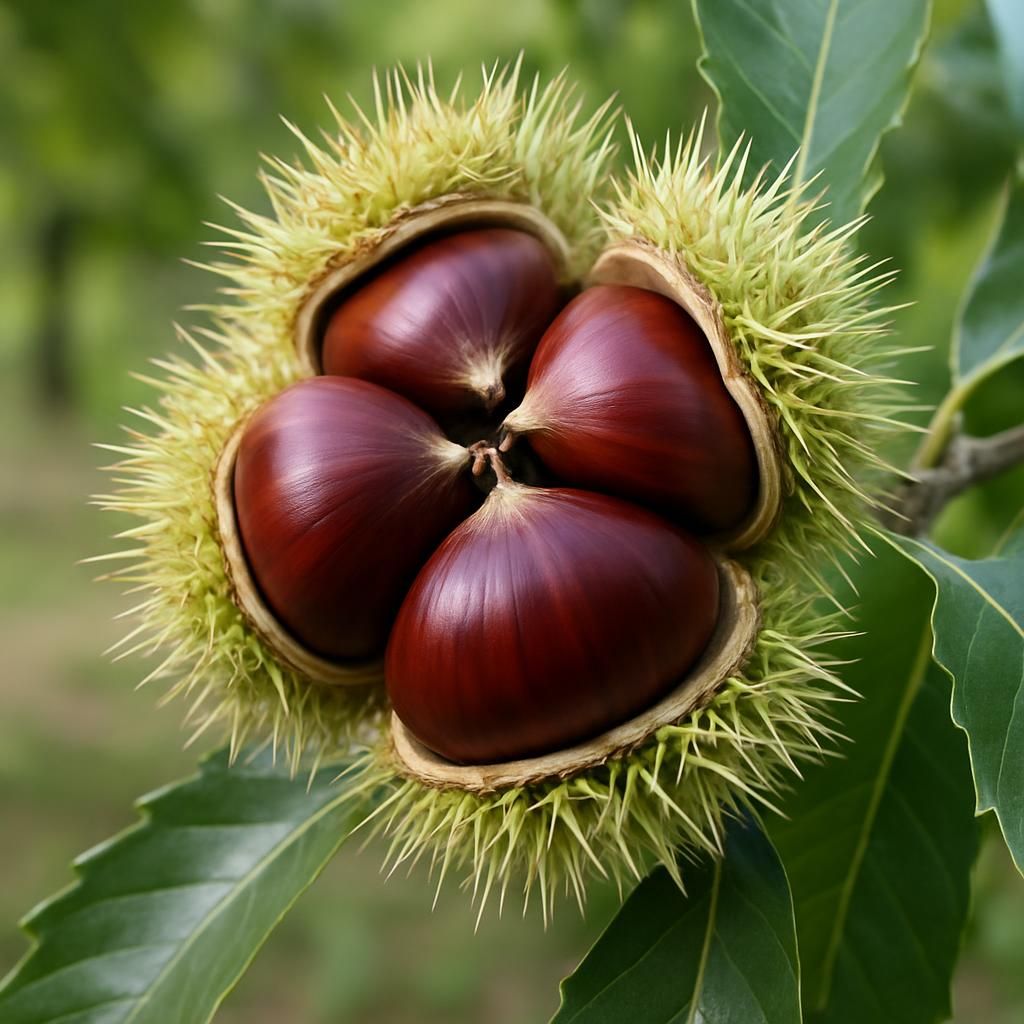
Introduction to Chestnut (European - Marrone di Marradi)
The Marrone di Marradi is a distinguished clonal selection of the European chestnut (Castanea sativa) originating from the Marradi area in Tuscany, Italy. It is prized by growers and markets for its large nut size, bright mahogany color, excellent flavor, and thin pellicle that peels cleanly after roasting. Commercial orchards of Marrone di Marradi are established across Mediterranean climates and increasingly in temperate zones with mild winters and warm summers.
Successful cultivation requires attention to soil drainage, chill-hour accumulation, and long-term management of fungal and insect pressures. With proper site selection and cultural practices, mature trees can remain productive for 80–100 years, delivering both timber value and high-value nuts. This definitive guide covers every stage from propagation through harvest and storage.
Botanical Profile of Chestnut (European - Marrone di Marradi)
Castanea sativa is a large deciduous tree in the Fagaceae family, capable of reaching 20–35 m in height with a broad, spreading crown. The Marrone di Marradi selection produces vigorous upright growth with smooth gray bark that becomes deeply furrowed with age. Leaves are oblong-lanceolate, 10–20 cm long, with sharply serrated margins and prominent parallel veins.
Catkins appear in late spring; male flowers release abundant pollen while female flowers develop into spiny cupules containing 1–3 nuts. The Marrone di Marradi nut is notably large (typically 10–16 g), with a sweet, aromatic kernel and minimal internal fiber. Trees are generally self-sterile, requiring compatible pollinizers such as Chestnut (Colossal) or Chestnut (Bouche de Betizac).
Soil, pH, and Climate Requirements for Chestnut (European - Marrone di Marradi)
Marrone di Marradi performs best on deep, well-drained sandy-loam to loam soils with high organic matter. The species is highly sensitive to waterlogging and compacted subsoils. Avoid heavy clays or sites with a high water table.
| Parameter | Ideal Range | Notes |
|---|---|---|
| Soil Texture | Sandy loam to loam | Good aeration and drainage essential |
| Soil pH | 5.0–6.5 | Strongly acid to slightly acid preferred |
| Organic Matter | 3–6 % | Improves moisture retention and fertility |
| Minimum Soil Depth | 1.0 m | Allows deep root development |
| Annual Rainfall | 700–1200 mm | Supplemental irrigation in dry summers |
| Chill Hours (0–7 °C) | 800–1200 hours | Required for uniform bud break |
| Summer Temperature | 20–30 °C daytime | Optimal nut filling and kernel quality |
| Winter Hardiness | –20 °C minimum | Young trees benefit from trunk protection |
Step-by-Step Planting & Propagation
- Site preparation begins 6–12 months before planting. Conduct soil tests and incorporate lime or sulfur to reach target pH. Deep-rip compacted layers and build raised beds if drainage is marginal.
- Source certified disease-free grafted Marrone di Marradi scions on seedling or clonal rootstocks. Grafting is performed in late winter using whip-and-tongue or cleft methods.
- Plant bare-root or container-grown trees in late autumn or early spring when soils are workable. Dig holes 60 cm wide and deep; backfill with native soil amended with well-rotted compost.
- Space trees 8–10 m apart in rows 10–12 m wide to allow machinery access and sunlight penetration. Install drip irrigation at planting.
- Apply 5–10 cm of organic mulch in a 1 m radius around each trunk, keeping mulch 10 cm from the stem to prevent collar rot.
- Stake young trees and install tree guards against rodent damage. Water thoroughly after planting and maintain consistent moisture during the first two growing seasons.
Care & Maintenance regimes for Chestnut (European - Marrone di Marradi)
Mature Marrone di Marradi orchards require disciplined annual programs of irrigation, nutrition, and pruning to sustain productivity and nut quality.
| Season | Watering Schedule | Fertilizer Application | Pruning Schedule |
|---|---|---|---|
| Early Spring | Maintain field capacity; 25–40 mm/week if rain insufficient | 40–60 g N/tree; apply boron (10 g/tree) if leaf analysis indicates deficiency | Remove dead, diseased, and crossing branches; shape central leader |
| Late Spring | Increase to 50 mm/week during flowering and nut set | Side-dress potassium sulfate (30–50 g K₂O/tree) | Light tipping of vigorous shoots to encourage lateral fruiting wood |
| Summer | 40–60 mm/week during kernel fill; deficit irrigation after shell hardening | Foliar zinc and manganese if deficiency symptoms appear | Summer prune water sprouts and low-hanging limbs for light penetration |
| Autumn | Reduce irrigation after harvest to encourage dormancy | Apply 20–30 g phosphorus/tree if soil test <15 ppm | Remove any remaining deadwood; sanitize tools between trees |
| Winter | Minimal; protect soil moisture with mulch | No fertilizer; soil test every 3 years | Dormant pruning of structural framework; remove 20–25 % of canopy on mature trees |
Pests, Diseases & Organic Management
The most serious disease threat is Chestnut Blight caused by Cryphonectria parasitica. Hypovirulent strains can be introduced as a biological control. Phytophthora root rot and Ink disease are managed through improved drainage and phosphite trunk injections. The Chestnut gall wasp (Dryocosmus kuriphilus) is controlled by releasing the parasitoid Torymus sinensis. Nut weevils (Curculio spp.) are monitored with trunk traps and targeted with organic insecticides containing spinosad during adult emergence. Regular sanitation—removing dropped burrs and mummified nuts—reduces overwintering pest populations.
Harvesting, Curing & Optimal Storage
Harvest begins when burrs start to split naturally, typically late September to mid-October in Mediterranean climates. Collect daily to minimize mold and weevil damage. Cure nuts by spreading in single layers at 15–18 °C and 70–80 % RH for 7–10 days until kernel moisture reaches 10–12 %. Grade by size and store at 0–2 °C and 85–90 % RH for up to 4 months. For longer storage, freeze at –18 °C after vacuum sealing. Monitor regularly for mold and discard any soft or discolored nuts.
Companion Planting for Chestnut (European - Marrone di Marradi)
Compatible understory species include Clover and Hairy vetch for nitrogen fixation and soil improvement. Nasturtium and Marigold deter soil pests and attract beneficial insects. Avoid planting shallow-rooted vegetables directly under the dripline to prevent competition for moisture. Interplanting with Thyme and Rosemary enhances biodiversity and provides habitat for predatory insects that help control aphids and mites.