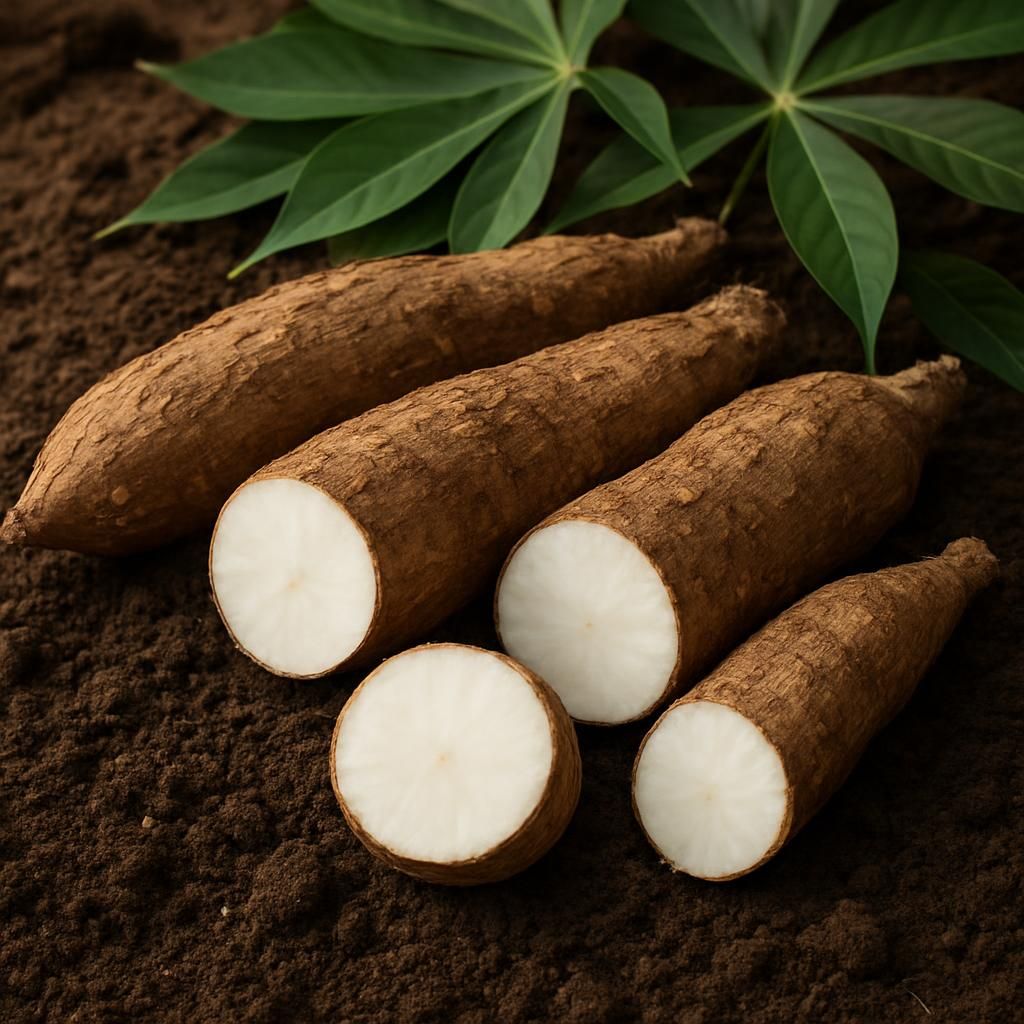
Introduction to Cassava (Manihot esculenta - White)
Cassava (Manihot esculenta - White) is one of the world’s most important staple root crops, feeding over 800 million people across tropical and subtropical regions. Its drought tolerance, ability to grow on poor soils, and flexible harvest window make it a strategic choice for smallholders and commercial growers alike. White cassava varieties are prized for their clean white flesh, mild flavor, and versatility in fresh, processed, and industrial uses.
Botanical Profile of Cassava (Manihot esculenta - White)
Cassava belongs to the Euphorbiaceae family and is a perennial shrub that is usually grown as an annual for its enlarged storage roots. The plant produces palmate leaves with 5–9 lobes and can reach 1.5–4 m in height depending on cultivar and growing conditions. The edible portion consists of long, cylindrical roots 15–100 cm long with white to cream-colored flesh and a thin, corky periderm. Cassava (crop) is propagated vegetatively from stem cuttings rather than true seeds.
Soil, pH, and Climate Requirements for Cassava (Manihot esculenta - White)
Cassava performs best on well-drained, sandy-loam to loam soils but tolerates a wide range of textures provided drainage is excellent. It prefers slightly acidic to neutral pH and requires consistent warmth with moderate rainfall.
| Parameter | Ideal Range | Notes |
|---|---|---|
| Soil Type | Sandy loam to loam | Avoid heavy clays and waterlogged sites |
| Soil pH | 5.5–7.0 | Tolerates 4.5–8.0 with reduced yields |
| Temperature | 20–32 °C (day) | Frost sensitive; minimum 15 °C |
| Annual Rainfall | 1000–2000 mm | Tolerates 600–3000 mm with good drainage |
| Altitude | 0–1800 m a.s.l. | Best yields below 1500 m |
| Growing Season | 8–18 months | Harvest window flexible after 8 months |
Step-by-Step Planting & Propagation
- Select healthy, disease-free stems 8–12 months old from high-yielding mother plants.
- Cut 20–30 cm long sections containing 5–7 nodes; soak in water or fungicide solution for 10 minutes.
- Prepare ridges or mounds 30–40 cm high and 90–120 cm apart on well-tilled soil.
- Insert cuttings vertically or at a 45° angle so 2–3 nodes remain above ground.
- Plant at the start of the rainy season or irrigate immediately after planting.
- Space plants 80–100 cm within rows for optimal root development and ease of weeding.
Care & Maintenance regimes for Cassava (Manihot esculenta - White)
Timely weeding, balanced nutrition, and moisture management during the first 3–4 months are critical for high tuber yields.
| Operation | Schedule | Details |
|---|---|---|
| Watering | Weeks 1–12: 25–30 mm/week | Maintain soil moisture; reduce after canopy closure |
| Fertilizer (NPK) | Basal: 200 kg/ha 15-15-15; Top-dress at 3 months: 100 kg/ha urea | Use compost or well-rotted manure where possible |
| Pruning | 4–6 months: remove lower leaves & branches | Improves airflow and reduces disease pressure |
| Weeding | 3–4 times in first 4 months | Hand weeding or shallow cultivation |
Pests, Diseases & Organic Management
Major threats include Cassava mealybug, Cassava green mite, cassava mosaic disease, and bacterial blight. Regular scouting, removal of infected plants, and use of resistant varieties are the foundation of integrated management. Encourage natural enemies such as predatory mites and lady beetles. Apply neem-based sprays or insecticidal soaps at early infestation stages. Rotate with non-host crops such as Maize (crop) or legumes to break pest and disease cycles.
Harvesting, Curing & Optimal Storage
Harvest when leaves begin to yellow or after 8–18 months depending on market needs. Carefully lift roots with a fork or cassava harvester to minimize damage. Cure freshly harvested roots in shaded, well-ventilated areas at 25–30 °C and 80–85 % RH for 3–5 days to reduce post-harvest decay. Store cured roots in cool (12–15 °C), dark, ventilated conditions for up to 4–6 weeks or process immediately into chips, flour, or starch.
Companion Planting for Cassava (Manihot esculenta - White)
Cassava pairs well with nitrogen-fixing legumes such as Pigeon pea (crop) and Cowpea (crop) that improve soil fertility and provide ground cover. Intercropping with Maize (crop) or Sorghum (crop) maximizes land use and reduces weed pressure. Aromatic herbs like Thai Basil (crop) can deter certain insect pests when planted at field borders.