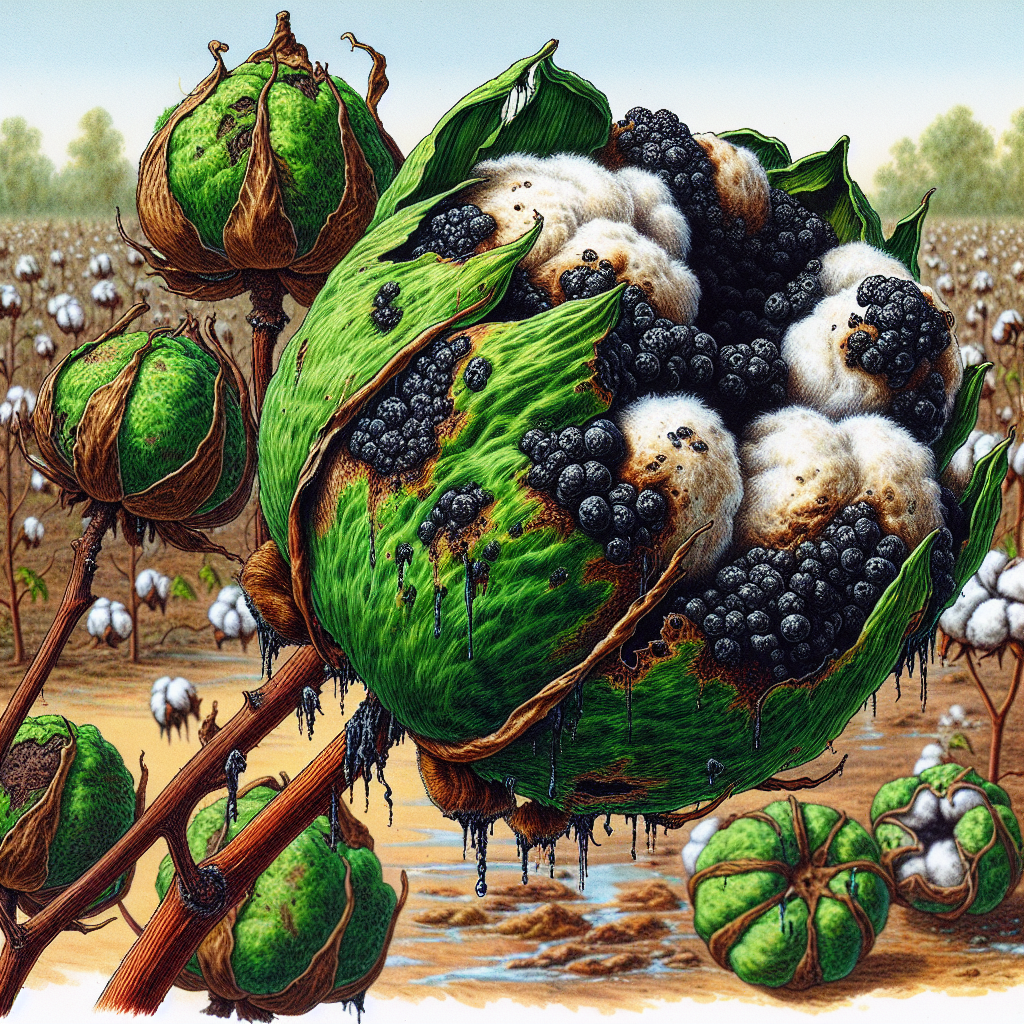
Introduction to Boll rot
Boll rot represents one of the most destructive diseases in cotton production worldwide, capable of wiping out 20-50% of yields in severe outbreaks. This fungal complex, dominated by pathogens such as Phytophthora nicotianae and Diplodia gossypina, targets the reproductive structures of the cotton plant—specifically the bolls—during critical fruiting stages. First identified in the early 20th century in the southeastern United States, boll rot has since spread to major cotton-growing regions including India, China, Brazil, and Australia, where humid subtropical climates exacerbate its impact.
The disease manifests as a wet, soft rot of immature bolls, often accompanied by a foul odor and prolific sporulation on the boll surface. Unlike foliar diseases, boll rot directly compromises fiber quality and seed viability, making it a primary concern for both conventional and organic growers. Economic losses from boll rot exceed billions annually, underscoring the need for integrated disease management. Early detection is crucial, as infected bolls shed prematurely, leaving fields dotted with mummified remnants. This guide provides comprehensive diagnostics, lifecycle insights, and proven organic strategies to safeguard your cotton crop. For more on cotton cultivation challenges, check out Why Misidentifying Plants Costs Small Farms Thousands - And How AI Camera Diagnosis Fixes It Fast.
Understanding boll rot's pathology is key to prevention. The pathogens enter through wounds or natural openings, rapidly colonizing boll tissues under favorable moisture. In high-density plantings, humidity within the canopy fosters rapid spread via splashing rain or overhead irrigation. Growers must integrate resistant varieties like Upland Cotton with vigilant scouting to minimize damage.
Identifying Symptoms & Damage
Accurate identification of boll rot is essential for timely intervention, distinguishing it from similar issues like anthracnose or bacterial blights. Initial symptoms appear 2-4 weeks post-bloom on young bolls (10-20 days old), starting as small, water-soaked lesions at the base or sides. These lesions expand rapidly, turning dark brown to black, with the boll wall softening and becoming mushy to the touch.
Examine affected bolls closely: healthy ones feel firm and fibrous, while boll rot yields a slimy texture under pressure, often releasing a reddish-brown liquid laced with fungal mycelium. White to pink spore masses (sporangia in Phytophthora) may ooze from cracks, especially after rain. Advanced stages show internal locules filled with rotted lint and seeds, emitting a fermented stench attracting secondary pests like sap beetles.
Damage assessment involves counting shed bolls and weighing harvested fiber from affected areas. Yield losses correlate directly with infection incidence: 10% boll infection can reduce lint yield by 15-20%. Differentiate from Helicoverpa species damage by the absence of larval entry holes and presence of uniform rot rather than tunneling. Use a hand lens to spot Phytophthora's lemon-shaped sporangia or Diplodia's black pycnidia. In fields, symptoms cluster in low-lying, poorly drained spots, with bracts appearing water-soaked and necrotic.
Scout weekly from first bloom, focusing on the lower canopy. Record incidence using a 1-5 scale: 1 (trace lesions), 5 (90% boll rot). This data informs threshold-based sprays and informs future rotations.
Lifecycle and Progression of Boll rot
Boll rot pathogens exhibit polycyclic lifecycles, with multiple infection cycles per season synchronized to cotton's fruiting. Phytophthora nicotianae survives as oospores in soil or infected debris, germinating in saturated conditions (>24 hours free water). Zoospores swim to bolls via splash or film water, encysting and penetrating within hours. At 25-30°C, lesions expand 1-2 cm daily, sporulating in 3-5 days to infect nearby bolls.
Diplodia gossypina overwinters as pycnidia in mummified bolls, releasing conidia during rains. Progression accelerates post-rain: Day 1 (infection), Day 3 (lesion visible), Day 7 (boll opens prematurely with rotted contents). Under optimal conditions (28°C, 95% RH), secondary cycles repeat every 7-10 days, amplifying epidemics.
The disease peaks during peak bloom to early boll set (60-90 days after planting), coinciding with monsoon seasons. Chlamydospores ensure long-term soil persistence, up to 2 years. Understanding this timeline allows predictive modeling: infections surge after 2+ inches rain with soil temps >25°C.
Environmental Triggers & Risk Factors
Boll rot epidemics hinge on the pathogen triangle: susceptible host, virulent pathogen, and conducive environment. Key triggers include prolonged leaf wetness (>12 hours), high humidity (>90%), and temperatures 24-32°C. Heavy rains or overhead irrigation create ideal splash-dispersal conditions, while poor drainage amplifies soil saturation.
Risk factors encompass dense canopies from excessive nitrogen, delaying canopy drying. Susceptible varieties like older Pima Cotton lines fare worse than modern upright types. Continuous cotton monoculture builds inoculum, as does residue retention. Compaction from machinery reduces aeration, favoring anaerobes like Phytophthora. Acidic soils (pH<6) enhance sporulation. Scout high-risk zones: field edges, depressions, and pivot tracks.
Organic Control & Treatment Plans
Organic management emphasizes cultural, biological, and threshold-based fungicides. Start with resistant varieties and 3-year rotations to non-hosts like corn or soybeans. Optimize planting: 30-36 inch rows for airflow, avoiding hillsides prone to runoff.
Biologicals shine: Apply Trichoderma viride or Bacillus subtilis at bloom (2-4 kg/ha), repeating post-rain. These antagonists colonize wounds, outcompeting pathogens. Boost with compost teas rich in Pseudomonas fluorescens for biocontrol.
Approved organics include copper hydroxide (2-3 kg/ha, 7-day intervals) and potassium bicarbonate for pH disruption. Integrate neem oil (1%) to deter vectors. Prune lower leaves pre-bloom to enhance drying. Threshold: Spray at 5% boll infection.
Step-by-step plan:
- Scout weekly, mapping hotspots.
- Apply biofungicide at first bloom.
- Post-rain: Copper within 48 hours.
- Defoliate early to expose bolls.
- Destroy volunteers and residue.
Field trials show 60-80% control with IPM vs. 30% standalone.
Preventing Boll rot in the Future
Long-term prevention builds resilient systems. Select varieties with boll rot tolerance (e.g., DP 1646). Implement tile drainage and raised beds in prone areas. Time planting to dodge peak rains: early-maturing cultivars evade monsoon.
Cover crops like clover suppress inoculum via allelopathy. Soil solarization (6 weeks summer) kills 90% oospores. Monitor with traps for early warning. Foliar nutrition: Calcium (2 kg/ha) strengthens boll walls. Post-harvest, shred and disk residue deeply. Annual soil tests guide liming to pH 6.5-7.0.
Integrated with precision irrigation (drip over pivot), prevention cuts incidence 70%. Track via apps for hyper-local forecasts.
Crops Most Affected by Boll rot
Primarily devastating to cotton, with Upland Cotton and Pima Cotton most vulnerable. Minor reports in okra (okra) and hibiscus under wet tropics. Cotton accounts for 95% losses, especially in subtropical belts.