Introduction to Black Pepper (Tellicherry)
Black Pepper (Tellicherry) is the gold standard of peppercorns, originating from the Malabar Coast of India where centuries of selective cultivation have refined its size and pungency. Tellicherry berries are harvested at peak ripeness and carefully dried to preserve volatile oils that give this variety its distinctive aroma and heat. Commercial growers value the cultivar for its consistent berry size and strong market demand in gourmet and spice trades.
Successful cultivation of Black Pepper (Tellicherry) demands attention to microclimate, vine support, and post-harvest handling. The crop performs best when integrated into diversified tropical systems that maintain humidity and soil health year-round.
Botanical Profile of Black Pepper (Tellicherry)
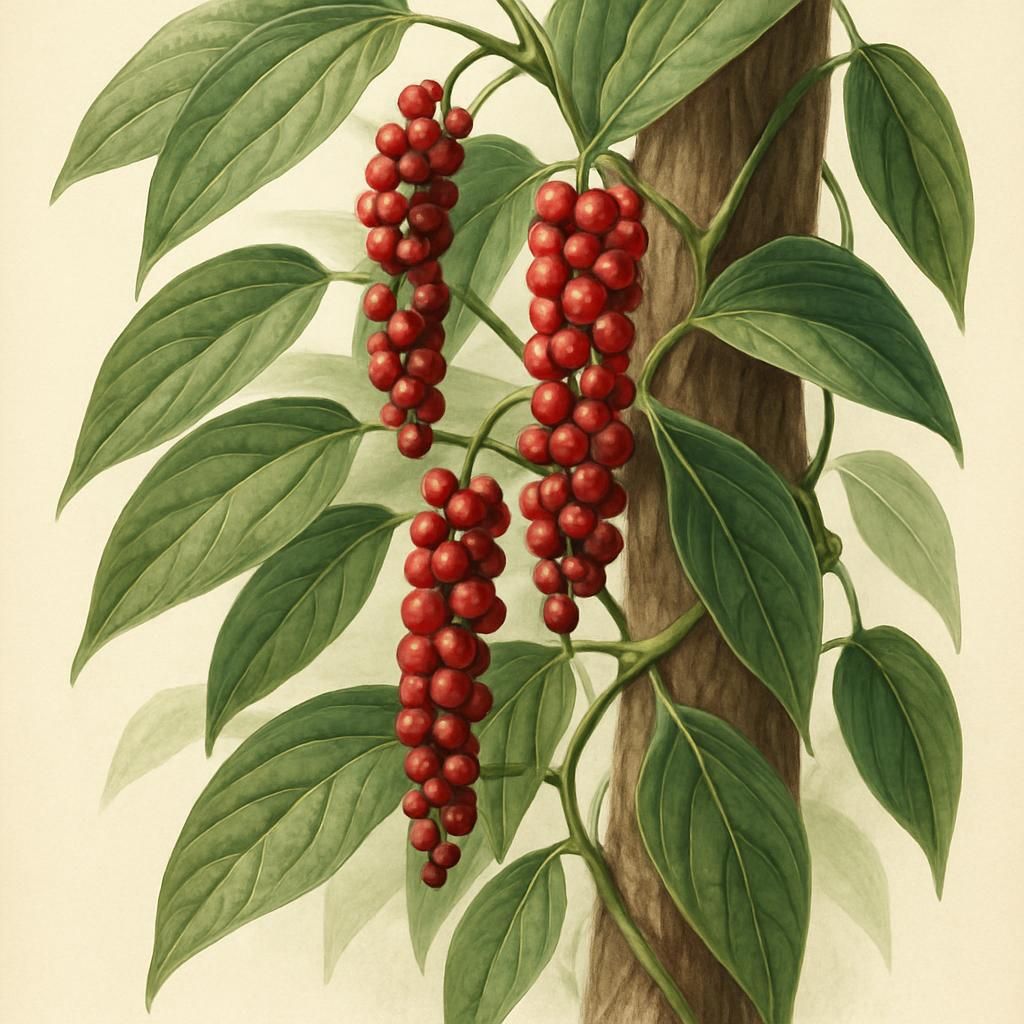
Piper nigrum 'Tellicherry' is a woody, evergreen climbing vine belonging to the Piperaceae family. The plant produces adventitious roots along its stems that anchor to supports such as living trees or trellises. Leaves are alternate, ovate, and dark green with prominent veins. Small, dioecious flowers form on pendulous spikes; female plants set the familiar drupes that mature from green to red before drying into black peppercorns.
The Tellicherry selection produces larger berries (typically 4.5–5.5 mm) with higher piperine content than standard varieties. Mature vines can reach 10–15 meters when grown on standards, though commercial plantings are usually pruned to 3–4 meters for ease of harvest.
Soil, pH, and Climate Requirements for Black Pepper (Tellicherry)
| Parameter | Ideal Range | Notes |
|---|---|---|
| Soil Type | Deep, well-drained loamy or lateritic | Rich in organic matter; avoid waterlogging |
| pH | 5.5 – 6.5 | Slightly acidic; liming rarely required |
| Temperature | 20 – 34 °C daytime | Minimum 15 °C; frost will kill vines |
| Annual Rainfall | 2000 – 3000 mm | Even distribution; supplemental irrigation in dry spells |
| Relative Humidity | 75 – 90 % | Critical during flowering and berry set |
| Altitude | 0 – 1500 m | Lower elevations often produce larger berries |
Step-by-Step Planting & Propagation
- Select healthy, disease-free cuttings 30–40 cm long with 3–4 nodes from high-yielding mother vines.
- Prepare nursery beds or polybags with a 1:1:1 mix of topsoil, well-rotted farmyard manure, and coarse sand.
- Plant cuttings at a 45° angle, leaving two nodes above the medium; maintain 70–80 % shade and daily misting.
- Rooting occurs in 4–6 weeks; harden off seedlings for two weeks before field transplanting.
- Establish permanent standards (live supports such as Gliricidia or Erythrina) at 3 × 3 m spacing or install 2.5 m concrete/wooden trellises.
- Transplant rooted cuttings at the base of supports during the onset of monsoon rains; mulch immediately with 10 cm of organic material.
Care & Maintenance regimes for Black Pepper (Tellicherry)
| Growth Stage | Watering Schedule | Fertilizer Application | Pruning Schedule |
|---|---|---|---|
| Establishment (Yr 1) | 2–3 times weekly; keep root zone moist | 50 g NPK 15-15-15 + 5 kg FYM per vine, split | Remove lower leaves; train 2–3 shoots upward |
| Vegetative (Yr 2–3) | Weekly deep soak; reduce in heavy rain | 100 g NPK + 2 kg neem cake twice yearly | Tip prune at 2 m; thin crossing branches |
| Flowering & Fruit | Maintain even moisture; drip irrigation ideal | 150 g NPK + 500 g bone meal + micronutrients | Light sanitary prune post-harvest only |
| Mature (Yr 4+) | 25–30 L per vine every 7–10 days | 200 g NPK + 3 kg vermicompost annually | Annual renewal prune of 30 % oldest wood |
Pests, Diseases & Organic Management
Major insect pests include Aphids, Mealybugs, and Scale insects. Regular monitoring and releases of Cryptolaemus montrouzieri lady beetles provide effective biological control. Spider mites may flare during dry periods; overhead misting and neem oil sprays (0.5 %) suppress populations.
Key diseases are Phytophthora foot rot and Anthracnose. Preventive soil drenches with Trichoderma viride (10 g/L) and copper-based sprays at 15-day intervals during monsoon reduce incidence. Remove and destroy infected plant parts promptly.
Harvesting, Curing & Optimal Storage
Berries reach full size 6–8 months after flowering. Harvest when the majority turn orange-red. Sun-dry whole spikes on clean mats for 3–5 days until moisture drops to 10–12 %. For Tellicherry grade, berries are size-graded and further dried to 8 % moisture before packing in food-grade jute bags with inner liners.
Store in cool (15–20 °C), dry conditions away from direct light. Properly cured pepper retains flavor and piperine content for 18–24 months.
Companion Planting for Black Pepper (Tellicherry)
Interplanting with leguminous standards such as Gliricidia supplies fixed nitrogen and partial shade. Marigold borders deter nematodes while Sesame strips attract beneficial insects. Avoid planting solanaceous crops nearby to limit shared disease pressure.