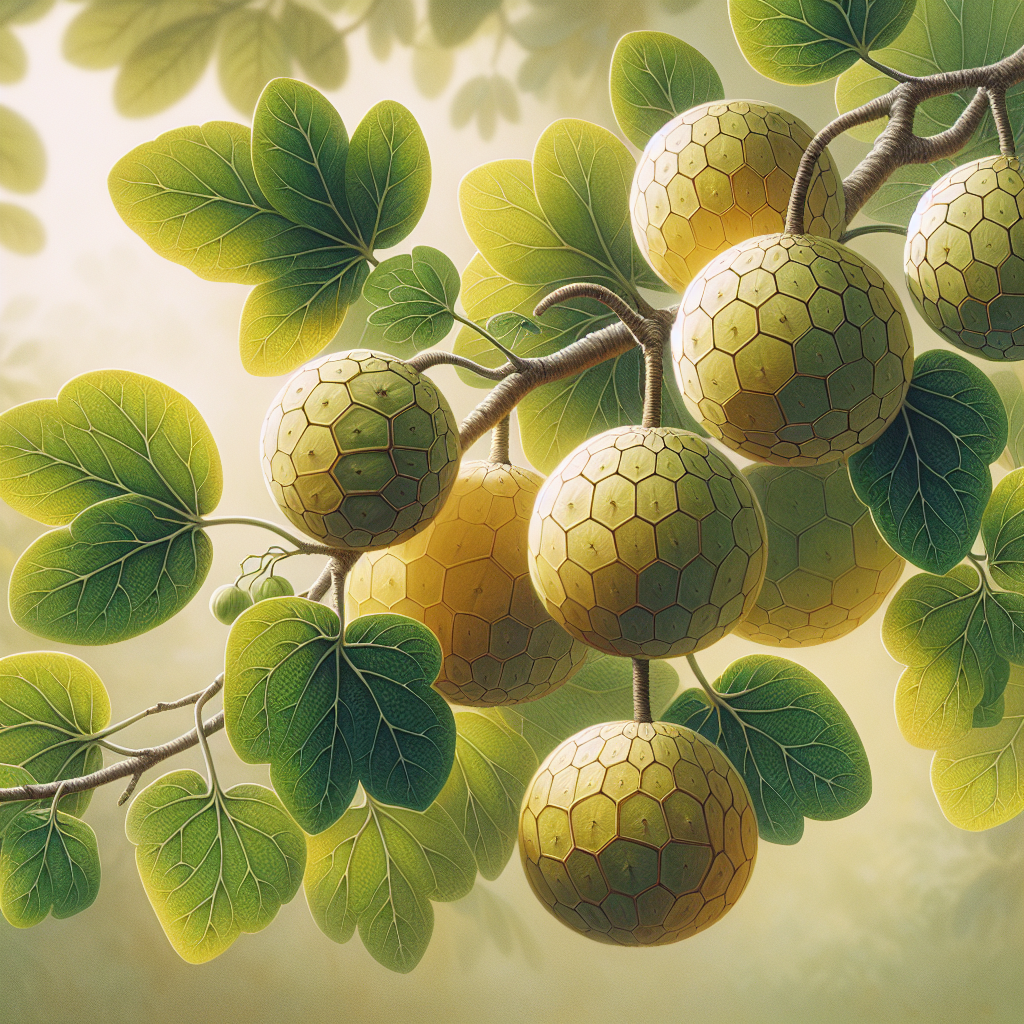
Introduction to Bael Fruit (Mirzapuri)
Bael Fruit (Mirzapuri), a superior selection of Aegle marmelos L., stands out among bael varieties for its superior flavor profile, larger fruit size, and higher pulp yield. Originating from the Mirzapur region in Uttar Pradesh, India, this cultivar has gained prominence for its sweet, granular pulp with minimal fiber, making it ideal for commercial processing into sharbat, preserves, and Ayurvedic medicines. The tree's resilience to arid conditions and minimal care requirements position it as an excellent choice for small-scale farmers diversifying into high-value fruit crops.
Mirzapuri bael trees can yield 200-300 fruits per mature tree annually, with each fruit weighing 2-4 kg and boasting a shelf life of up to 2 years when properly stored. Rich in riboflavin, thiamine, and vitamin C, the fruit supports digestive health, acts as a natural laxative, and exhibits antidiabetic properties. For Mango (crop) growers expanding their orchard diversity, Mirzapuri bael offers complementary growth habits and similar subtropical requirements. Check out this Fall Companion Planting Guide: Boost Yields and Soil Health for Small Farms and Gardens for integration strategies.
The tree's trifoliate leaves, thorny branches, and aromatic wood add ecological value, providing habitat for beneficial insects while suppressing weed growth under the canopy. With proper management, Mirzapuri bael establishes reliable income streams through fresh sales, processed products, and value-added herbal formulations.
Botanical Profile of Bael Fruit (Mirzapuri)
Aegle marmelos var. Mirzapuri belongs to the Rutaceae family, closely related to citrus species. This evergreen to semi-deciduous tree reaches 10-15 meters in height with a spreading canopy of 8-12 meters. The bark is smooth and grayish, peeling in patches to reveal reddish underlayers. Characteristic trifoliate leaves (3-5 leaflets) are 5-15 cm long, ovate-lanceolate, with crenate margins and a strong citrus-like aroma when crushed.
Flowers emerge in profusion during late winter to early summer (February-April), forming panicles of 10-30 fragrant, bisexual blooms. Each flower measures 1.5-2 cm across with greenish-white petals and numerous stamens. Mirzapuri cultivar produces superior fruit compared to standard bael: spherical to obovoid shape, 15-25 cm diameter, with thick (5-10 mm) grayish-yellow rind covered in hexagonal pits. The pulp is orange-yellow, sweet (TSS 38-42° Brix), granular, and seed-free in superior selections.
Trees exhibit strong taproot development, enabling drought tolerance, and produce root suckers for vegetative propagation. Flowering is cauliflorous (on old wood) and leaf-opposed, ensuring consistent yields. Phenological stages include leaf flush (post-monsoon), flowering (dry season), fruit set (April-May), and maturity (November-February). This cultivar shows partial parthenocarpy, setting seedless fruits under optimal pollination.
Soil, pH, and Climate Requirements for Bael Fruit (Mirzapuri)
Mirzapuri bael thrives in a wide range of soils but performs best in deep, well-drained loamy soils with 20-30% clay content. Avoid waterlogged or highly saline conditions; soil electrical conductivity should remain below 4 dS/m. Optimal pH range is 6.5-8.5, tolerating up to pH 9.5 in sodic soils when amended with gypsum.
Prepare planting pits (1x1x1 m) filled with FYM (20 kg), neem cake (5 kg), and single superphosphate (2 kg) per pit. Incorporate 10-15 tons/ha FYM during orchard establishment to enhance microbial activity. The tree's deep taproot system accesses subsoil moisture, making it suitable for rainfed cultivation in semi-arid regions.
Climate Profile: Subtropical to tropical, 25-45°C maximum temperatures, 5-40°C minimums. Annual rainfall 600-1200 mm suffices; supplemental irrigation during fruit development boosts yields by 30-50%. Full bloom requires 15-20°C night temperatures for optimal pollen viability. Avoid frost-prone areas below -2°C. High humidity (60-80%) during fruit set prevents flower drop, while dry weather at maturity enhances sugar accumulation and storage quality.
Elevation up to 1000 m ASL works well. Windbreaks using Gliricidia (crop) protect young trees from hot winds reducing transpiration stress.
Step-by-Step Planting & Propagation
Seed Propagation (for rootstock): Sow fresh seeds 2-3 cm deep in raised nursery beds during June-July. Germination occurs in 15-30 days at 85-90% rates. Transplant seedlings at 6-8 months (30-45 cm height) to polybags for budding.
Vegetative Propagation (preferred for Mirzapuri): Use shield budding on 1-year-old rootstocks during monsoon (July-August). Success rate: 75-85%. Approach grafting or veneer grafting in February-March yields 90% take. Select 10-15 cm scion shoots with 2-3 buds from pencil-thick branches.
Planting Procedure:
- Pit preparation: Dig 1x1x1 m pits 8x8 m spacing (125 trees/ha). Expose 15 days, refill with pit mixture.
- Planting time: Monsoon onset (June-July) for rainfed; anytime with irrigation.
- Placement: Keep graft union 15 cm above ground. Stake immediately.
- Basin formation: Create 1 m radius saucer for rainwater harvesting.
Initial pruning shapes trees to single stem up to 1 m, then open center system. First yield in year 4-5, full production year 7-8 (200+ fruits/tree).
Care & Maintenance regimes for Bael Fruit (Mirzapuri)
Irrigation: Drip irrigation (20-40 L/tree/week) during dry spells. Critical periods: flowering, fruit set (March-June), fruit swell (Sept-Oct). Mature trees tolerate 2-3 month drought; mulch conserves 30% moisture.
Fertilization: Year 1: NPK 0.5:0.25:0.5 kg/tree. Mature: 1:0.5:1 kg/tree split into 3 doses (monsoon, post-monsoon, pre-bloom). Foliar micronutrients (ZnSO4 0.5%, Fe 0.2%) twice yearly prevent deficiency chlorosis.
Pruning: Annual post-harvest removal of deadwood, water sprouts, crossing branches. Maintain 4-6 scaffold branches. Heading back fruiting wood every 2 years sustains productivity.
Weed Management: Mulch with dry leaves (10 cm layer). Slash mowing under canopy. Pre-emergent glyphosate sparingly on young trees.
Intercropping: Legumes like pigeon pea (crop) or mung bean years 1-4 generate income while improving soil fertility.
Pests, Diseases & Organic Management
Major Pests:
- Leaf miners (Leafminers (pest)): Neem oil 3% spray at bud break.
- Fruit flies: Bait traps with methyl eugenol + malathion.
- Mealybugs (Mealybugs (pest)): Introduce Cryptolaemus montrouzieri or 2% neem.
- Stem borers: Inject monocrotophos 0.2% or hook destructive removal.
Key Diseases:
- Fruit canker (Xanthomonas): Copper oxychloride 0.25% post-rain.
- Leaf spot (Leaf spot diseases (disease)): Mancozeb 0.2%.
- Root rot (Root rot (disease)): Soil drench carbendazim + improve drainage.
Organic IPM: Yellow sticky traps (20/tree), neem seed kernel extract (5%) rotations, release Trichogramma (fruit fly parasitoid), poultry manure compost suppresses soil pathogens. Regular canopy aeration via pruning reduces humidity-related issues.
Harvesting, Curing & Optimal Storage
Harvest at physiological maturity (November-February) when fruit rind turns yellow-brown and seeds rattle. Clip with secateurs leaving 2 cm stalk. Yield: 25-40 tons/ha at peak.
Curing: Shade dry 7-10 days at 30-35°C to reduce moisture, enhance flavor. Avoid direct sun to prevent rind cracking.
Storage: Whole fruits store 4-6 months at ambient (15-25°C), 12-18 months at 10°C (85% RH). Pulp extraction: Scoop manually, dry slabs on mats 3-5 days for preserve making.
Post-harvest grading: >2 kg premium, 1-2 kg grade II. Market fresh, processed (pulp, powder, candy), or medicinal extracts.
Companion Planting for Bael Fruit (Mirzapuri)
Bael orchards benefit from nitrogen-fixing legumes understory: Clover (crop), cowpea, sunn hemp suppress weeds, fix 80-100 kg N/ha. Intercrop Marigold (crop) repels nematodes, attracts pollinators.
Perimeter planting of Thyme (crop) and Nasturtium (crop) deters aphids. Avoid competitive shallow-rooted crops like banana near trunks. Windbreaks with Casuarina or Eucalyptus protect from cyclonic damage. Sequential planting: legumes year 1-3, ginger/turmeric year 4-6, then pure bael.
This system boosts biodiversity, soil organic matter (2-3% increase), and overall farm profitability.