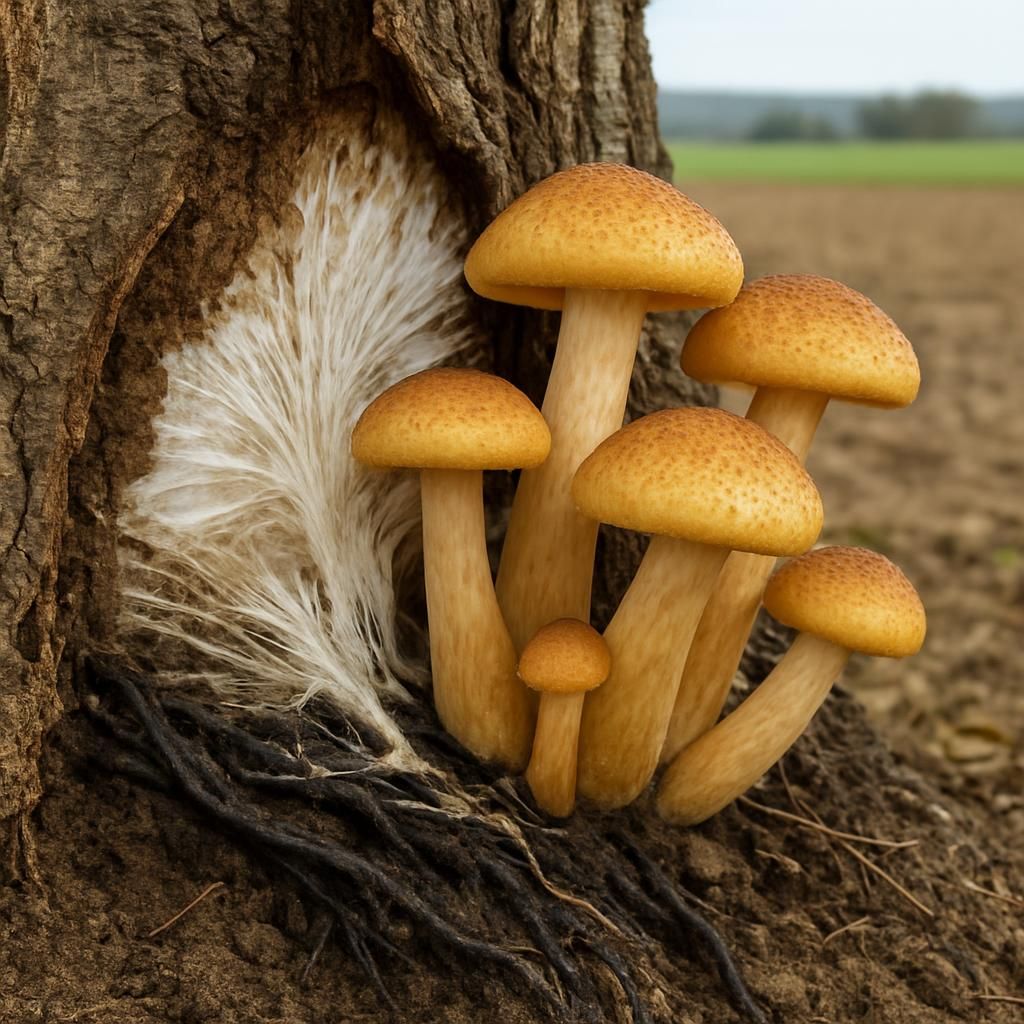
Introduction to Armillaria mellea
Armillaria mellea, commonly known as honey fungus, is one of the most destructive root pathogens in temperate and subtropical agriculture and forestry. This basidiomycete fungus infects the roots and root collars of woody plants, causing a progressive decay that ultimately kills the host. The pathogen is notorious for its ability to persist in soil for decades through thick, black rhizomorphs that resemble shoestrings, allowing it to spread from infected stumps or roots to healthy plants. Because symptoms often appear only after significant root damage has occurred, early detection is critical for limiting spread.
The economic impact of Armillaria mellea is substantial in orchards, vineyards, and managed woodlands. Infected trees exhibit reduced vigor, smaller fruit, and increased susceptibility to secondary stresses such as drought or other pathogens. Once established, the fungus is extremely difficult to eradicate because rhizomorphs can remain viable in woody debris for 20–50 years. Professional growers therefore emphasize prevention, sanitation, and integrated management rather than relying on curative chemical treatments.
Identifying Symptoms & Damage
Above-ground symptoms of Armillaria mellea infection typically appear late in the disease cycle. Infected trees show gradual decline characterized by sparse foliage, smaller leaves, premature autumn coloration, and dieback of branches. In severe cases, sudden wilting of the entire canopy occurs during periods of high evapotranspiration because the compromised root system cannot supply adequate water.
At the base of the trunk or on major roots, diagnostic white mycelial fans or sheets develop beneath the bark. These fans have a distinct fan-like pattern and a strong mushroom odor when crushed. In late summer and autumn, clusters of honey-colored mushrooms may appear at the base of infected trees or from buried wood. These fruiting bodies have a ring on the stalk and produce white spore prints.
Root examination reveals dark, string-like rhizomorphs adhering to or penetrating the bark. In advanced infections, the wood becomes soft, stringy, and water-soaked with black zone lines (demarcation lines) visible in cross-sections. These signs distinguish Armillaria from other root rots such as Phytophthora or Fusarium.
Lifecycle and Progression of Armillaria mellea (MUST INCLUDE A MARKDOWN TABLE OF LIFECYCLE STAGES)
Armillaria mellea completes its lifecycle through both sexual and asexual stages. The fungus produces basidiospores from mushrooms that can infect freshly cut stumps, but most new infections occur when rhizomorphs contact living roots. Once established, the pathogen colonizes the cambium and sapwood, killing tissue and producing new rhizomorphs that extend through soil to adjacent hosts.
| Lifecycle Stage | Description | Duration | Key Conditions |
|---|---|---|---|
| Spore Germination | Basidiospores land on fresh woody debris or wounds and germinate | Days to weeks | High moisture, moderate temperatures (15–25 °C) |
| Mycelial Colonization | Mycelium spreads through wood, forming fans under bark | Weeks to months | Presence of living or recently dead host tissue |
| Rhizomorph Formation | Thick, melanized strands develop and grow through soil | Months to years | Cool, moist soil; organic matter present |
| Root Infection | Rhizomorphs contact and penetrate healthy roots | Ongoing | Root wounds or natural openings |
| Mushroom Production | Fruiting bodies emerge in autumn from colonized wood | 2–4 weeks | Cool nights, adequate rainfall |
| Spore Dispersal | Wind carries basidiospores to new sites | Seasonal | Dry weather following mushroom emergence |
Environmental Triggers & Risk Factors
Armillaria mellea thrives in cool, moist soils with abundant woody debris. The optimal temperature range for rhizomorph growth is 15–25 °C, while activity slows above 30 °C and below 5 °C. Poorly drained sites, compacted soils, and areas with frequent irrigation favor disease development because they maintain the high moisture levels required by the pathogen.
Stress factors that weaken host resistance significantly increase susceptibility. These include drought, nutrient deficiencies, mechanical root injury from tillage or construction, and prior infection by other soil-borne pathogens. Sites previously occupied by susceptible tree species or containing large amounts of buried stumps and roots present the highest risk.
| Environmental Factor | Risk Level | Recommended Threshold |
|---|---|---|
| Soil Temperature | High | 15–25 °C favors rhizomorph growth |
| Soil Moisture | High | Prolonged saturation increases infection |
| Soil pH | Moderate | 4.5–7.0; extremes may stress hosts |
| Organic Matter | High | Abundant woody debris supports survival |
| Host Vigor | High | Stressed trees are far more susceptible |
Organic Control & Treatment Plans (MUST INCLUDE A MARKDOWN TABLE OF TREATMENT OPTIONS AND FREQUENCIES)
Organic management of Armillaria mellea focuses on sanitation, cultural practices, and biological amendments rather than eradication. Complete removal of infected trees, including as much of the root system as possible, is the foundation of control. Stumps should be excavated or ground to below soil level and the surrounding soil solarized or treated with antagonistic organisms.
| Treatment Option | Method | Frequency | Notes |
|---|---|---|---|
| Sanitation & Removal | Excavate infected trees and roots; grind stumps | One-time, followed by monitoring | Dispose of material off-site or burn where permitted |
| Solarization | Cover moist soil with clear plastic for 4–6 weeks | Annual in summer | Most effective in hot climates |
| Trichoderma Application | Apply commercial Trichoderma harzianum to soil and planting holes | At planting and annually for 3 years | Antagonistic fungus that competes with Armillaria |
| Compost Tea & Microbial Inoculants | Drench soil with aerated compost tea or EM preparations | Every 4–6 weeks during growing season | Improves soil biology and plant resilience |
| Mulching & Moisture Management | Apply 5–10 cm organic mulch; avoid over-irrigation | Continuous | Maintains even moisture without waterlogging |
| Resistant Rootstocks | Use tolerant species or cultivars when replanting | At establishment | Examples: certain Prunus and Malus selections |
Preventing Armillaria mellea in the Future
Long-term prevention begins with site selection and preparation. Avoid planting susceptible species in areas with known Armillaria history or recent tree removal without thorough stump and root extraction. Improve soil drainage through raised beds or tile systems and maintain optimal plant nutrition to reduce stress.
Crop rotation with non-host annuals for several years can reduce inoculum levels, although the longevity of rhizomorphs makes complete elimination unlikely. Regular monitoring for early symptoms, combined with prompt removal of declining plants, limits secondary spread. The Crop Rotation Realities: 6 Organic Patterns That Deliver for Small Farms post provides additional guidance on designing resilient rotation plans.
Crops Most Affected by Armillaria mellea
Armillaria mellea has an extremely broad host range encompassing more than 500 woody species. In commercial agriculture the most frequently damaged crops include Apple, Peach, Cherry, Grapes, Avocado, and various stone-fruit and nut trees. Ornamental and forest species such as oak, maple, and pine are also commonly affected, serving as reservoirs of inoculum near production areas.
Young trees and recently transplanted stock are particularly vulnerable because their root systems are smaller and more easily girdled. In vineyards, infection often begins at the edge of blocks adjacent to native woodland or old orchard sites. Growers should maintain detailed records of previous land use and conduct pre-plant soil assays when feasible to assess risk before establishing new plantings.