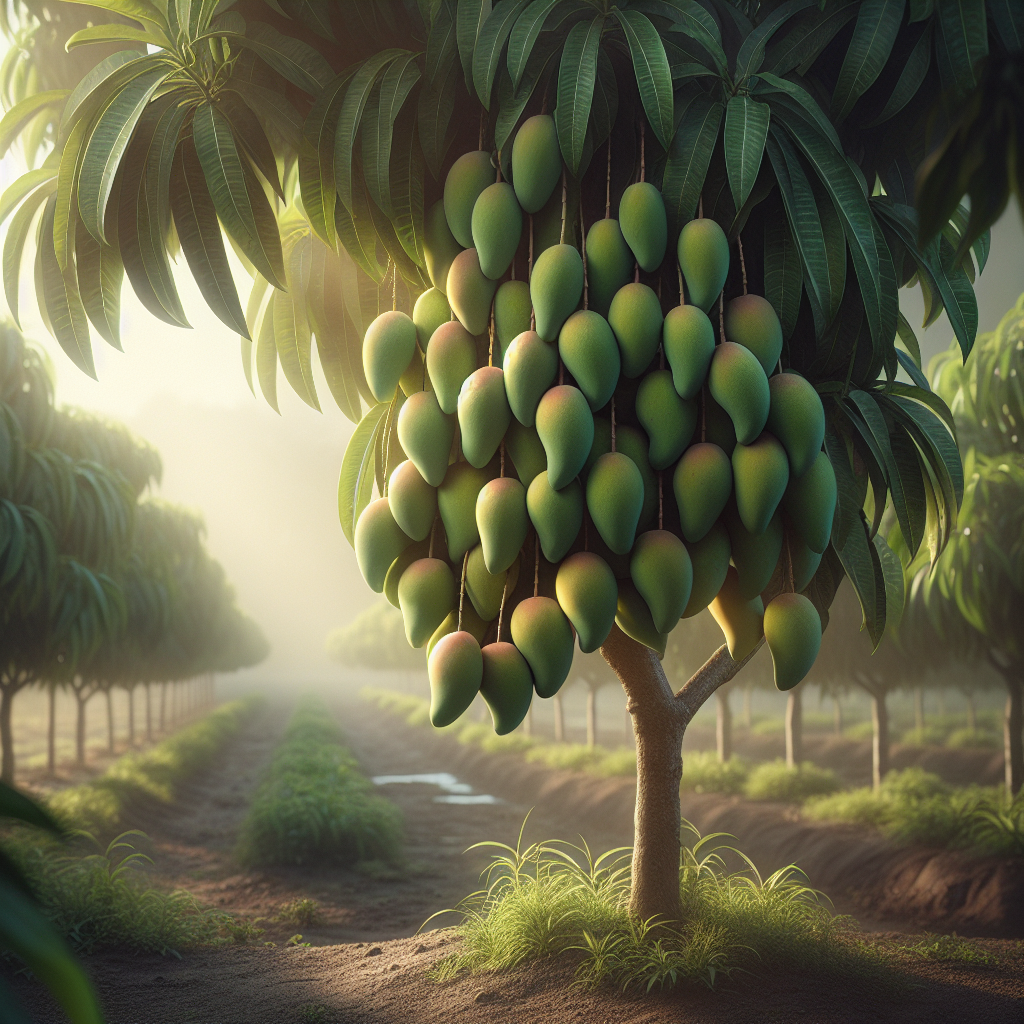
Introduction to Amrapali Mango
Developed in India by hybridizing Dashehari with Neelum, this cultivar is widely recognized as one of the most important compact mango selections for small orchards, backyard gardens, and high-density planting systems. Its breeding goal was practical as much as sensory: combine excellent dessert quality with regular bearing and a tree architecture that is easier to manage than vigorous traditional mango types.
The tree is naturally semi-dwarf to dwarf, forming a dense, rounded canopy with relatively restrained internodal elongation. That compact habit is one of its greatest agronomic advantages because it lowers pruning costs, simplifies spraying and harvesting, and allows more trees per unit area than highly vigorous cultivars. Fruit are generally medium-sized, borne in clusters, and known for deep orange flesh, high total soluble solids, good keeping quality relative to many table mangoes, and a pleasantly rich aroma. The stone is relatively small compared with the edible flesh, which improves pulp recovery.
A notable characteristic is regular and often heavy bearing under good management, though excessive cropping can reduce individual fruit size if nutrition, irrigation, and thinning are neglected. Because the canopy can become crowded and the crop load substantial, professional cultivation depends on balancing vegetative growth and reproduction. For broader background on the species, see mango basics. Orchardists who want to improve root-zone structure and long-term fertility will also benefit from principles outlined in soil health strategies.
Botanical Profile of Amrapali Mango
This cultivar belongs to the family Anacardiaceae and shares the evergreen, long-lived habit typical of cultivated mango. The tree produces leathery, lanceolate leaves that emerge coppery-red to bronze when young, later maturing to dark green. Flushes of growth occur in waves, especially after pruning, rainfall, or improved nutrition. Flowering occurs on terminal panicles, usually during the dry, cooler part of the year in suitable tropical and subtropical climates.
Its hybrid parentage explains much of its field behavior. From Dashehari it inherits dessert quality and flesh character; from Neelum it gains better regularity of bearing and a more manageable growth pattern. Trees generally remain shorter than many seedling or vigorous grafted mangoes, often making them suitable for spacings that would be too tight for sprawling cultivars such as some traditional orchard types. Despite the compact stature, the canopy can become very dense, which is both an advantage and a liability: it protects fruit from sunburn but can create shaded, humid interiors where Anthracnose, Scale insects, and poor flowering may become more likely.
Fruit shape is typically oblong to ovate-oblong. Skin color at maturity may remain greenish with yellow undertones rather than developing the dramatic external blush some export varieties show, so harvest decisions should not rely on color alone. The flesh is firm, nearly fiberless to low-fiber, richly colored, and notably sweet when properly ripened. Brix often rises to premium dessert levels under dry ripening conditions and balanced potassium nutrition. The seed is comparatively thin, which is one reason this variety is appreciated for table use and processing.
In flowering biology, it behaves as a largely cross-compatible mango but does not require a second cultivar to set fruit. Even so, insect activity around bloom can improve fruit set in some environments. Alternate bearing is generally less severe than in many mango cultivars, yet poor nutrition, moisture stress at the wrong time, or unmanaged overcropping can still trigger biennial tendencies.
Soil, pH, and Climate Requirements for Amrapali Mango
The ideal soil is deep, well-drained, aerated loam to sandy loam with moderate water-holding capacity and no hardpan within at least 1 to 1.5 meters. Mango roots are extremely intolerant of chronic waterlogging. For this cultivar, which is often planted at higher density, drainage matters even more because close planting can intensify humidity and root-zone competition. If water remains in the planting pit longer than 24 hours after heavy irrigation or rain, the site is marginal and should be raised into mounds or ridges before planting.
An optimum pH range is about 5.5 to 7.5, with best nutrient availability usually around 6.0 to 7.0. It can tolerate slightly alkaline soils, but micronutrient deficiencies, especially zinc and iron, become more common above pH 7.8. In calcareous soils, leaves may show interveinal chlorosis on young flushes, reduced leaf size, and weak terminal growth. In acidic soils below pH 5.0, aluminum stress and phosphorus fixation may limit establishment. Corrective liming or gypsum-based reclamation should be completed before orchard establishment whenever possible.
Climate should be tropical to warm subtropical, with a pronounced dry period encouraging floral induction. Optimal mean temperatures for growth are roughly 24-30°C. Mature trees tolerate hotter weather if soil moisture is adequate, but temperatures above 40°C during flowering can reduce pollen viability and fruit set. Young trees are sensitive to frost; even brief exposure near 0°C can scorch leaves and kill tender shoots. Mature trees may survive light cold events, but floral damage can destroy the crop.
Annual rainfall of 750-2500 mm can support production if drainage is excellent and the wettest period does not coincide with peak bloom. Persistent rain, fog, or high humidity during flowering strongly increases Anthracnose and Powdery mildew pressure. Dry weather from bud break through early fruit set is highly favorable. Wind protection is important because storm damage can split limbs in heavily laden trees and abrasion can blemish fruit.
For irrigation scheduling, avoid both drought shock and saturation. In field terms, the root zone should remain moist but never anaerobic. A practical target is to maintain soil near 60-80% of field capacity during establishment and fruit enlargement, then reduce irrigation moderately before flowering in climates where controlled moisture stress helps induction. Overwatering signs include yellowing older leaves, a sour smell near the basin, slow flush maturation, blackened feeder roots, gummosis near the trunk base, and unusually soft vegetative growth with poor flowering. Underwatering signs include dull, folded leaves by midday that do not recover by evening, tip burn on young flushes, fruit drop, and undersized fruit.
Step-by-Step Planting & Propagation
Commercially and horticulturally, this cultivar should be propagated by grafting, not by seed, if true-to-type performance is desired. Veneer grafting, epicotyl grafting, or softwood grafting onto healthy polyembryonic or regionally adapted rootstocks is standard. Seedling propagation produces variable offspring and is unsuitable when predictable dwarfness, fruit quality, and bearing habit are required.
Begin with certified disease-free grafted plants, ideally 8-12 months old, with a well-healed graft union, straight central stem, and active but not overly lush growth. Reject plants with circling roots, bark cracking at the union, dieback, or thick weed matting in the nursery container.
Site preparation should start several weeks in advance. Clear perennial weeds, test soil, and improve drainage if necessary. In heavy soils, create raised planting platforms 30-60 cm above grade. Dig pits approximately 60 x 60 x 60 cm in moderate soils, larger in poor or compacted ground. Refill with topsoil mixed with 15-25 kg well-decomposed farmyard manure or compost, 1-2 kg neem cake if available, and a modest starter dose of rock phosphate where phosphorus is low. Avoid direct contact between roots and concentrated fertilizers.
Recommended spacing depends on training intensity. In conventional systems, 6 x 6 m or 7 x 7 m works well. In high-density systems, 4 x 2.5 m, 4 x 3 m, or similar layouts may be used, but only with disciplined annual pruning, nutrition, and irrigation. The natural compactness of this cultivar makes it more suitable than vigorous mangoes for such arrangements.
Plant at the onset of the rainy season in well-drained regions or post-monsoon where excess wetness is a risk. In irrigated dry zones, early spring planting is also successful. Position the graft union at least 15-20 cm above the final soil line. Planting too deep invites collar rot and weak establishment. After backfilling, gently firm the soil, create a shallow basin, irrigate thoroughly, and mulch while keeping mulch 15 cm away from the trunk.
Stake young trees in windy sites. Head back broken twigs, but avoid severe top pruning at planting. Remove any flowers that appear in the first 1-2 years so the tree directs resources into framework development.
Care & Maintenance regimes for Amrapali Mango
Training should begin immediately after establishment. Because the canopy tends to become compact and crowded, develop 3-4 well-spaced primary scaffold branches starting 60-100 cm above ground. Remove weak, crossing, inward-growing, or very low shoots. The goal is a low, open, evenly balanced canopy that admits light into the interior without exposing scaffold limbs to severe sunburn.
Pruning is best done after harvest. Remove deadwood, diseased shoots, and congested inner branches. In high-density systems, annual size control is essential: lightly head back terminals, reduce tree height to a manageable level, and maintain lateral spread within alley space. Avoid harsh pruning immediately before expected flowering, as heavy vegetative regrowth can suppress bloom.
Nutrient management should be age-based and soil-test-guided. Young trees need modest but frequent feeding to support root and canopy establishment. Mature bearing trees need larger amounts, especially nitrogen for canopy renewal, potassium for fruit filling and quality, and secondary plus micronutrients for consistent flowering and healthy flushes. A practical orchard approach is to split fertilizer into 2-4 applications: post-harvest, pre-flowering if needed, fruit set, and fruit enlargement. Excess nitrogen late in the season produces vigorous leaf flushes at the expense of flowering and may worsen pest susceptibility.
Organic matter is especially useful. Apply 20-50 kg well-rotted compost or manure annually around mature trees, depending on size and soil condition, distributed under the canopy drip line rather than piled at the trunk. Supplement with neem cake or oilseed meals where available. Zinc, boron, and iron deficiencies are common in many mango soils; foliar correction is often faster than soil application. Zinc deficiency appears as small leaves, shortened internodes, and rosetting. Boron shortage can impair flowering and fruit retention.
Irrigation should follow tree age and phenological stage. Newly planted trees may need watering every 3-5 days in hot dry weather on sandy soils, or every 7-10 days in heavier soils, always adjusted to actual moisture. Once established, deep irrigation at wider intervals is better than frequent shallow sprinkling because feeder roots should occupy a broad, oxygenated zone. During flowering, avoid excessive irrigation that promotes vegetative flushing and disease-conducive humidity. After fruit set, maintain steady moisture; erratic watering can increase fruit drop and reduce final size. During fruit enlargement, moisture stress often leads to smaller fruit, less pulp, and lower marketable yield.
Mulching with dry leaves, straw, or composted biomass helps stabilize soil temperature, suppress weeds, and reduce evaporation. Keep the mulch ring broad and refreshed, but do not let it touch the trunk. Weed control is particularly important in the first 3 years; weeds directly competing in the basin can reduce growth dramatically.
Fruit thinning is not always practiced in mango, but with this cultivar's tendency toward clustered heavy bearing, selective thinning of malformed, diseased, or overcrowded fruitlets can improve size uniformity and reduce limb breakage. Support overloaded branches where necessary.
Pests, Diseases & Organic Management
Fruit fly is often the most economically damaging pest in many mango-growing regions. Adult females puncture fruit to lay eggs, and larvae feed inside, causing internal breakdown and premature drop. Orchard sanitation is the first line of defense: collect fallen fruit daily, destroy infested fruit, and avoid leaving culls in the field. Use methyl eugenol traps for male monitoring and suppression where appropriate, combined with protein bait sprays allowed under local organic standards.
Mango hoppers attack inflorescences and tender shoots, sucking sap and excreting honeydew that supports sooty mold. Severe infestation reduces fruit set. Pruning to open the canopy, avoiding excess nitrogen, and encouraging natural enemies help. Neem-based sprays can suppress early populations when applied carefully during pre-bloom or early bloom, though timing must avoid harming pollinators.
Scale insects and Mealybugs can build up in dense canopies and on neglected trunks. They weaken trees, contaminate surfaces with honeydew, and predispose shoots to sooty mold. Mechanical removal of heavily infested twigs, trunk banding against mealybug crawlers where relevant, and conservation of predatory beetles and lacewings are valuable. Ant control is often necessary because ants protect sap-sucking pests.
Anthracnose, caused mainly by Colletotrichum species, is one of the most important diseases, especially in humid climates. It affects panicles, leaves, twigs, and fruit, causing blossom blight, black lesions, fruit rot, and post-harvest losses. Management depends heavily on airflow, sanitation, and timing. Open the canopy, remove dead infected twigs, avoid overhead irrigation, and protect flowers and young fruit with approved copper or biological sprays according to local regulations and weather risk.
Powdery mildew is favored by humid nights and dry days during bloom. It appears as whitish fungal growth on panicles, flowers, and small fruitlets, causing flower drop and poor set. Sulfur-based products, applied preventively at safe temperatures, are commonly used in organic-compatible programs. Once infestation is advanced, control is less effective.
Stem-end rot and Post-harvest fungal decay often originate from orchard infections or rough harvesting. Maintaining calcium balance, preventing fruit injury, harvesting at the correct maturity, and handling gently are as important as field sprays.
Physiological problems also matter. Fruit drop can result from poor pollination, nutrient imbalance, drought, sudden rain after dry spells, hopper damage, or overbearing. Spongy tissue is less notorious in this cultivar than in some others, but uneven ripening can still occur under heat stress and improper storage.
Harvesting, Curing & Optimal Storage
Harvest maturity should be judged by a combination of days from fruit set, shoulder development, fullness of cheeks, slight lightening of ground color, and internal maturity rather than external color alone. For local fresh markets, fruit can be picked when physiologically mature but still firm. For shipping or longer holding, harvest at mature-green stage before full softness develops.
Use clippers instead of pulling fruit by hand. Leave a short pedicel initially, then de-sap properly to prevent latex burn on the skin. Mango sap can stain and injure fruit surfaces, lowering market value. A common practice is to place harvested fruit stem-end downward on racks or padded surfaces for 20-30 minutes so sap drains away without smearing the peel.
Sort fruit carefully, removing damaged, diseased, undersized, or insect-stung specimens. Wash only if water sanitation is reliable; otherwise, poorly managed washing can spread post-harvest pathogens. Shade curing for several hours after harvest helps stabilize fruit temperature and reduce field heat. Do not leave harvested fruit in direct sun.
For ripening, hold mature fruit at about 20-24°C with good ventilation. Lower temperatures slow ripening but can impair flavor if too cold. Chilling injury may occur below about 10-13°C depending on maturity stage, expressed as uneven ripening, skin pitting, grayish flesh, and off-flavor. For short-term storage, mature-green fruit generally keep best around 12-13°C with 85-90% relative humidity. Fully ripe fruit are best consumed quickly and may hold only a few days even under refrigeration.
Because this cultivar has rich sweetness and strong flavor, harvesting too early sacrifices much of its character. A professional grower should periodically cut sample fruit before main harvest to verify flesh color development, dry matter, sweetness progression, and aroma.
Companion Planting for Amrapali Mango
Companion planting is most useful in the early orchard years, when sunlight still reaches the inter-row space and root competition remains manageable. The best companions are low-growing, non-invasive, and beneficial for pollinators, soil cover, or pest balance rather than heavy nutrient competitors.
Thai Basil is an excellent orchard-edge or basin-margin companion because its flowers attract pollinators and beneficial insects while its modest root system usually does not aggressively compete with young mango roots if kept outside the immediate trunk zone. Clover is valuable as a living mulch in wider alleys, helping suppress erosion, moderate soil temperature, and contribute biologically fixed nitrogen when managed by mowing before it becomes excessively competitive. Yarrow supports beneficial insects and can improve biodiversity in orchard borders. Nasturtium functions well as a low, flowering groundcover that helps occupy bare soil and attract predatory insects.
Avoid tall, water-hungry, or densely shading intercrops close to the tree row, especially once trees begin significant fruiting. Also avoid companions that require frequent overhead irrigation or heavy cultivation, as both practices can increase disease pressure and root disturbance. In mature, closely spaced orchards, companion plants should be limited mostly to managed alley covers and beneficial border species rather than intense intercropping within the root zone.