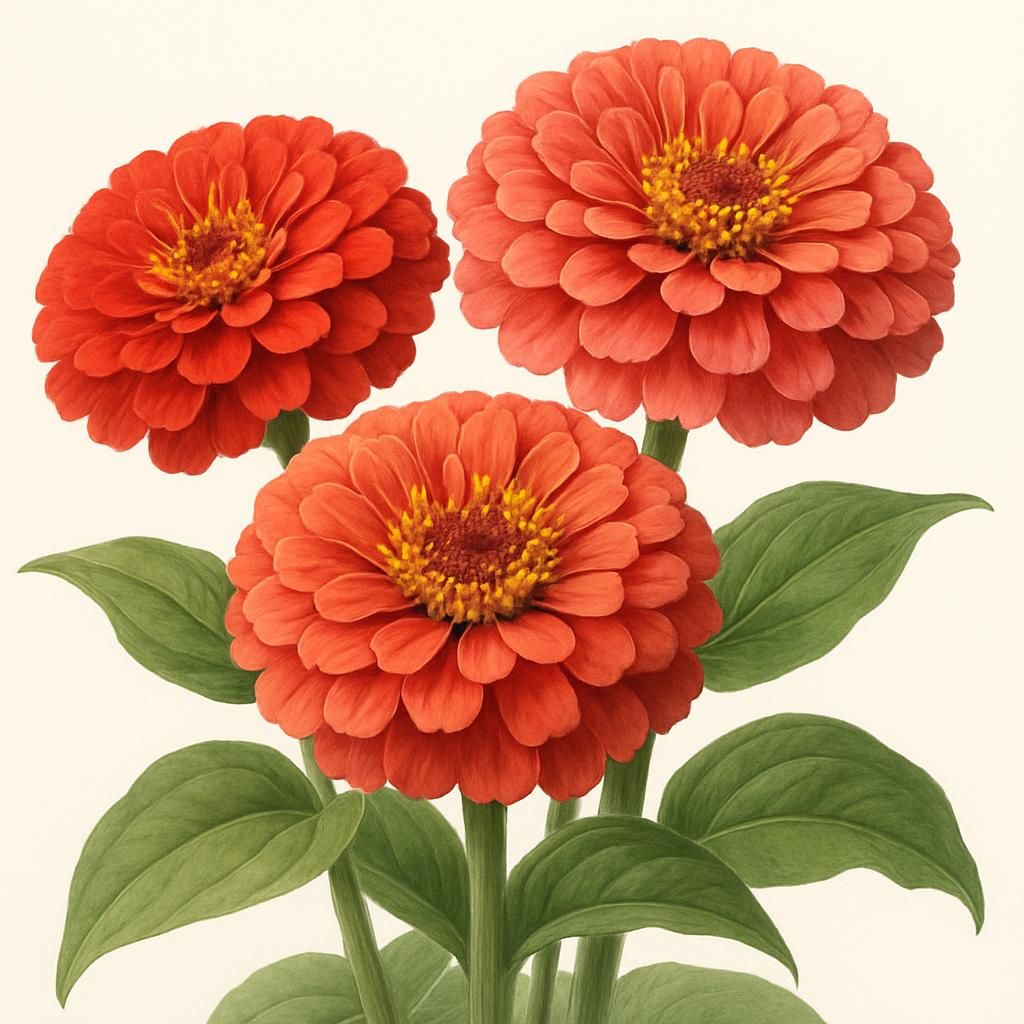
Introduction to Zinnia
Zinnia (Zinnia elegans) ranks among the most reliable warm-season annuals for cut-flower production and landscape color. Its rapid 60–75-day cycle, wide color palette, and tolerance of high temperatures make it a staple in both small-scale and commercial operations. Because zinnias respond dramatically to spacing, fertility, and consistent harvesting, growers who follow disciplined regimes routinely achieve 15–25 stems per plant over an 8–10 week window.
Botanical Profile of Zinnia
Zinnia elegans belongs to the Asteraceae family and originates from hot, semi-arid regions of Mexico and Central America. Plants produce opposite, lanceolate leaves and terminal capitula (flower heads) 5–12 cm across. Modern hybrids range from 20 cm dwarfs to 120 cm cut-flower cultivars. The composite flower consists of showy ray florets surrounding a dense central disk of fertile florets that attract bees, butterflies, and beneficial insects.
Soil, pH, and Climate Requirements for Zinnia
Zinnias demand full sun (minimum 6–8 hours) and well-drained soil. They tolerate a broad temperature range but resent prolonged humidity above 85 % RH, which favors foliar disease.
| Parameter | Ideal Range | Notes |
|---|---|---|
| Soil Type | Loamy sand to sandy loam | 20–30 % organic matter improves drainage |
| Soil pH | 6.0–7.0 | Below 5.8 increases aluminum toxicity |
| Temperature (Day) | 24–32 °C | Growth stalls below 15 °C |
| Temperature (Night) | 18–22 °C | Frost kills plants at −1 °C |
| Spacing (Cut Flower) | 20–30 cm between plants | Rows 45–60 cm apart |
| Spacing (Landscape) | 30–45 cm | Prevents lodging and improves airflow |
Step-by-Step Planting & Propagation
- Sow seed indoors 4–6 weeks before last frost at 21–24 °C; germination occurs in 5–7 days.
- Harden seedlings for 7–10 days, then transplant after soil reaches 18 °C.
- Direct sow after danger of frost when soil is 18 °C; sow 6 mm deep, thin to final spacing.
- For succession, sow every 2–3 weeks until 8 weeks before first expected frost.
Care & Maintenance regimes for Zinnia
Consistent moisture, balanced fertility, and regular harvesting keep plants productive and disease-free.
| Practice | Schedule | Rate / Method |
|---|---|---|
| Watering | 2–3× weekly at base | 2.5–3.8 cm per week; avoid overhead irrigation |
| Fertilizer | Week 2, Week 5, Week 8 | 100 ppm N liquid feed (10-10-10) or 5-10-10 side-dress |
| Pruning | Weekly from week 4 onward | Pinch terminal bud at 4–6 leaf stage; harvest when 50 % petals open |
Pests, Diseases & Organic Management
Common issues include Aphids, Spider Mites, Powdery Mildew, and Botrytis. Scout weekly. Release lady beetles for aphids; apply horticultural oil or neem for mites. Maintain 30 cm spacing and drip irrigation to reduce foliar humidity. Remove and destroy infected foliage at first sign of powdery mildew; rotate crops on a 3-year cycle.
Harvesting, Curing & Optimal Storage
Harvest in early morning when 50–75 % of petals are open. Use clean, sharp shears; immediately place stems in 2–4 °C water with floral preservative. Grade by stem length (40 cm, 50 cm, 60 cm). Store upright in 90–95 % humidity at 2–4 °C for up to 7 days. For market bunches, recut stems underwater and sleeve in perforated cellophane.
Companion Planting for Zinnia
Pair zinnias with Tomato, Cucumber, and Marigold to attract pollinators and beneficial insects while repelling nematodes. Avoid planting near Fusarium-susceptible hosts without rotation. Interplant with Nasturtium for aphid diversion.