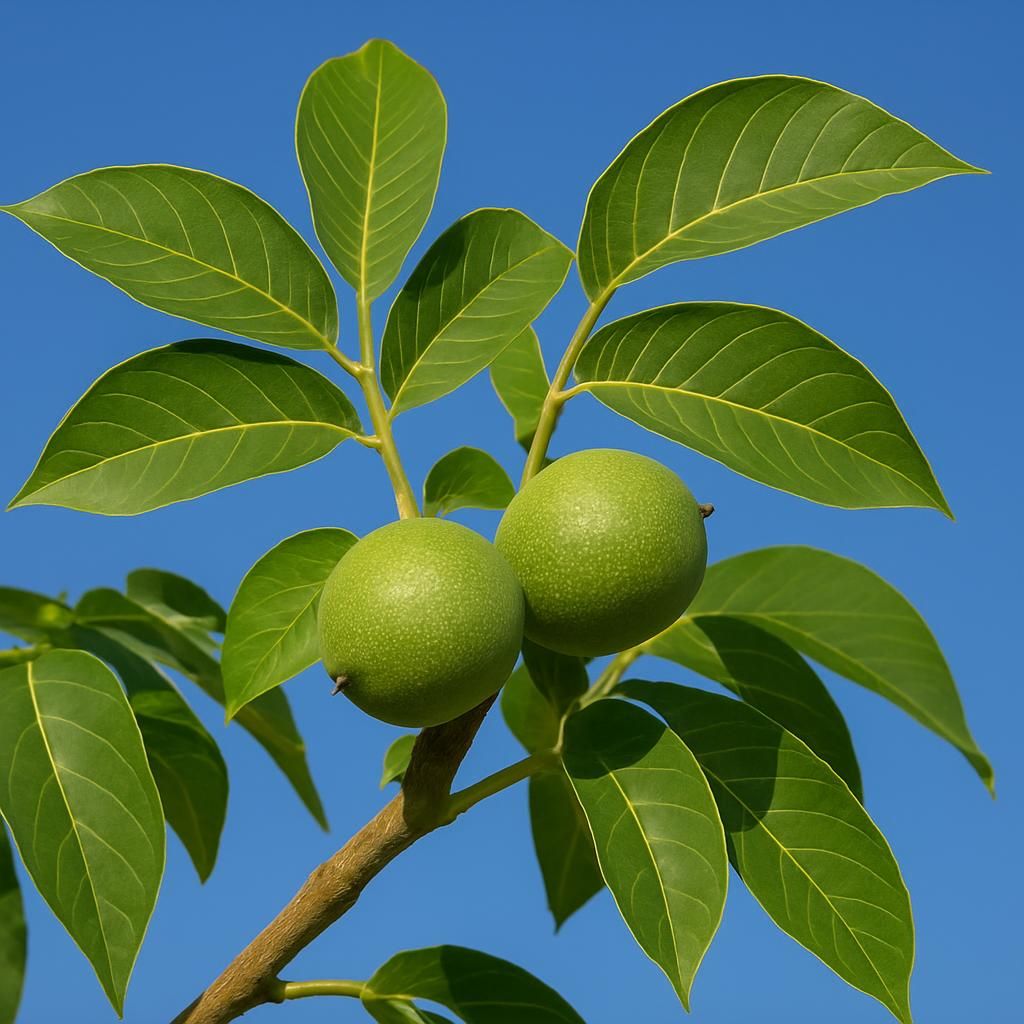
Introduction to Walnut (English - Tulare)
The Tulare cultivar of English walnut (Juglans regia) was developed in California for superior nut size, high kernel percentage, and late leafing that reduces spring frost risk. It has become a preferred choice for both commercial orchards and serious home growers seeking reliable production with lower disease pressure. Tulare trees produce large, light-colored kernels with excellent flavor and store well when properly cured.
Botanical Profile of Walnut (English - Tulare)
Tulare is a deciduous tree in the Juglandaceae family that reaches 40–60 feet at maturity with a broad, spreading canopy. The compound leaves emerge late in spring, reducing vulnerability to late frosts. Male catkins and female flowers appear on the same tree, though cross-pollination from compatible cultivars such as Chandler Walnut improves set. The tree produces large, thin-shelled nuts with high kernel fill.
Soil, pH, and Climate Requirements for Walnut (English - Tulare)
Tulare walnuts perform best in deep, fertile, well-drained soils. The cultivar tolerates a range of conditions but yields highest when provided optimal parameters.
| Parameter | Ideal Range | Notes |
|---|---|---|
| Soil Type | Loam to sandy loam | Deep profile (>5 ft) preferred |
| Soil pH | 6.0–7.5 | Avoid alkaline soils causing zinc deficiency |
| Temperature Range | 25–95 °F (growing season) | Late leafing reduces frost risk |
| Annual Chill Hours | 800–1,200 | Required for uniform bud break |
| USDA Hardiness Zones | 5–9 | Protect young trees in zone 5 |
| Annual Rainfall | 30–45 inches | Supplemental irrigation essential in drier areas |
Step-by-Step Planting & Propagation
Plant bare-root or container-grown Tulare trees in late winter to early spring while dormant. Select a site with full sun and protection from strong winds. Dig holes twice the width of the root ball and amend heavy soils with organic matter. Space trees 30–35 feet apart in commercial orchards or 25 feet in home settings. Stake young trees and apply a 3–4 inch layer of organic mulch, keeping it away from the trunk. Water deeply after planting and maintain consistent moisture for the first two seasons.
Care & Maintenance regimes for Walnut (English - Tulare)
Consistent irrigation, balanced nutrition, and annual pruning are essential for sustained productivity. The following table outlines recommended schedules.
| Season | Watering Schedule | Fertilizer Application | Pruning Schedule |
|---|---|---|---|
| Spring | Deep irrigation every 10–14 days | Apply 1–2 lbs N per tree at bud swell | Remove dead wood; shape scaffold branches |
| Summer | Increase to weekly deep watering | Side-dress with potassium if deficiency | Light summer pruning for light penetration |
| Fall | Reduce frequency as leaves yellow | Apply compost or aged manure | Remove crossing branches; structural cuts |
| Winter | Minimal unless drought persists | Soil test and adjust pH if needed | Dormant pruning for structure and airflow |
Pests, Diseases & Organic Management
Tulare shows good resistance to walnut blight caused by Xanthomonas arboricola pv. juglandis, but remains susceptible to Walnut husk fly, Walnut aphid, and occasional Codling moth damage. Monitor with traps and apply organic controls such as kaolin clay, neem oil, or spinosad during peak flight periods. Maintain orchard sanitation by removing fallen husks and practicing Crop Rotation Realities: 6 Organic Patterns That Deliver for Small Farms to reduce pest pressure.
Harvesting, Curing & Optimal Storage
Harvest when the hulls begin to split and the kernel reaches 8–10% moisture. Shake or knock nuts from the tree and remove hulls immediately. Spread nuts in a single layer in a shaded, well-ventilated area for 2–3 weeks until kernels reach 5–8% moisture. Store in-shell nuts in cool, dry conditions (32–40 °F, <60% RH) for up to 12 months. Shelled kernels keep best when vacuum-sealed and frozen.
Companion Planting for Walnut (English - Tulare)
Walnuts produce juglone, which inhibits many plants. Compatible companions include Clover, Garlic, and certain grasses that tolerate juglone. Avoid planting tomatoes, peppers, and potatoes near mature trees. Use deep-rooted cover crops such as Hairy vetch in alleyways to improve soil structure without competing for resources.