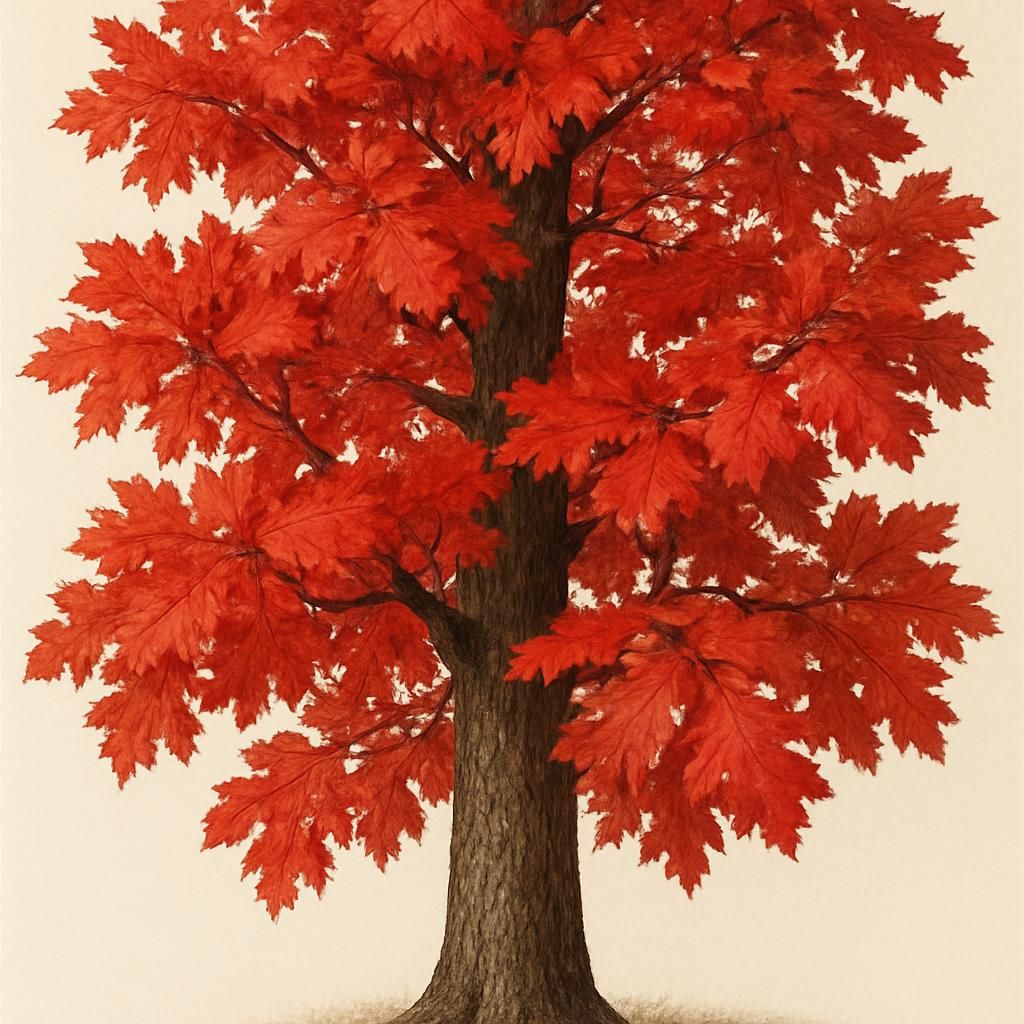
Introduction to southern red oak
Southern red oak (Quercus falcata) is a cornerstone species of southeastern hardwood forests, prized by foresters, farmers, and landowners for its straight bole, durable wood, and ecological value. The tree reaches 60–100 feet at maturity with a broad, rounded crown and distinctive three-lobed leaves that turn deep red in autumn. Its acorns provide critical food for deer, turkeys, and squirrels, while its timber is used for flooring, furniture, and barrel staves. Because it tolerates a wide range of soils and grows rapidly on good sites, southern red oak is increasingly planted in agroforestry systems and managed woodlots.
Botanical Profile of southern red oak
Southern red oak belongs to the red oak group (section Lobatae) within the beech family (Fagaceae). It features alternate, simple leaves with 3–7 pointed lobes and bristle tips, dark green above and paler, pubescent beneath. The tree produces separate male and female flowers in spring; female flowers develop into oval acorns maturing in two years. Bark is dark gray to nearly black with shallow fissures on older trunks. Southern red oak is wind-pollinated and moderately shade-intolerant, requiring full sun for optimal growth.
Soil, pH, and Climate Requirements for southern red oak
Southern red oak performs best on well-drained upland sites but tolerates a broad spectrum of textures provided drainage is adequate. It prefers deep, fertile loams but succeeds on clay or sandy soils if compaction is avoided.
| Parameter | Ideal Range | Notes |
|---|---|---|
| Soil Texture | Loam to sandy loam | Avoid heavy compacted clays |
| Soil pH | 5.0–6.5 | Tolerates up to 7.0; acid soils preferred |
| Drainage | Well-drained | Standing water for >48 hours reduces survival |
| Annual Rainfall | 40–60 inches | Supplemental irrigation helpful first 2 years |
| Temperature Range | −20 °F to 100 °F | Hardy in USDA zones 6–9 |
| Elevation | Sea level to 2,500 ft | Performs well on slopes and ridges |
Step-by-Step Planting & Propagation
- Site selection: Choose full-sun locations with at least 6 hours of direct light and 40+ inches of annual precipitation.
- Soil testing: Collect samples to 12 inches; amend only if pH < 4.5 with agricultural lime at 1–2 tons/acre.
- Seed collection: Gather sound acorns in October–November; float test and discard floaters.
- Stratification: Mix acorns with moist sand or peat and store at 33–38 °F for 60–90 days.
- Direct seeding: Plant acorns 1–2 inches deep, 6–8 inches apart in rows 10 ft wide; cover with 1 inch of mulch.
- Seedling planting: Use 1-0 or 2-0 bare-root seedlings in late winter; space 10–12 ft apart in rows 12–16 ft wide.
- Protection: Install 4-ft tree shelters or wire cages to prevent deer browse.
Care & Maintenance regimes for southern red oak
During the first three years, focus on weed control, supplemental water, and formative pruning. After canopy closure, shift to thinning and sanitation.
| Task | Frequency / Timing | Rate or Method |
|---|---|---|
| Watering | Weeks 1–8 after planting | 5–10 gal per tree twice weekly if <1" rain |
| Fertilizer | Year 1 spring & fall | ½ lb 10-10-10 broadcast in 3-ft radius |
| Fertilizer | Year 2–3 spring | 1 lb 10-10-10 per inch trunk diameter |
| Mulch | Spring after planting | 3–4 inches wood chips, keep 6" from trunk |
| Pruning | Dormant season, years 2–5 | Remove lower limbs up to 8 ft; retain central leader |
| Thinning | Age 15–25 | Remove 25–30 % of stems to favor crop trees |
Pests, Diseases & Organic Management
Southern red oak faces pressure from several native insects and pathogens. Monitor for Oak wilt (Bretziella fagacearum) by scouting for vascular streaking and wilting crowns; prevent spread by avoiding pruning during April–July. Two-lined chestnut borer and red oak borer cause branch dieback; maintain tree vigor through mulching and avoid compaction. Gypsy moth and variable oakleaf caterpillar defoliate in outbreak years; Bacillus thuringiensis (Bt) sprays timed at early instars provide effective organic control. Phytophthora root rot is mitigated by planting on well-drained sites and avoiding over-irrigation.
Harvesting, Curing & Optimal Storage
Timber harvest typically occurs at 60–80 years when diameter at breast height reaches 18–24 inches. Select crop trees with straight boles and minimal defects. Fell during dormant season to reduce checking. Immediately limb and buck logs to length; transport to sawmill within 30 days to limit stain fungi. For acorn collection, gather in October, air-dry 7–10 days on screens, then store in breathable bags at 35–40 °F with 30–40 % relative humidity for up to one year.
Companion Planting for southern red oak
Southern red oak integrates well into multi-story systems. Understory Clover and Hairy vetch fix nitrogen and suppress weeds. Nasturtium and Marigold repel aphids and attract beneficial insects. In agroforestry layouts, pair with Pecan or Persimmon (Fuyu) at wide spacing to diversify income. Avoid planting under dense canopies of Black Walnut due to juglone sensitivity.