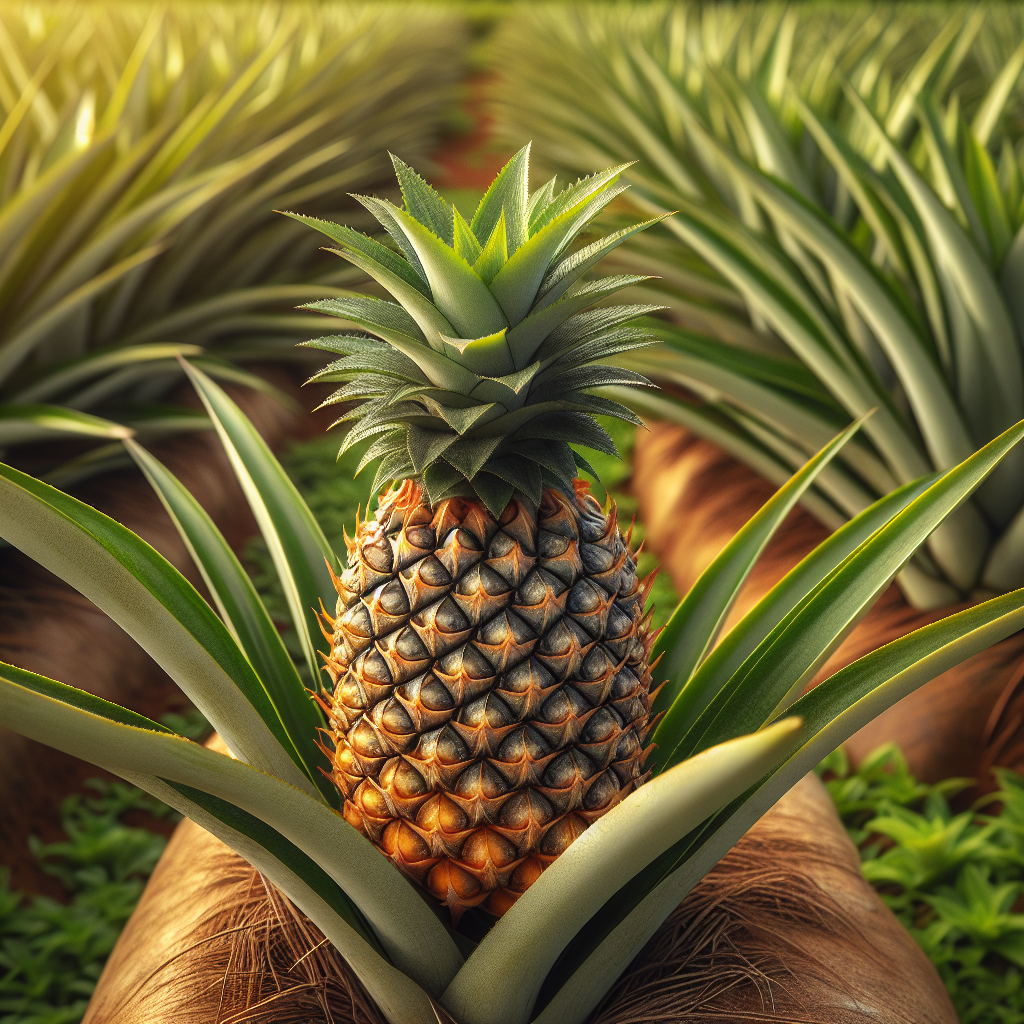
Introduction to Smooth Cayenne Pineapple
One of the foundational pineapple types in global tropical horticulture, this cultivar group helped shape the modern canning and fresh-fruit industries because of its relatively large fruit, low-spined to nearly spineless leaves, broad adaptability, and excellent processing quality. Compared with smaller dessert types, Smooth Cayenne is typically recognized by its robust plant habit, cylindrical to slightly tapering fruit form, pale yellow aromatic flesh, and high juice content.
Historically, it became especially important in plantation systems across Hawaii, the Caribbean, parts of Asia, and Latin America. It was favored not only for eating fresh but also for slicing, canning, juice production, and export handling. Although newer hybrids have replaced it in some commercial regions, Smooth Cayenne remains a benchmark pineapple for agronomic study because many cultivation recommendations for pineapple were first standardized around this group. For general species background, see our Pineapple guide.
This is not a crop that rewards neglect. While pineapple is often described as tough and drought tolerant, premium Smooth Cayenne fruit requires disciplined management of drainage, nutrition, weed pressure, and disease prevention. The plant stores water in its tissues and can survive short dry spells, but irregular moisture often leads to smaller fruit, poor sugar accumulation, delayed maturity, or internal quality defects. Its commercial value lies in uniformity, and uniformity is created by consistent field management.
Botanical Profile of Smooth Cayenne Pineapple
This cultivar belongs to the bromeliad family, Bromeliaceae, and is a terrestrial rosette-forming perennial grown as a fruit crop. The plant consists of a dense spiral of waxy, fibrous leaves arising from a short stem. In Smooth Cayenne, leaves are generally broad, arching, and greener than some more heavily armed types. Margins are often smooth or only lightly spined, which is one reason the group gained popularity in larger-scale production.
A mature vegetative plant commonly reaches 90-150 cm across and roughly 60-120 cm tall depending on fertility, spacing, and climate. The root system is relatively shallow and concentrated in the upper soil profile, often within the top 15-30 cm, though roots can penetrate deeper in loose, aerated soils. This shallow rooting pattern explains why drainage and surface moisture stability are so critical.
The inflorescence emerges from the plant center after floral induction, whether naturally triggered by plant age and seasonal conditions or artificially induced in commercial systems. Numerous individual flowers fuse with the central axis and associated bracts to form the compound fruit. After fruiting, the mother plant does not fruit again, but it produces vegetative propagules including slips, suckers, and ratoons, which are the basis for subsequent planting material.
Smooth Cayenne fruit is usually medium to large, often 1.5-2.5 kg under good management and sometimes more in fertile, well-managed fields. Flesh is pale yellow to yellow, juicy, and moderately fibrous with a pronounced sweet-tart balance. The soluble solids can be excellent when the crop is grown under high light and moderate but consistent moisture. Acidity remains an important part of the flavor profile, especially if harvested slightly early for transport.
Because the leaves form a central cup and tight heart, the plant can trap water after rain or overhead irrigation. This is a biological advantage in dry conditions but also a disease risk when cool, stagnant, or contaminated moisture lingers in the crown. Good airflow and careful irrigation method selection matter more than many new growers realize.
Soil, pH, and Climate Requirements for Smooth Cayenne Pineapple
This crop thrives in warm, humid, frost-free conditions with abundant sunlight. Optimal temperature for vegetative growth is generally 22-32°C. Growth slows noticeably below about 18°C, and prolonged exposure below 10°C can stunt plAnts, injure leaf tissue, and delay fruiting. Frost can kill the growing point outright. In very hot districts above 35°C, plAnts usually survive, but fruit skin sunscald, reduced fruit fill, and stress-related irregularity become more common if soil moisture fluctuates.
Annual rainfall of 1000-1500 mm is workable when drainage is excellent and rainfall distribution is not excessively concentrated. Pineapple can also be grown successfully in drier climates with irrigation. Smooth Cayenne often performs best where there is a distinct warm growing period with high light intensity. Bright sun improves carbohydrate production and fruit sweetness, but newly planted propagules may benefit from a brief establishment period without severe midday stress.
The ideal soil is sandy loam to loam with very sharp drainage, high aeration, and moderate organic matter. Heavy clay is risky unless planted on raised beds or ridges because oxygen-starved roots rapidly lose vigor and become susceptible to rot. Water should move through the root zone quickly; if a hole remains waterlogged 24 hours after heavy irrigation or rain, the site is generally unsuitable without major modification.
Preferred pH is slightly acidic, around 4.5-6.5, with 5.0-5.8 often considered especially favorable. Pineapple tolerates acidity better than many fruit crops, but highly alkaline soils frequently induce micronutrient imbalance, especially iron and manganese deficiency. On calcareous soils, leaves may become pale, striped, or chlorotic despite fertilizer application because nutrients are present but unavailable.
Before planting, aim for a friable bed with at least 20-30 cm of loose, weed-free rooting depth. Incorporate well-finished compost sparingly to moderately rather than creating a rich, wet, nitrogen-heavy planting hole. Excessive undecomposed organic matter can hold too much moisture against the stem base and attract rot. If you want broader fertility-building ideas, read soil health strategies.
Drainage is more important than fertility. A moderately fertile, well-drained field will usually outperform a highly fertile but poorly drained field. In commercial plantings, raised beds 15-25 cm high are commonly used in high rainfall zones. Mulch can suppress weeds and reduce soil splash, but keep thick, wet mulch from pressing directly against the basal stem.
Step-by-Step Planting & Propagation
Propagation is vegetative, not normally by seed. The three principal planting materials are crowns, slips, and suckers. Crowns are the leafy tops from harvested fruit; they are easy to obtain but usually slower to reach fruiting. Slips arise on the fruit stalk below the fruit and are often excellent for uniform planting. Suckers arise from leaf axils on the mother plant and are typically the fastest to establish and fruit. In professional systems, large, healthy suckers and slips are preferred for field uniformity.
Select planting material carefully. Choose disease-free propagules from vigorous mother plAnts with no soft base, no foul odor, no black lesions, and no Mealybug infestation. Ideal propagules are medium to large, firm, and well matured rather than very juvenile.
Trim and cure. Remove dead basal leaves to expose 2-4 cm of stem tissue. If roots are old or decayed, trim them away. Cure the propagules in a shaded, airy place for 3-7 days so cut surfaces dry and callus. This simple step greatly reduces basal rot after planting.
Optional sanitation dip. In high-disease areas, growers often use a biological or approved organic sanitation dip such as compost tea from reliable sources, diluted hydrogen peroxide protocols, or hot-water treatment under expert supervision. Avoid improvised treatments that burn living tissue.
Prepare the bed. Form raised rows or ridges if rainfall is heavy. Remove perennial weeds completely before planting because weeding around spiny bromeliads later is labor intensive.
Space according to production goal. A common professional spacing is 25-35 cm between plAnts in-row and 60-90 cm between double rows or bed centers, depending on machinery access, fertility, and target fruit size. Tighter spacing increases plant population but often reduces average fruit size if fertility and irrigation are not scaled accordingly.
Plant at the correct depth. Set propagules deep enough that the exposed stem is covered and the plant stands firmly upright, usually 3-6 cm deep depending on propagule size. Do not bury the leaf bases too deeply, and do not pack wet soil tightly around the crown.
Water lightly after planting. Moistening the root zone is useful, but soaking the planting hole is not. The goal is to settle soil around the stem without saturating it. During the first 2-4 weeks, keep the soil slightly moist, not wet.
Rooting usually begins within several weeks in warm conditions. Establishment is successful when the central leaves resist a gentle tug and new leaf growth appears from the center. If the center pulls out easily or smells fermented, the propagule is rotting.
Care & Maintenance regimes for Smooth Cayenne Pineapple
Water management should be precise rather than generous. Pineapple tolerates moderate dry periods because of its CAM-type physiology, but premium fruit production depends on steady growth. During establishment, maintain moisture in the upper root zone so the soil feels lightly moist at 5-10 cm depth, never muddy or airless. Once established, allow the top few centimeters to dry somewhat between irrigations, but avoid deep drought cycles that cause leaf folding, dull gray-green color, reduced leaf expansion, and slow canopy development.
Overwatering signs are especially important in Smooth Cayenne: persistent wetness around the base, yellowing lower leaves, a sour smell in the bed, blackened stem tissue, crown stagnation, and easy removal of the central spear. In contrast, underwatered plAnts become rigid, narrow, and stressed, with reduced glossiness, shortened internodes, and undersized fruit later on. Drip irrigation or low-volume micro-irrigation is strongly preferred over overhead irrigation because it limits water sitting in the plant heart.
Nutritionally, pineapple is a moderate feeder with relatively high potassium demand during fruit development. Nitrogen supports canopy growth early, but excess nitrogen late in the cycle can create lush, disease-prone plAnts and dilute fruit quality. A balanced fertility approach usually includes split applications of nitrogen and potassium, with smaller but adequate amounts of phosphorus, calcium, magnesium, sulfur, and micronutrients.
A practical professional schedule is to feed lightly but repeatedly rather than heavily and infrequently. During the first 4-6 months, emphasize vegetative growth with moderate nitrogen and potassium. From mid-growth to pre-flowering, maintain strong potassium supply to support eventual fruit size and sugar movement. Foliar feeding is common in pineapple systems, especially for iron, zinc, manganese, and magnesium where soil lock-up is a problem.
Watch the leaves closely. Healthy plAnts are robust green, not excessively dark and soft. Nitrogen deficiency often appears as overall pale growth and reduced leaf size. Potassium deficiency may show as marginal scorching, weak fruit fill, and lower sugar accumulation. Magnesium deficiency can appear as chlorosis on older leaves. On alkaline ground, iron deficiency causes young leaves to yellow while veins remain greener.
Weed control matters because the shallow root system competes poorly with aggressive grasses and creeping weeds. Keep a clean ring or strip around plAnts, especially during the first 5-6 months. Organic mulches, woven ground cover, or shallow hand weeding are all effective. Avoid deep hoeing, which damages feeder roots.
Floral induction occurs naturally as plAnts mature, but in commercial production it is often synchronized to improve harvest uniformity. Organic-scale growers may simply allow natural induction, which usually means a broader harvest window. Fruit maturation often takes roughly 5-7 months after flowering under warm conditions, though local climate can lengthen this considerably.
After harvest, the mother plant declines while producing ratoon material. Select the strongest sucker or ratoon if you plan to carry a second crop, and remove excess shoots to direct energy efficiently. Ratooning can reduce establishment costs, but disease carryover and uneven plant stand are greater risks than with a clean replant.
Pests, Diseases & Organic Management
The most common chronic pest issue is Mealybug infestation, often associated with Ants that protect and spread the insects. Mealybugs weaken plAnts by sucking sap and can transmit wilt-associated disorders. Look for cottony clusters at leaf bases, roots, and around the stem. Control starts with ant management, sanitation, and removal of heavily infested planting material. Beneficial predators help, but severe infestations usually require repeated intervention with horticultural soap or neem-based products applied carefully into protected crevices.
Nematodes can also suppress root function, especially in sandy soils with long pineapple history. Symptoms include weak growth, uneven stands, poor rooting, and reduced fruit size. Rotation, fallowing, organic matter improvement, and clean planting stock are the best organic defenses.
Among diseases, Heart Rot and Root Rot are the most destructive, typically caused by water-favoring pathogens such as Phytophthora spp. Early symptoms include a dull central whorl, wilting despite wet soil, browning at the stem base, and eventual pull-out of the center spear. Prevention is far superior to treatment: use raised beds, avoid planting in depressions, cure propagules before planting, and never let irrigation water pool around the stem.
Fruit Rot can occur from mechanical injury, insect entry points, or prolonged wetness close to harvest. Good airflow, weed control, and careful handling reduce losses. Sunburn on exposed fruit may also occur in very hot, bright locations, especially where plant canopy is sparse due to nutrient imbalance.
Wilt and decline syndromes may appear where planting material is repeatedly recycled without selection. If a block becomes chronically unthrifty, uneven, and virus- or Mealybug-associated, the best response is often rogueing, sanitation, and complete re-establishment from clean material rather than trying to rescue weak plAnts.
Organic management depends on integration, not a single spray. Start with clean propagules, plant into drained soil, suppress Ants, maintain airflow, avoid excess nitrogen, remove diseased plAnts promptly, and keep weeds low. Because pineapple leaves create many hidden niches, scouting should involve physically opening the lower leaf axils and inspecting the basal stem area.
Harvesting, Curing & Optimal Storage
Maturity judgment affects flavor more than almost any other decision. Smooth Cayenne develops best sweetness when allowed to color and ripen substantially on the plant, but shipping requirements may force earlier harvest. For local markets, harvest when the shell changes from green to yellow over one-third to two-thirds of the fruit and the aroma becomes noticeable but not fermented. Eyes become flatter and less angular as the fruit fills.
For more distant transport, fruit may be cut at the early color-break stage, but sugar does not increase dramatically after harvest the way it does in some climacteric fruits. Pineapple softens and colors somewhat, yet its eating quality is fundamentally tied to maturity at picking. Harvesting too early gives attractive but bland fruit.
Use a sharp knife or pruning tool to cut the fruit with a short stem attached. Avoid tearing, twisting aggressively, or dropping fruit, as bruises quickly become infection sites. Harvest in the cool part of the day whenever possible. Field heat should be reduced soon after picking by shade and ventilation.
Curing in the classic root-crop sense is not required, but postharvest conditioning is useful. Keep freshly harvested fruit dry, shaded, and clean for several hours so surface moisture evaporates and minor stem wounds stabilize. Do not stack deeply while warm. Remove obviously damaged or diseased fruit immediately.
Ideal storage is around 7-10°C with high relative humidity, roughly 85-90%. Below this range, chilling injury may appear as internal browning, poor flavor, and skin pitting. At warm room temperatures, ripe fruit deteriorates quickly. Whole fruits generally store for 1-2 weeks under good cool conditions, though best flavor is usually within the first several days after harvest. Once cut, refrigerate promptly and use within a few days.
Companion Planting for Smooth Cayenne Pineapple
Because this crop is shallow-rooted and slow to form full ground cover, the best companions are usually low-growing, non-competitive species that help suppress weeds, attract beneficial insects, or occupy bed edges without creating dense shade. Good companion choices include Thyme, Yarrow, and Clover.
Thyme works well on drier margins and pathways because it stays relatively low, does not cast heavy shade, and can contribute to a cleaner, less weedy planting edge. Yarrow is useful nearby rather than crowded directly into the pineapple row; it attracts pollinators and predatory insects and tolerates lean soils. Clover can function as a living groundcover in wider alleys where rainfall is not excessive and competition is carefully managed.
The key principle is distance and restraint. Pineapple should not be crowded by sprawling vegetables or tall, thirsty companions. Keep companion plAnts in alleys, borders, or designated strips rather than immediately at the base of each plant. Any companion that increases humidity around the crown, traps debris in the leaf axils, or competes strongly for potassium and moisture can reduce fruit quality.
Avoid aggressive grasses, tall legumes that shade the rosette, and dense mulching plAnts that hold stem-level moisture in rainy seasons. In wet tropical areas, simpler systems are often best: clean rows of pineapple with beneficial insect strips nearby rather than mixed planting directly through the crop.