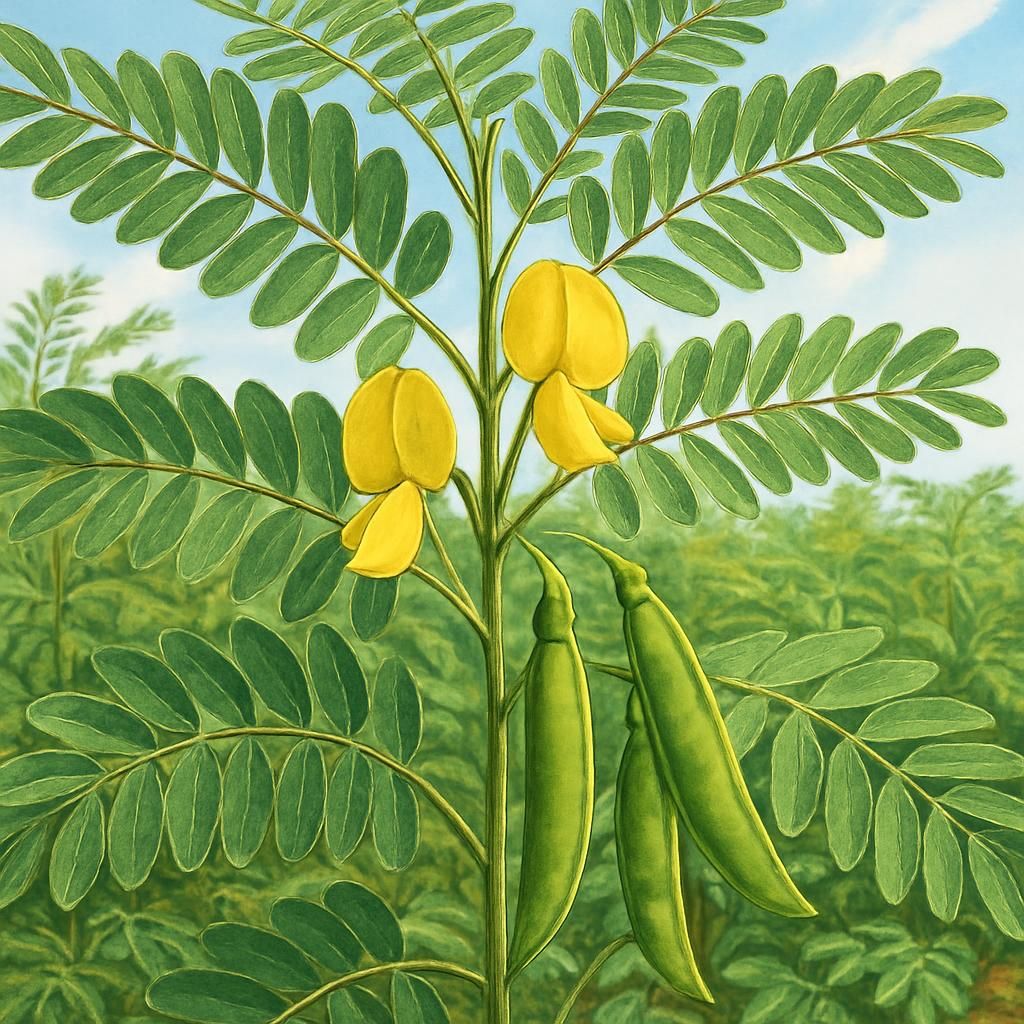
Introduction to sesbania
Sesbania (Sesbania sesban) is a short-lived perennial legume widely cultivated across tropical and subtropical regions for its rapid growth, nitrogen-fixing ability, and multiple agricultural uses. Farmers rely on it as a green manure crop, livestock fodder, and living fence because it establishes quickly and improves soil fertility within a single season. Its deep taproot system helps break compacted soils while its foliage provides high-protein feed for ruminants and poultry.
Botanical Profile of sesbania
Sesbania sesban belongs to the Fabaceae family and typically reaches 2–6 meters in height within 6–8 months. The plant produces compound leaves with 6–30 pairs of leaflets and bears yellow, pea-like flowers that attract pollinators. Its slender pods contain 20–40 seeds each and mature in 90–120 days. The species is closely related to other legumes such as Pigeon pea and Gliricidia, sharing similar symbiotic relationships with Rhizobium bacteria.
Soil, pH, and Climate Requirements for sesbania
Sesbania thrives in a wide range of soils but performs best in well-drained loams with moderate fertility. It tolerates periodic waterlogging yet suffers in prolonged anaerobic conditions. The crop grows optimally between 20–35 °C and requires 600–1500 mm of annual rainfall, although it can survive on as little as 400 mm once established.
| Parameter | Ideal Range | Notes |
|---|---|---|
| Soil Type | Loam to sandy loam | Avoid heavy clays without drainage |
| Soil pH | 5.5–8.0 | Tolerates mild salinity |
| Temperature | 20–35 °C | Frost sensitive below 5 °C |
| Annual Rainfall | 600–1500 mm | Supplemental irrigation in dry spells |
| Altitude | 0–1500 m | Best below 1200 m |
Step-by-Step Planting & Propagation
- Select healthy, scarified seed or 3–4 month-old seedlings.
- Sow seeds directly at 2–3 cm depth in rows 50–75 cm apart with 30–40 cm between plants.
- For transplanting, raise seedlings in nursery beds for 4–6 weeks before moving to the field.
- Inoculate seeds with appropriate Rhizobium strain before sowing to ensure effective nodulation.
- Irrigate lightly after planting to settle soil around seeds or roots.
Care & Maintenance regimes for sesbania
Sesbania requires minimal inputs once established but responds well to timely weeding and light fertilization. Mulching conserves moisture and suppresses weeds during the first 60 days. Pruning at 1 m height encourages branching and increases leaf biomass for fodder or green manure.
| Task | Frequency | Details |
|---|---|---|
| Watering | Every 7–10 days | Deep watering during establishment; reduce once taproot develops |
| Fertilizer | At planting + 45 days | 20 kg N, 40 kg P₂O₅, 20 kg K₂O per hectare; avoid excess nitrogen |
| Pruning | At 60–90 days & 150 days | Cut back to 1 m to promote regrowth and leaf production |
Pests, Diseases & Organic Management
Common pests include Aphids, leafhoppers, and pod borers that can reduce seed yield. Fungal issues such as Cercospora leaf spot and powdery mildew appear under humid conditions. Organic control relies on neem-based sprays, encouraging natural predators, and removing infected plant debris. Crop rotation with cereals helps break pest and disease cycles.
Harvesting, Curing & Optimal Storage
Harvest green biomass for fodder or green manure at 90–120 days when plants reach peak nitrogen content. For seed production, allow pods to turn brown and dry on the plant before threshing. Store clean, dry seed at 8–10 % moisture in airtight containers at 15 °C or below to maintain viability for up to three years.
Companion Planting for sesbania
Sesbania pairs well with maize, sorghum, and cassava as an intercrop because it fixes nitrogen and provides partial shade. It also serves as a living mulch beneath fruit trees such as Mango and Papaya. Avoid planting near heavy feeders that compete for light during early growth stages. For more companion planting strategies, see Summer Companion Planting: 10 Organic Pairings to Boost Small Farm Resilience.