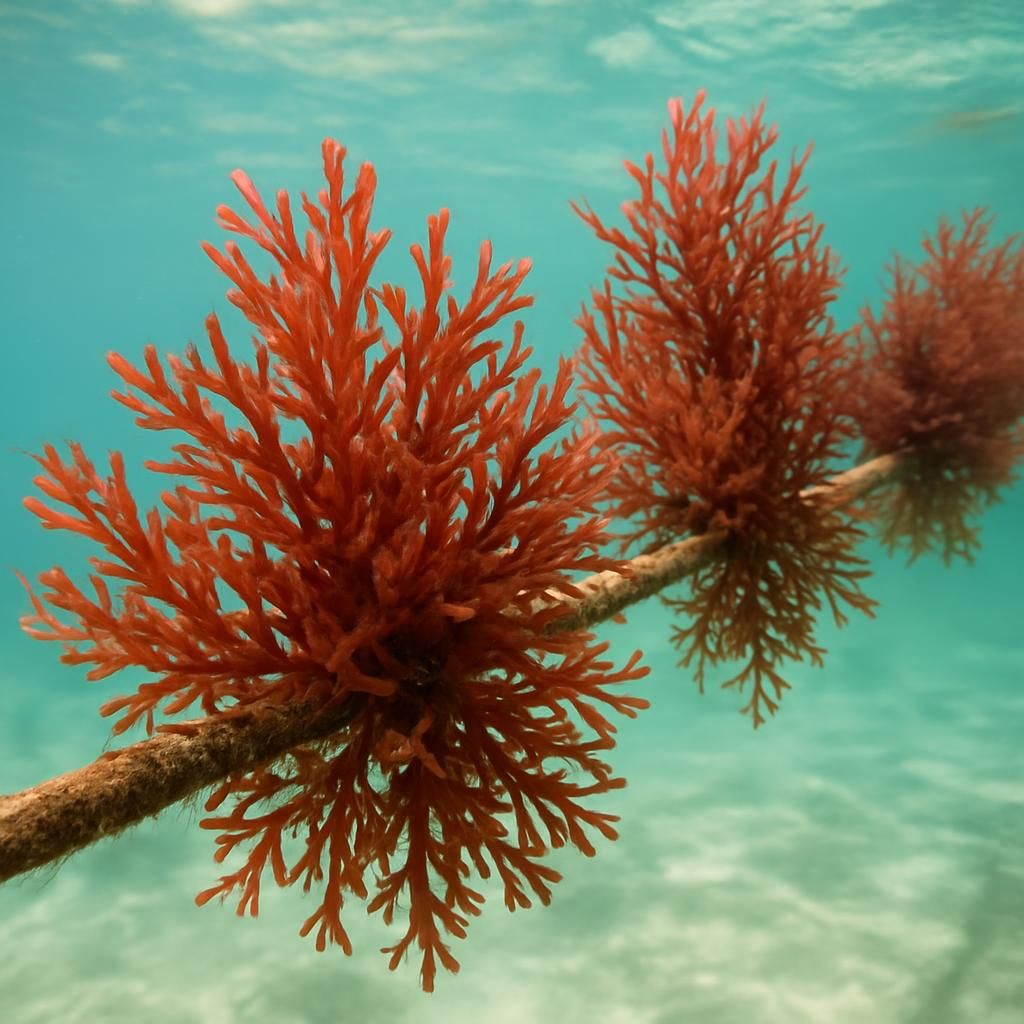
Introduction to Seaweed Farming
Seaweed farming is a rapidly expanding form of aquaculture that cultivates marine macroalgae in coastal and offshore waters. Unlike land-based crops, it requires no freshwater, arable soil, or synthetic fertilizers, making it one of the most sustainable protein and carbohydrate production systems available. Global demand for carrageenan, agar, and alginate continues to drive expansion, while emerging uses in animal feed, bioplastics, and carbon sequestration create additional market opportunities.
Commercial cultivation supports coastal communities by providing year-round employment with relatively low capital entry. Species such as Kappaphycus alvarezii and Eucheuma denticulatum dominate tropical production, while temperate regions focus on Saccharina japonica and Undaria pinnatifida. Success depends on selecting appropriate species for local water chemistry, temperature regimes, and market access.
Botanical Profile of Seaweed Farming
Seaweeds are multicellular marine algae classified into three major groups: red (Rhodophyta), brown (Phaeophyceae), and green (Chlorophyta). Commercially important species used in farming include Kappaphycus alvarezii (red), Gracilaria spp. (red), and Saccharina japonica (brown). These organisms lack true roots, stems, and leaves; instead they possess holdfasts, stipes, and blades that absorb nutrients directly from seawater.
Growth occurs through apical meristems or intercalary cell division, enabling biomass doubling times as short as 15–30 days under optimal conditions. Photosynthetic efficiency is high because of accessory pigments that capture a broad spectrum of light. Seaweeds also release dissolved organic carbon and oxygen, improving local water quality and supporting associated marine life.
Soil, pH, and Climate Requirements for Seaweed Farming
Seaweed farming occurs entirely in marine environments, eliminating traditional soil requirements. Cultivation relies on seawater chemistry, light penetration, water movement, and substrate availability.
| Parameter | Ideal Range | Notes |
|---|---|---|
| Salinity | 28–35 ppt | Avoid freshwater inflows during heavy rain |
| Water Temperature | 20–30 °C (tropical spp.); 5–20 °C (temperate) | Species-specific; monitor seasonal swings |
| pH | 7.8–8.4 | Stable oceanic buffering is preferred |
| Dissolved Oxygen | >5 mg/L | Aeration from currents reduces hypoxia risk |
| Nutrient Levels (N, P) | Moderate natural upwelling | Excess nutrients can cause epiphyte blooms |
| Water Depth | 0.5–3 m for fixed lines; 5–20 m offshore | Balance light penetration and wave energy |
| Current/Wave Action | Gentle to moderate (0.1–0.5 m/s) | Prevents sediment smothering and disease |
| Light (PAR) | 200–600 µmol photons m⁻² s⁻¹ | Shading nets used in high-light tropics |
Step-by-Step Planting & Propagation
- Site selection begins with bathymetric surveys, current measurements, and water-quality testing to confirm suitable depth and flow.
- Seedling production uses either vegetative cuttings from healthy mother plants or laboratory-produced sporelings for species such as Saccharina.
- Vegetative fragments of 50–100 g are tied to cultivation lines using soft plastic ties or inserted into rope braids at 10–15 cm spacing.
- Lines are suspended between bamboo or HDPE rafts anchored to the seabed; long-line systems are preferred for exposed sites.
- Deployment occurs during neap tides to minimize stress; initial biomass is monitored weekly for attachment success.
- Nursery phase lasts 15–30 days before transfer to grow-out plots where lines are spaced 1–1.5 m apart.
Care & Maintenance regimes for Seaweed Farming
Routine husbandry focuses on biomass monitoring, epiphyte removal, and line tension adjustment. Because seaweeds absorb nutrients directly from seawater, supplemental fertilization is rarely required except in nutrient-poor embayments.
| Task | Frequency | Method | Notes |
|---|---|---|---|
| Water Quality Monitoring | Weekly | Handheld salinometer, DO meter, pH probe | Record at three depths |
| Epiphyte & Fouling Removal | Bi-weekly | Gentle brushing or freshwater dips | Avoid damaging meristem tissue |
| Line Inspection & Repair | Monthly | Visual check of knots, anchors, and buoys | Replace frayed sections immediately |
| Biomass Sampling | Every 14 days | Weigh 10 random plants per line | Adjust harvest schedule accordingly |
| Fertilizer (if needed) | As required | Slow-release N-P-K bags attached to lines | Only in oligotrophic waters |
| Pruning / Thinning | At 45–60 days | Remove lower blades to improve light | Maintain 30 cm spacing between plants |
Pests, Diseases & Organic Management
Common challenges include “ice-ice” disease caused by bacterial and environmental stress, resulting in thallus bleaching and fragmentation. Epiphytic algae such as Ceramium and Polysiphonia compete for light and nutrients. Grazing by herbivorous fish and sea urchins can reduce yields by 20–40 % if uncontrolled.
Organic management relies on site selection, polyculture with herbivore-excluding nets, and regular removal of infected fronds. Maintaining optimal salinity and avoiding temperature spikes above 32 °C significantly reduces disease incidence. Biological control using cleaner fish or sea cucumbers has shown promise in integrated multi-trophic aquaculture (IMTA) systems.
Harvesting, Curing & Optimal Storage
Tropical species are typically harvested 45–60 days after planting when biomass reaches 3–5 kg per meter of line. Temperate kelps are harvested after 4–6 months. Cutting is performed manually or with mechanical harvesters, leaving 10–15 cm of stipe to allow regrowth.
Post-harvest, fronds are rinsed in seawater to remove sand and epiphytes, then sun-dried on raised racks to 15–20 % moisture within 48 hours. For carrageenan extraction, controlled drying at 35–40 °C preserves gel strength. Dried product is baled and stored in cool, dry warehouses (<25 °C, <65 % RH) to prevent mold and oxidation. Vacuum packaging extends shelf life beyond 12 months.
Companion Planting for Seaweed Farming
Seaweed polycultures enhance resilience and diversify income. Coconut plantations along shorelines provide windbreaks and reduce sediment runoff. Integrating Oyster Mushroom cultivation on land uses spent seaweed media as substrate. IMTA systems pairing seaweed with finfish and bivalves recycle nutrients while suppressing pests. Rice farmers in estuarine zones sometimes rotate brackish ponds between seaweed and salt-tolerant rice varieties to maintain soil health.
Companion species such as Gracilaria (new crop link) and Clam (new crop link) improve water clarity and provide additional revenue streams without increasing disease pressure.