Introduction to Pseudomonas savastanoi
Pseudomonas savastanoi, commonly known as the causal agent of olive knot disease, is a gram-negative bacterium that induces the formation of tumor-like galls or knots on olive trees (Olea europaea). This pathogen, specifically the pathovar Pseudomonas savastanoi pv. savastanoi, is a significant threat to olive production worldwide, particularly in Mediterranean regions, California, and other major olive-growing areas. The disease manifests as irregular, woody galls on twigs, branches, and sometimes trunks, which serve as sites for secondary infections and harbor the bacteria over winter.
First identified in the early 20th century, Pseudomonas savastanoi spreads primarily through contaminated pruning tools, rain splash, and wounds. It produces virulence factors like indoleacetic acid and cytokinins, which manipulate host plant hormones to cause uncontrolled cell proliferation, resulting in galls. While olive trees rarely die from the disease, severe infections can reduce productivity by 20-50% through defoliation, dieback, and weakened vigor. In commercial groves, losses escalate due to aesthetic damage and reduced oil quality. Early detection and integrated management are crucial for minimizing impact. This guide provides professional-grade diagnostic and management strategies tailored for growers facing this persistent bacterial foe.
Identifying Symptoms & Damage
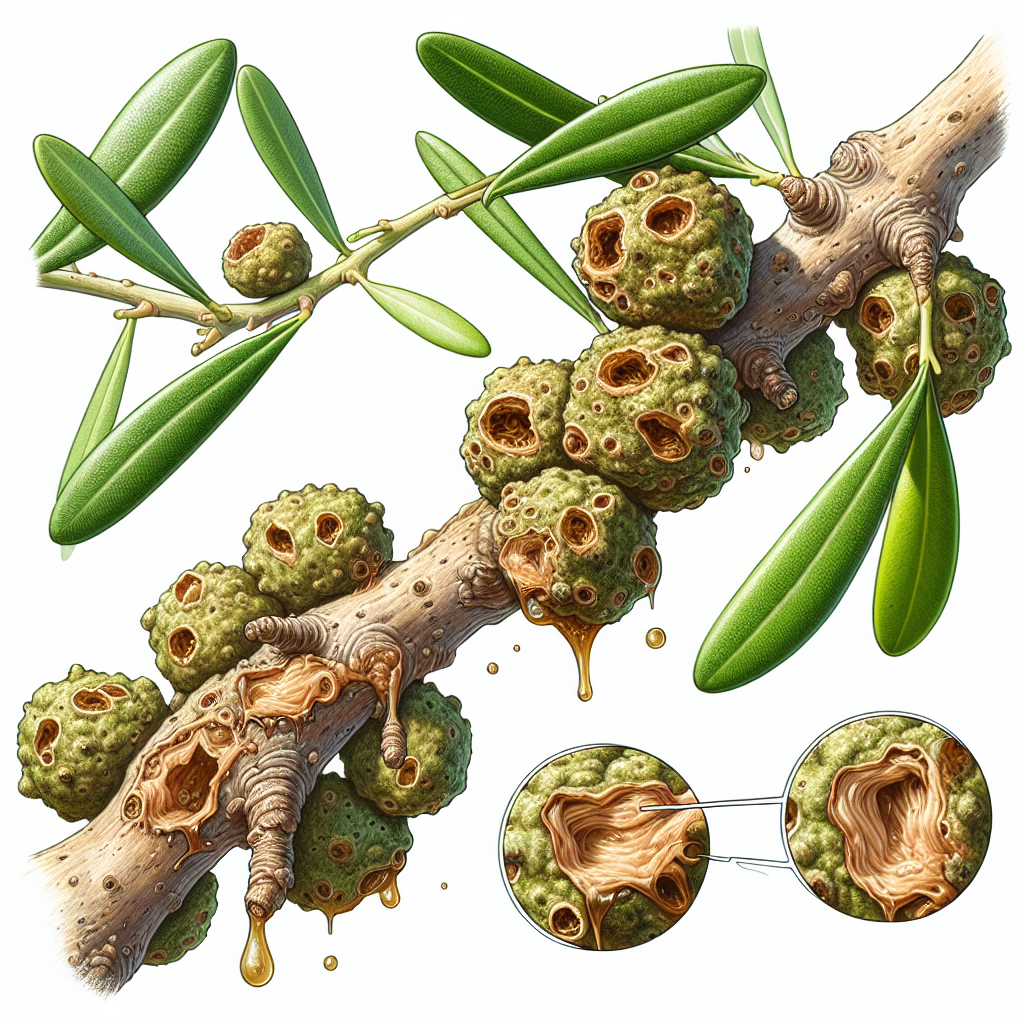
Recognizing Pseudomonas savastanoi early is key to limiting spread. Initial symptoms appear as small, light brown, soft swellings at wound sites, buds, or leaf axils, often following pruning or mechanical injury. These swellings harden over 2-4 weeks into irregular, tumor-like knots ranging from pea-sized to several centimeters in diameter. Galls are rough, corky, and olive-brown, cracking open to reveal lighter interior tissue.
Affected branches show twig dieback, leaf yellowing, and premature drop. In advanced stages, multiple galls coalesce, girdling stems and causing canopy thinning. On trunks, large knots ooze gum-like exudate during wet weather, attracting insects that vector the bacteria. Differentiate from crown gall (Agrobacterium tumefaciens), which produces smoother, more spherical galls without ooze, or fungal cankers, which feature sunken lesions rather than raised knots.
Damage assessment involves counting galls per branch: light (<10% twig length), moderate (10-30%), severe (>30%). Yield losses correlate with gall density; trees with >50 galls per meter of branch length may lose 30% fruit production. Secondary effects include increased susceptibility to olive fruit fly and Verticillium wilt. Lab confirmation via bacterial isolation on King's B medium (fluorescent under UV) or PCR is recommended for accurate diagnosis.
Lifecycle and Progression of Pseudomonas savastanoi
Pseudomonas savastanoi has a simple yet persistent lifecycle tied to olive tree phenology. The bacterium overwinters in galls, protected from desiccation and cold. In spring, as temperatures rise above 15°C (59°F), populations multiply within knots, exuding bacteria-laden ooze during rain or high humidity (>80%).
Primary infection occurs via wounds from pruning, frost cracks, or insect feeding. Bacteria enter through lenticels or stomata, colonizing the cortex and cambium within hours. Virulence genes activate, inducing gall formation in 7-14 days. Peak activity aligns with bud break and flowering (March-May in Mediterranean climates), when free water on tissues facilitates epiphytic spread.
Dissemination happens via rain splash (up to 10m), wind-driven rain, contaminated tools, and human activity. Inside galls, bacteria persist for years, releasing via cracks during wet periods. Progression accelerates in summer with irrigation; a single rain event can infect 20-30% of nearby wounds. Systemic movement is limited, but latent infections activate under stress. Full gall maturation takes 1-3 months, with new cycles starting annually. Understanding this enables timed interventions, like pruning during dry spells.
Environmental Triggers & Risk Factors
Warm, wet conditions are prime triggers for Pseudomonas savastanoi outbreaks. Optimal infection occurs at 20-28°C (68-82°F) with leaf wetness >8 hours. High humidity (>85%) and frequent rainfall (>50mm/month) during spring promote ooze production and splash dispersal. Overhead irrigation exacerbates spread by mimicking rain.
Risk factors include dense canopies reducing airflow, susceptible cultivars like 'Leccino' or 'Frantoio', and poor sanitation. Pruning during wet seasons introduces entry points; tools harbor bacteria for days without sterilization. Young trees (<5 years) and stressed plants (drought, nutrient deficiency) are vulnerable due to thinner bark. Soil pH >7.5 limits copper efficacy, a common control.
Regional hotspots include Italy's Apulia (humid springs), Spain's Andalusia (irrigated groves), and California's Central Valley (foggy winters). Climate change may intensify risks with warmer winters favoring overwintering. Monitor forecasts via hyper-local tools to preempt outbreaks, as in Why 80% of Small Farms Battle Weather Disasters - And How Hyper-Local AI Forecasts Can Save Your Harvest.
Organic Control & Treatment Plans
Organic management emphasizes prevention over cure, as no bactericide fully eradicates Pseudomonas savastanoi. Core strategy: cultural, biological, and barrier methods.
Pruning and Sanitation: Remove galls during dry periods (summer/fall), sterilizing tools with 10% bleach or 70% alcohol between cuts. Dispose of debris by burning or deep burial (>1m). Delay pruning until after harvest.
Copper-Based Sprays: Apply Bordeaux mixture or copper hydroxide (fixed copper, 1-2kg/ha) at bud swell, petal fall, and post-rain. Limit to 4 applications/year to avoid resistance. Efficacy: 60-80% reduction in new knots.
Biological Controls: Antagonistic bacteria like Pseudomonas fluorescens or Bacillus subtilis suppress populations via competition. Apply biweekly during high-risk periods (foliar sprays, 10^9 CFU/ml). Plant growth-promoting rhizobacteria (PGPR) enhance tree resistance.
Resistance Inducers: Foliar chitosan or acibenzolar-S-methyl boosts systemic defenses, reducing gall formation by 40%. Integrate with olive nutrition: balanced N-K fertilization strengthens bark.
Treatment Plan: 1) Scout weekly; 2) Prune infected parts; 3) Copper spray post-pruning; 4) Biocontrol every 14 days; 5) Monitor progress. For severe cases, rogue heavily infected trees. Success rates: 70-90% with IPM.
Preventing Pseudomonas savastanoi in the Future
Long-term prevention builds resilient groves. Select resistant cultivars like 'Arbequina' or 'Koroneiki' (Arbequina Olive implied in lists). Plant at wide spacing (6-7m) for airflow; avoid low-lying frost pockets.
Implement strict hygiene: footbaths at grove entry, dedicated tools per block. Time irrigation for midday to minimize wetness duration. Mulch to suppress weeds, reducing mechanical injury. Annual soil tests guide amendments; maintain Ca >1000ppm for cell wall strength.
Monitoring grids with sticky traps detect early insect vectors. Rotate copper with biocontrols to prevent resistance. Eradicate wild olives nearby, reservoirs for the pathogen. For small farms, AI-driven scheduling optimizes timings, as detailed in Why Timing Kills Small Farm Profits - And How AI Task Scheduling Saves Your Harvests. Quarantine new plantings for 2 years. These steps can reduce incidence by 85%.
Crops Most Affected by Pseudomonas savastanoi
Primarily olives, with pathovars targeting others: P. savastanoi pv. nerii on nerium (oleander), pv. fraxini on ash, pv. glycinea on soybean (soybeans). Olives suffer most economically; global losses exceed $100M/year. Young orchards (<3 years) face 50% infection rates. In California, 30% of 800,000 acres affected. Related hosts like privet amplify risks in mixed landscapes. Focus protection on high-value olive varieties like Kalamata (Kalamata Olive).