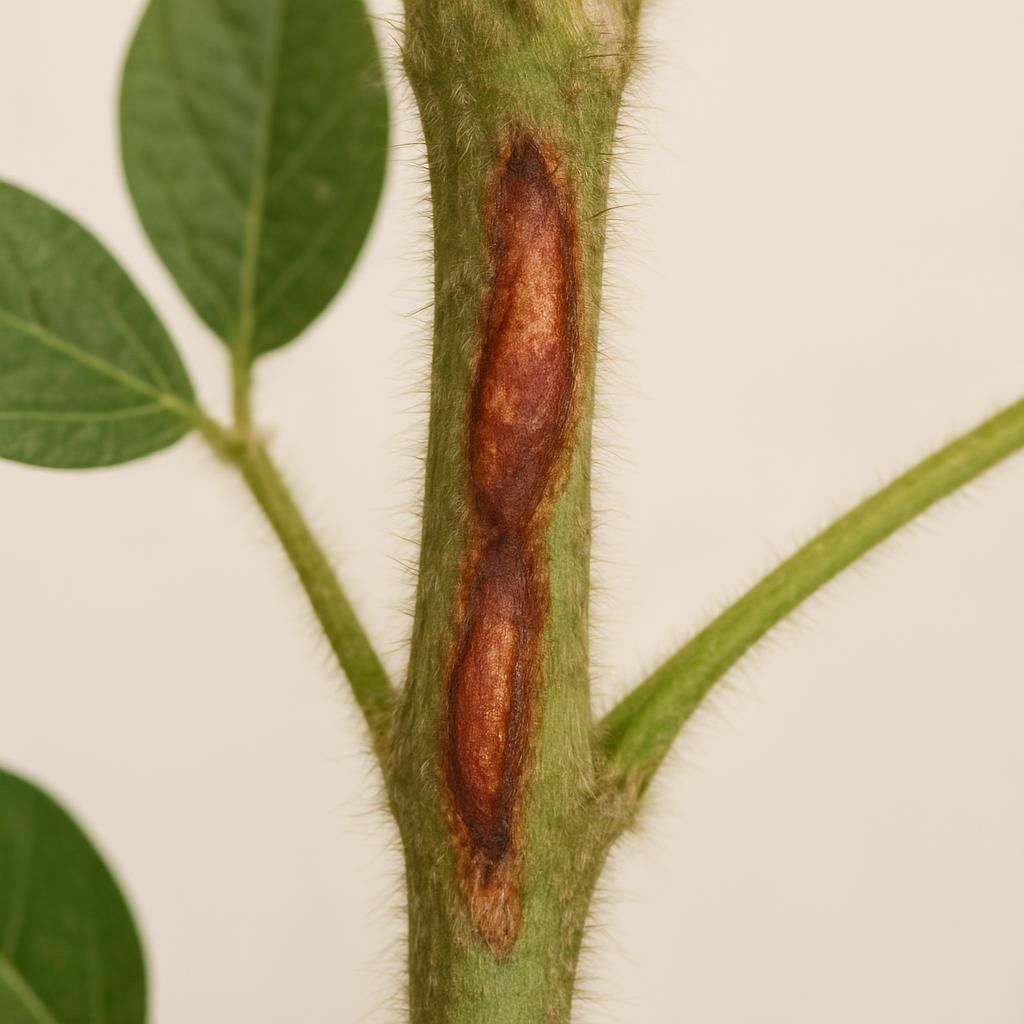
Introduction to Phomopsis stem canker
Phomopsis stem canker, caused primarily by the fungal pathogens Phomopsis longicolla and Diaporthe phaseolorum, is a major disease affecting Soybeans worldwide. The disease thrives in warm, humid environments and can lead to stem girdling, lodging, and substantial reductions in seed quality and yield. Effective management requires understanding its symptoms, lifecycle, environmental triggers, and control strategies.
Identifying Symptoms & Damage
Early symptoms appear as small, reddish-brown lesions on lower stems near the soil line, often during vegetative growth stages. As the infection progresses, these lesions enlarge into elongated cankers that may girdle the stem, causing wilting, premature senescence, and plant death. Infected stems often show internal discoloration, and pods may develop white mold and shriveled seeds. Severe infections result in lodging and yield losses exceeding 30% in susceptible varieties.
Lifecycle and Progression of Phomopsis stem canker (MUST INCLUDE A MARKDOWN TABLE OF LIFECYCLE STAGES)
The pathogen overwinters as pycnidia and perithecia in crop residue. Spores are released during warm, wet periods and infect plants through wounds or natural openings. The table below outlines the key lifecycle stages:
| Stage | Description | Duration/Timing |\n|-------|-------------|-----------------|\n| Overwintering | Pycnidia and perithecia survive in infected residue | Fall to Spring |\n| Spore Release | Conidia and ascospores dispersed by rain splash and wind | Spring to early Summer |\n| Infection | Spores enter through stem wounds or lower nodes | Vegetative stages V1-V6 |\n| Symptom Development | Lesions expand into cankers; internal stem discoloration | Flowering to pod fill |\n| Reproduction | New pycnidia form on lesions; secondary spread occurs | Mid to late season |\n| Seed Infection | Seeds become infected, serving as source for next season | Harvest time |
Environmental Triggers & Risk Factors
High humidity (>80%), temperatures between 20-30°C, and prolonged leaf wetness favor disease development. Dense planting, poor air circulation, and fields with heavy residue increase risk. Continuous soybean cropping and delayed harvest also heighten susceptibility.
| Factor | Optimal Range for Disease | Impact Level |\n|--------|---------------------------|--------------|\n| Temperature | 20-30°C | High |\n| Relative Humidity | >80% | High |\n| Soil Moisture | Wet conditions | Moderate |\n| Crop Residue | High levels | High |\n| Planting Density | High | Moderate |
Organic Control & Treatment Plans (MUST INCLUDE A MARKDOWN TABLE OF TREATMENT OPTIONS AND FREQUENCIES)
Organic management focuses on cultural practices, resistant varieties, and approved biological agents. Timely removal of infected residue and crop rotation are foundational.
| Treatment Option | Frequency | Application Method | Notes |\n|------------------|-----------|--------------------|-------|\n| Crop Rotation (non-host crops) | Every 2-3 years | Field planning | Reduces inoculum buildup |\n| Resistant Varieties | At planting | Seed selection | Choose varieties with partial resistance |\n| Residue Management | Post-harvest | Tillage or removal | Limit overwintering sites |\n| Biological Fungicides (Bacillus subtilis) | Every 7-14 days during high-risk periods | Foliar spray | Apply preventively |\n| Compost Tea / Microbial Inoculants | Monthly during growing season | Soil drench | Improves soil microbiome |\n| Neem Oil Spray | Every 10-14 days | Foliar application | Suppresses secondary spread |
Preventing Phomopsis stem canker in the Future
Implement a diversified rotation including Corn and Wheat to break the disease cycle. Use certified, disease-free seed and maintain optimal plant spacing for airflow. Monitor fields regularly during humid periods and remove volunteer plants. For additional insights on soil health and resilience, see The Forgotten Art of Fall Soil Revival: 8 Organic Strategies for Small Farm Resilience.
Crops Most Affected by Phomopsis stem canker
While primarily a threat to Soybeans, the disease also impacts Sunflower, Dry Beans, and certain Peas under conducive conditions. Leguminous crops in rotation are particularly vulnerable when residue from previous soybean crops remains in the field.