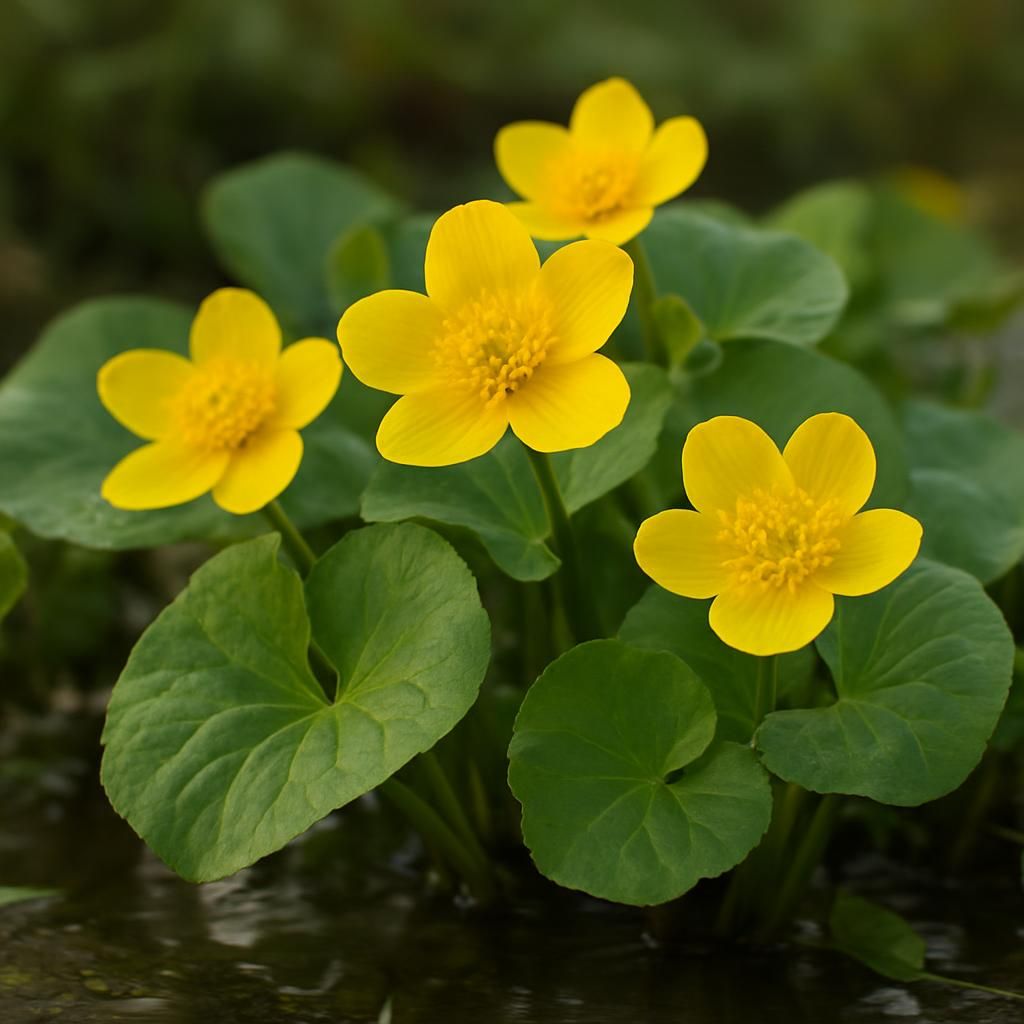
Introduction to Marsh Marigold
Marsh Marigold (Caltha palustris) is a robust herbaceous perennial native to temperate wetlands across North America and Europe. Valued for both ornamental and ecological uses, it produces vivid yellow buttercup-like flowers in early spring while tolerating standing water that would drown conventional crops. Its ability to stabilize wet soils and support pollinators makes it an increasingly popular choice for sustainable wetland agriculture and restoration projects.
Commercial and home growers appreciate Marsh Marigold for its low maintenance once established and its capacity to generate revenue through cut-flower sales, wetland seed production, and value-added products such as natural dyes. Because it blooms when few other wetland species are active, it fills an important market niche in early-season floral arrangements.
Botanical Profile of Marsh Marigold
Marsh Marigold belongs to the Ranunculaceae family. Plants form dense clumps of rounded, heart-shaped leaves that emerge from thick, fleshy rhizomes. Bright yellow flowers, typically 2–5 cm across, appear from March to May depending on latitude. Each flower lacks true petals; instead, five to nine showy sepals surround numerous stamens and carpels. After flowering, plants produce follicles containing many small black seeds that disperse in late summer.
The species is fully hardy in USDA zones 3–7 and can survive prolonged flooding as well as brief periods of drought once dormant. Rhizomes store carbohydrates that fuel rapid spring growth, allowing the plant to outcompete many invasive wetland species.
Soil, pH, and Climate Requirements for Marsh Marigold
Successful cultivation begins with matching site conditions to the plant’s natural preferences. Marsh Marigold performs best in consistently moist to saturated soils with high organic matter.
| Parameter | Ideal Range | Notes |
|---|---|---|
| Soil Type | Loamy, silty, or mucky | High humus content improves water retention |
| Soil pH | 5.5 – 7.0 | Tolerates slightly acidic to neutral conditions |
| Moisture | Saturated to 5 cm standing water | Never allow complete drying during active growth |
| Temperature Range | 15–24 °C daytime; cool nights | Flowers initiate after winter chilling |
| USDA Hardiness | Zones 3–7 | Mulch crowns in zone 3 for winter protection |
| Light | Full sun to partial shade | More sun yields denser flowering |
Step-by-Step Planting & Propagation
- Site Selection: Choose a low-lying area or constructed wetland bed that retains moisture year-round. Remove competing woody vegetation.
- Soil Amendment: Incorporate 5–8 cm of well-rotted leaf mold or compost to increase organic matter and cation exchange capacity.
- Division (Preferred Method): In early spring or fall, lift established clumps and separate rhizomes into sections each containing at least two buds. Replant immediately at the same depth.
- Seed Propagation: Collect ripe follicles in July–August. Sow fresh seed on the surface of moist flats; cold-stratify at 4 °C for 60–90 days. Germination occurs in 30–45 days at 18 °C.
- Spacing: Space plants 30–40 cm apart in rows 45 cm wide to allow for clump expansion.
- Initial Watering: Flood the bed to 2–3 cm depth immediately after planting and maintain saturation for the first six weeks.
Care & Maintenance regimes for Marsh Marigold
Once established, Marsh Marigold requires minimal intervention beyond moisture management and occasional division.
| Season | Water Schedule | Fertilizer Application | Pruning & Division |
|---|---|---|---|
| Spring | Maintain 2–5 cm standing water | Top-dress with 2 cm compost or fish emulsion (NPK 5-1-1) at 4-week intervals | Remove spent flowers to prolong bloom; divide every 3–4 years |
| Summer | Keep soil saturated; irrigate if rainfall <2.5 cm/week | Light side-dress with aged manure tea | Cut back yellowing foliage after seed set |
| Autumn | Reduce standing water to 1 cm | Apply 1 cm leaf mold mulch | Divide rhizomes; remove dead material |
| Winter | Allow natural freeze-thaw cycles | No fertilizer | Protect crowns with 5 cm straw mulch in zone 3 |
Pests, Diseases & Organic Management
Marsh Marigold is relatively pest-resistant but can be affected by Aphids and Slugs during prolonged wet periods. Monitor leaf undersides weekly; blast aphids with a strong water spray or apply insecticidal soap at the first sign of infestation. Copper tape and beer traps provide effective slug control without harming beneficial insects.
Fungal issues such as Botrytis may appear in overly crowded stands. Improve air circulation by thinning clumps and removing infected tissue. Pythium root rot is rare but can occur in stagnant, poorly oxygenated water; install gentle subsurface aeration or thin plant density to restore oxygen levels.
Harvesting, Curing & Optimal Storage
Cut flower stems when 50–75 % of buds are open, ideally in early morning. Place immediately in cool water (4–7 °C) with floral preservative. For seed production, allow follicles to turn dark brown before collection. Air-dry seeds at 20–25 °C for 7–10 days, then store in paper envelopes inside airtight containers at 4 °C. Viability remains above 70 % for up to three years under these conditions.
Rhizomes harvested for propagation should be lifted in early autumn, cleaned of soil, and stored in moist sphagnum moss at 2–4 °C until replanting.
Companion Planting for Marsh Marigold
Pair Marsh Marigold with other wetland species to create resilient polycultures. Clover and Yarrow improve soil structure and attract beneficial insects. Nasturtium provides aphid-trapping sacrificial foliage while adding edible flowers. Avoid planting near heavy feeders such as Corn or Tomato that demand drier, fertile soils.
For additional guidance on organic wetland soil management, see the blog post The Forgotten Art of Fall Soil Revival: 8 Organic Strategies for Small Farm Resilience.