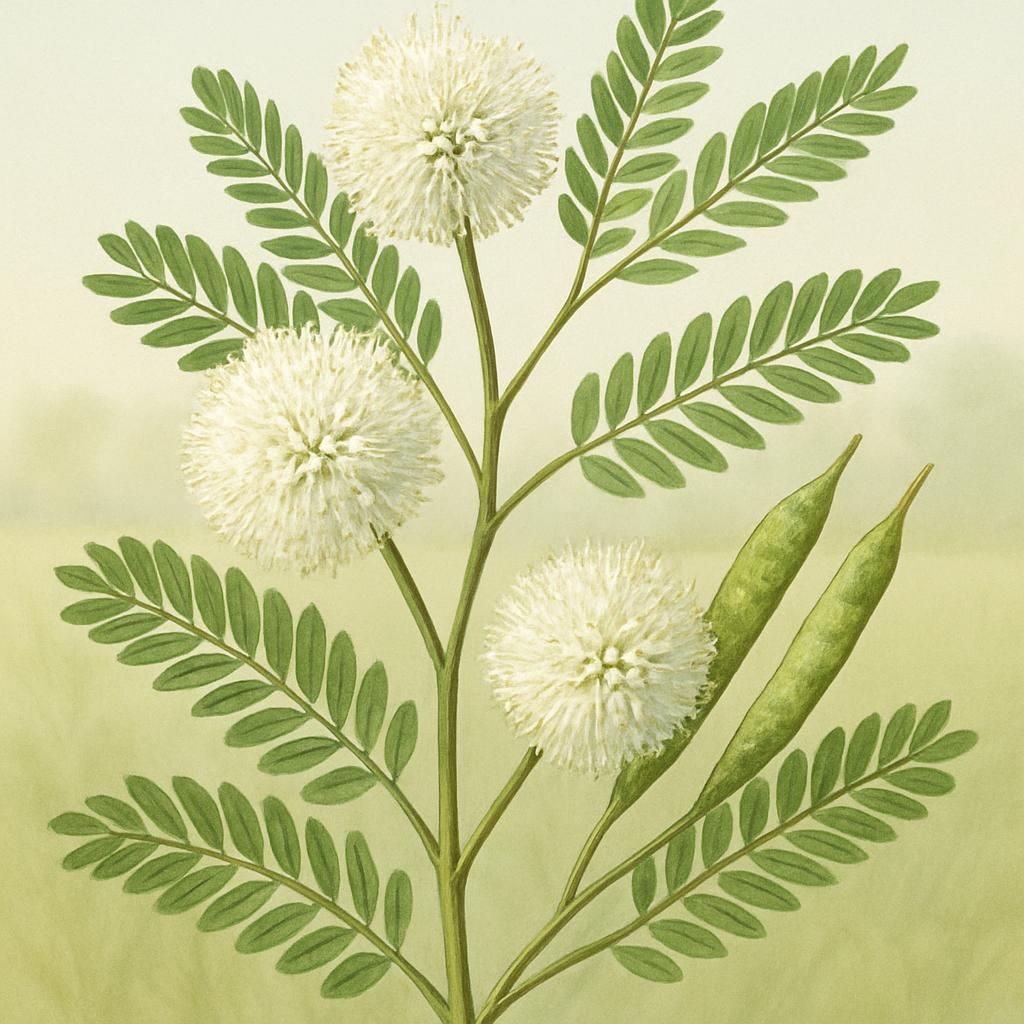
Introduction to Illinois bundleflower
Illinois bundleflower (Desmanthus illinoensis) is a warm-season perennial legume native to the central and eastern United States. This deep-rooted plant produces distinctive spherical clusters of flowers and twisted seed pods that resemble bundles, giving the species its common name. Farmers, ranchers, and restoration practitioners value it for high-protein forage, nitrogen fixation, wildlife cover, and long-term soil health improvement. Because it is adapted to prairie conditions, it performs well on marginal lands where other legumes may struggle.
Botanical Profile of Illinois bundleflower
Illinois bundleflower belongs to the Fabaceae family. Mature plants reach 2–4 feet in height with multiple stems arising from a woody crown. The bipinnately compound leaves consist of numerous small leaflets that fold at night or under stress. Small white to cream-colored flowers form in dense, globe-shaped heads from June through August. Following pollination, flat, curved pods develop that contain 2–6 hard-coated seeds. The plant develops a deep taproot that can exceed 6 feet, enabling drought tolerance and soil profile exploration.
Soil, pH, and Climate Requirements for Illinois bundleflower
Illinois bundleflower thrives across USDA zones 4–9. It prefers well-drained soils but tolerates periodic flooding and moderate salinity.
| Parameter | Ideal Range | Notes |
|---|---|---|
| Soil Type | Loam to clay loam | Performs on sandy soils with organic matter |
| Soil pH | 6.0–7.5 | Tolerates 5.5–8.0 |
| Temperature | 70–90 °F daytime | Frost hardy to −20 °F once established |
| Annual Rainfall | 20–45 inches | Supplemental irrigation improves first-year stands |
| Light | Full sun | Tolerates light shade but reduces flowering |
Step-by-Step Planting & Propagation
- Site selection: Choose a location with full sun and minimal weed pressure. Test soil and correct pH if below 5.8.
- Seedbed preparation: Remove existing vegetation and lightly disk or harrow to create a firm, fine seedbed.
- Seed treatment: Scarify seed mechanically or with hot water (180 °F for 5–10 seconds) followed by inoculation with Desmanthus-specific rhizobia.
- Seeding rate: Broadcast 8–12 lb/acre of pure live seed or drill at ¼–½ inch depth. Increase rate to 15 lb/acre for broadcast plantings.
- Timing: Plant in late spring after soil temperature reaches 60 °F. Fall dormant seeding is possible in zones 6–8.
- Establishment: Roll or cultipack after seeding to ensure seed-to-soil contact. Expect emergence in 7–21 days.
Care & Maintenance regimes for Illinois bundleflower
Illinois bundleflower requires minimal inputs once established, but strategic management maximizes longevity and yield.
| Practice | Schedule | Details |
|---|---|---|
| Water | Year 1: 1 inch/week | Reduce to natural rainfall after establishment |
| Fertilizer | Establishment: 20–30 lb N/acre | Top-dress phosphorus if soil test <15 ppm |
| Pruning | Early spring or post-harvest | Mow to 6–8 inches to stimulate regrowth |
Pests, Diseases & Organic Management
Illinois bundleflower is relatively pest-resistant but can be affected by grasshoppers and occasional leaf spot diseases. Monitor stands in late summer for defoliation exceeding 30 %. Cultural controls include diverse planting mixes and timely mowing. Organic sprays of neem or spinosad are effective against heavy grasshopper pressure. Root rots are rare on well-drained sites; avoid planting in compacted or waterlogged soils.
Harvesting, Curing & Optimal Storage
Forage harvest occurs at early bloom (late June–July) for highest protein content (18–22 %). Cut at 6–8 inches stubble height and allow 30–45 days regrowth. Field-dry hay to 15 % moisture before baling. Seed harvest takes place when pods turn dark brown (September–October). Combine at 12–15 % seed moisture and clean to 98 % purity. Store seed in cool, dry conditions (40–50 °F, <50 % RH) for up to five years with minimal viability loss.
Companion Planting for Illinois bundleflower
Pair Illinois bundleflower with warm-season grasses such as switchgrass or big bluestem for balanced forage and erosion control. It also complements clover and sunflower in pollinator strips. Avoid planting near heavy feeders like corn without rotation to prevent nutrient competition.
Desmanthus illinoensis provides a native alternative to introduced legumes. For additional regional adaptation strategies, see The Truth About Weather Patterns and Small Farm Resilience.