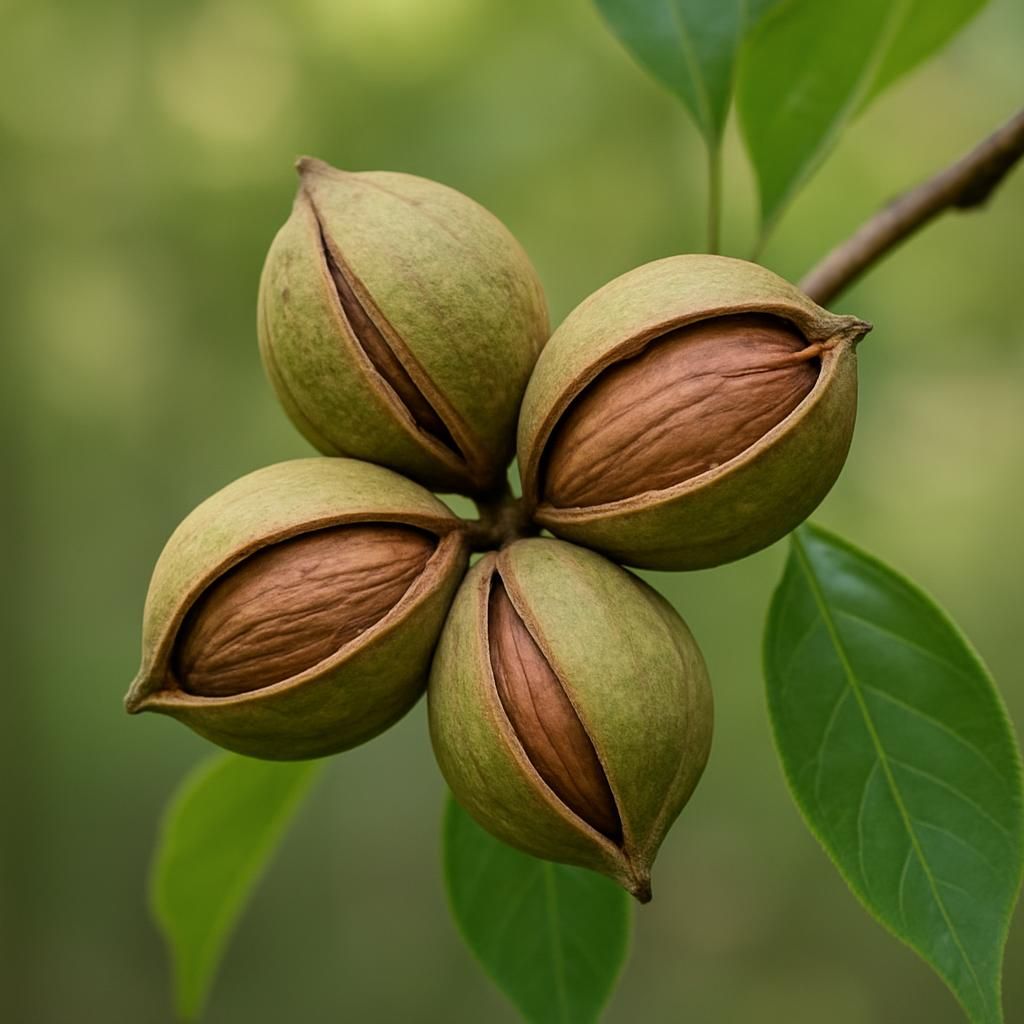
Introduction to Hickory (Pignut)
Pignut hickory (Carya glabra) is a medium-to-large deciduous tree native to eastern North America, prized for its thin-shelled, sweet nuts and exceptionally strong wood. The species thrives in well-drained upland forests and is increasingly planted in agroforestry systems and nut orchards for both timber and edible nut production. Its deep taproot and moderate growth rate make it a resilient choice for long-term plantings.
Botanical Profile of Hickory (Pignut)
Carya glabra belongs to the Juglandaceae family. Mature trees reach 60–80 feet with a straight trunk and narrow crown. Leaves are pinnately compound with 5–7 lanceolate leaflets. Male catkins appear in spring, followed by wind-pollinated female flowers. Nuts form inside a thin, pear-shaped husk that splits cleanly at maturity. The kernel is sweet and high in oil, making it attractive to wildlife and human harvesters alike.
Soil, pH, and Climate Requirements for Hickory (Pignut)
Pignut hickory prefers deep, fertile, well-drained loams but tolerates a range of upland soils. The following table summarizes ideal conditions:
| Parameter | Ideal Range | Notes |
|---|---|---|
| Soil Type | Sandy loam to clay loam | Deep profiles (>3 ft) preferred |
| Soil pH | 5.5–7.0 | Slightly acidic to neutral |
| Drainage | Excellent | Avoid compacted or seasonally wet sites |
| USDA Hardiness Zones | 4–9 | Cold hardy once established |
| Annual Rainfall | 30–60 inches | Supplemental irrigation for first 3 years |
| Temperature Range | −20 °F to 95 °F | Avoid frost pockets for young trees |
Step-by-Step Planting & Propagation
- Site Selection: Choose full sun on a gentle slope with deep soil. Avoid low-lying frost pockets.
- Soil Testing: Amend based on lab results to reach pH 5.5–7.0 and incorporate 2–4 inches of aged compost.
- Propagation: Stratify nuts 90–120 days at 34–40 °F in moist sand. Sow in fall or spring at 1–2 inch depth.
- Spacing: Plant seedlings 30–40 feet apart in rows 40 feet wide for nut orchards; 20-foot spacing for timber.
- Planting Depth: Set root collar at soil level; water thoroughly and mulch 3–4 inches deep, keeping mulch 6 inches from trunk.
Care & Maintenance regimes for Hickory (Pignut)
Young trees require consistent moisture and weed control for the first five years. The following table outlines recommended schedules:
| Season | Watering | Fertilizer | Pruning Schedule |
|---|---|---|---|
| Spring | 1 inch/week if rainfall <1 inch | ½ lb 10-10-10 per tree (year 2–4) | Remove competing leaders; shape crown |
| Summer | Deep soak every 10–14 days | None unless deficiency symptoms appear | Minimal; tip-prune only if needed |
| Fall | Reduce to harden off | Light compost top-dress | Remove dead or crossing branches |
| Winter | None | None | Dormant structural pruning |
Pests, Diseases & Organic Management
Major pests include hickory shuckworm, pecan nut casebearer, and nut weevils. Monitor with pheromone traps and apply kaolin clay or spinosad at egg hatch. Common diseases are anthracnose and phytophthora root rot. Improve drainage, remove fallen debris, and apply compost tea to suppress pathogens. Aphids can be controlled with strong water sprays and insecticidal soap.
Harvesting, Curing & Optimal Storage
Nuts ripen September–October when husks turn brown and begin to split. Shake or hand-pick from the ground daily. Remove husks immediately, then cure nuts in a single layer at 60–70 °F with good airflow for 2–3 weeks. Store cured nuts in mesh bags or sealed containers at 32–40 °F; viability remains high for 12–18 months. For longer storage, freeze at 0 °F.
Companion Planting for Hickory (Pignut)
Compatible understory species include Clover for nitrogen fixation and Yarrow to attract beneficial insects. Avoid planting shallow-rooted crops directly under the drip line. Thyme and Rosemary provide aromatic pest deterrence when interplanted in orchard margins.