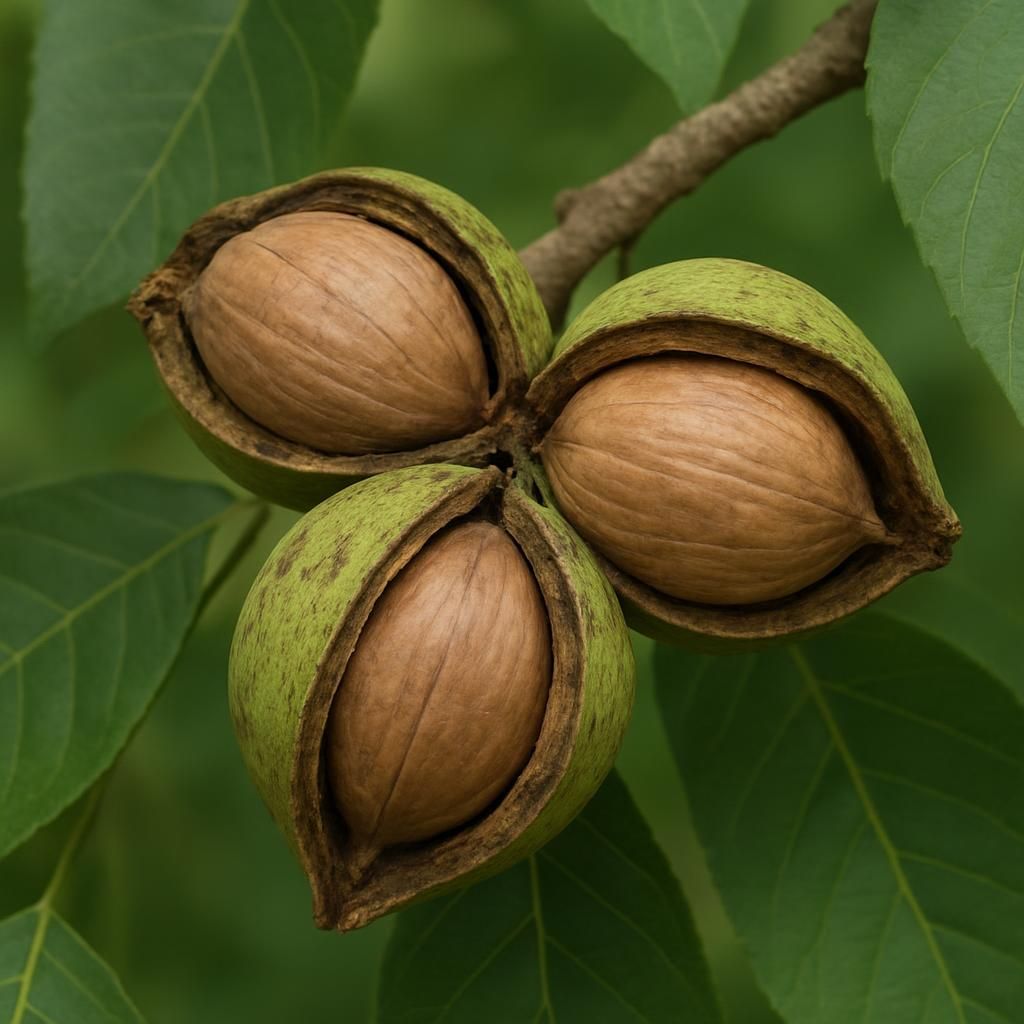
Introduction to Hickory (Mockernut)
Mockernut hickory (Carya tomentosa) is one of the most valuable native nut trees in eastern North America, producing thick-shelled, sweet kernels prized by wildlife and humans alike. The species grows slowly but lives for centuries, reaching 60–80 feet with a straight trunk and rounded crown. Its dense, shock-resistant wood is used for tool handles, flooring, and smoking meats. Because of its deep taproot and slow juvenile growth, successful establishment requires careful site preparation and long-term planning. Commercial interest is increasing due to demand for native, climate-resilient nut crops that require minimal inputs once mature.
Botanical Profile of Hickory (Mockernut)
Mockernut hickory belongs to the Juglandaceae family and is characterized by compound leaves with 7–9 leaflets, each covered in fine, velvety hairs on the underside. The bark is light gray and develops deep, interlacing ridges with age. Trees are monoecious, producing male catkins and female flowers on the same plant; wind is the primary pollinator. Nuts mature in a thick, four-sectioned husk that splits at maturity, revealing a hard, ridged shell. Seedlings develop a pronounced taproot that makes transplanting difficult after the first year. The species is cold-hardy to USDA Zone 5 and prefers well-drained upland sites.
Soil, pH, and Climate Requirements for Hickory (Mockernut)
Mockernut hickory performs best on deep, fertile, loamy soils with good internal drainage. It tolerates a range of textures but declines in compacted or seasonally wet sites. The tree is moderately drought-tolerant once established but benefits from consistent moisture during the first five years.
| Parameter | Ideal Range | Notes |
|---|---|---|
| Soil Type | Loam to sandy loam | Avoid heavy clay and shallow soils |
| Soil pH | 5.5 – 6.8 | Slightly acidic to neutral |
| Drainage | Well-drained | Standing water causes root decline |
| USDA Hardiness Zones | 5 – 9 | Tolerates cold winters and hot summers |
| Annual Rainfall | 35 – 60 inches | Supplemental irrigation needed in drought |
| Sun Exposure | Full sun | Minimum 6 hours direct light |
| Elevation | 0 – 2,500 ft | Performs well on slopes with air drainage |
Step-by-Step Planting & Propagation
Mockernut hickory is almost always grown from seed because of its taproot. Collect sound nuts in autumn after the husk splits; float-test and discard floaters. Stratify nuts in moist sand at 35–40 °F for 90–120 days. Sow stratified nuts 1–2 inches deep in well-prepared beds in early spring. Seedlings should be spaced 12–18 inches apart in rows 3–4 feet wide. Protect young plants from rodents with wire guards. Transplant seedlings at 1–2 years old when dormant; prune the taproot to 12–18 inches to encourage lateral root development. Grafting is possible onto shagbark or shellbark rootstocks for improved nut size but requires skilled technique.
Care & Maintenance regimes for Hickory (Mockernut)
Young trees require regular weed control and protection from deer. Mulch a 3-foot circle around each trunk to conserve moisture and suppress competition. Fertilization should be based on soil tests; young trees benefit from light nitrogen applications in spring. Pruning focuses on developing a single central leader and removing lower branches gradually over the first decade.
| Task | Schedule | Details |
|---|---|---|
| Watering | Years 1–3: 1 inch/week | Deep soak during dry spells; reduce after establishment |
| Fertilizer | Year 1: ½ lb 10-10-10 per tree | Split applications in April and June |
| Mature trees: 2–4 lbs N/acre | Based on leaf analysis every 3 years | |
| Pruning | Dormant season (Dec–Feb) | Remove dead, crossing, or low branches; train central leader |
| Mulching | Spring and fall | 3–4 inches organic mulch; keep 6 inches from trunk |
| Weed Control | Monthly during growing season | Hand pull or shallow cultivation within 3 ft radius |
Pests, Diseases & Organic Management
Major insect pests include hickory shuckworm, pecan weevil, and nut weevils. Hickory shuckworm larvae bore into husks, causing premature drop; monitor with pheromone traps and apply spinosad at peak flight. Weevils lay eggs in developing nuts; sanitation and timely harvest reduce populations. Diseases are uncommon but include anthracnose and leaf spot diseases during wet seasons. Maintain good air circulation through proper spacing and remove fallen leaves. Organic sprays of neem oil or copper fungicides provide adequate control when applied at first sign of infection. Deer and squirrels are the primary vertebrate pests; use fencing or repellents during establishment.
Harvesting, Curing & Optimal Storage
Nuts ripen from late September through October depending on latitude. Collect daily as husks split to minimize weevil damage. Remove husks promptly by rolling nuts underfoot or using a mechanical dehusker. Air-dry nuts on screens in a shaded, well-ventilated area for 2–3 weeks until kernel moisture reaches 8–10 %. Store cured nuts in mesh bags or bins at 32–40 °F with 60–70 % relative humidity. Properly cured and stored nuts remain viable for 2–3 years. For commercial sale, grade by size and sell in-shell or cracked.
Companion Planting for Hickory (Mockernut)
Mockernut hickory forms beneficial associations with nitrogen-fixing understory plants such as clover and hairy vetch. These legumes improve soil fertility and provide ground cover that reduces erosion. Avoid planting shallow-rooted crops directly under the canopy once trees mature, as competition for water increases. Compatible orchard companions include pecan and walnut on similar sites. Flowering herbs such as thyme and yarrow attract beneficial insects that help control aphids and mites. Maintain a diverse understory to support pollinators and natural pest enemies while avoiding aggressive grasses that compete with young trees.