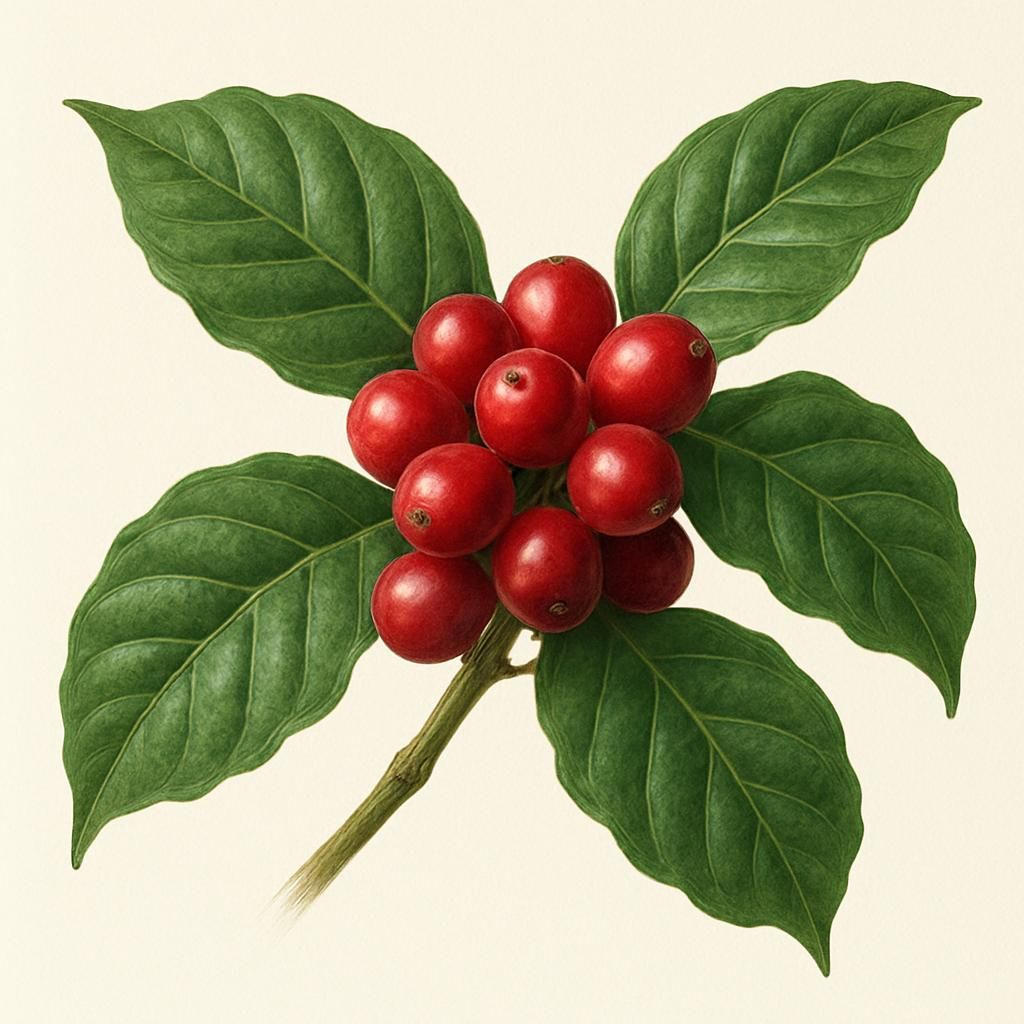
Introduction to Coffee (Arabica - Caturra)
Coffea arabica 'Caturra' originated as a natural dwarf mutation of the Bourbon variety discovered in Brazil in the 1930s. Its compact stature (typically 1.2–1.8 m) and high productivity quickly made it a favorite among Latin American growers seeking higher densities and easier harvesting. Today Caturra remains a cornerstone cultivar in specialty coffee programs because of its bright acidity, clean cup profile, and reliable performance at elevations between 1,000 and 1,800 m.
Commercial success with Caturra depends on matching its specific physiological demands with precise environmental management. Unlike taller Arabica types, Caturra responds dramatically to spacing, pruning, and nutrition; small deviations in any of these factors can reduce both yield and cup quality. This guide synthesizes decades of field research into actionable, professional-grade recommendations.
Botanical Profile of Coffee (Arabica - Caturra)
Caturra belongs to the Rubiaceae family and exhibits the classic opposite, glossy, dark-green leaves typical of Arabica. The cultivar is characterized by short internodes, abundant secondary branching, and a naturally compact growth habit that allows planting densities up to 5,000–7,000 plants per hectare. Flowers are white, fragrant, and self-fertile, emerging in clusters at each leaf axil after the onset of the rainy season. Fruit development follows a 6–9 month cycle, producing round to slightly elongated cherries that ripen from green to bright red.
Genetic studies confirm Caturra carries the compact “Ct” gene, which reduces plant height by approximately 30 % compared with Bourbon while maintaining similar bean size and cup quality. The variety is susceptible to coffee leaf rust (Hemileia vastatrix) and coffee berry disease (Colletotrichum kahawae), necessitating integrated disease management.
Soil, pH, and Climate Requirements for Coffee (Arabica - Caturra)
Caturra performs best on deep, well-drained, fertile soils with high organic matter. The root system is shallow and fibrous; waterlogging quickly induces root anoxia and dieback. Ideal conditions are summarized below:
| Parameter | Ideal Range | Notes |
|---|---|---|
| Soil pH | 5.8 – 6.5 | Below 5.0 causes aluminum toxicity |
| Soil Texture | Loam to sandy loam | >30 % clay requires raised beds |
| Organic Matter | 3 – 5 % | Maintain with compost or cover crops |
| Elevation | 1,000 – 1,800 m | Higher elevations improve acidity |
| Temperature (day) | 18 – 24 °C | >30 °C reduces photosynthesis |
| Temperature (night) | 12 – 18 °C | Frost below 5 °C is lethal |
| Annual Rainfall | 1,500 – 2,500 mm | Even distribution critical during flowering |
| Relative Humidity | 70 – 85 % | High humidity favors fungal pathogens |
Supplemental irrigation is often required during the dry season to maintain soil moisture at 60–70 % field capacity.
Step-by-Step Planting & Propagation
- Seed Selection: Use certified seed from selected Caturra mother trees with proven rust tolerance. Soak seeds for 24 h, then sow in sterile germination medium at 2 cm depth.
- Nursery Phase: Maintain 50 % shade and 25 °C day / 18 °C night. Seedlings are ready for transplant at 6–8 pairs of true leaves (4–5 months).
- Site Preparation: Clear vegetation, incorporate 20 t ha⁻¹ well-rotted compost, and adjust pH with dolomitic lime if below 5.5.
- Field Layout: Mark rows on contour at 2.0 m × 1.0 m or 2.5 m × 0.8 m spacing (5,000–6,250 plants ha⁻¹). Dig 40 × 40 × 40 cm planting holes.
- Transplanting: Harden seedlings for 2 weeks under full sun. Plant at the same depth as the nursery bag; firm soil and water immediately.
- Initial Shade: Provide temporary shade (30–40 %) for the first 4–6 weeks to reduce transplant shock.
Care & Maintenance regimes for Coffee (Arabica - Caturra)
Consistent nutrition and canopy management are essential. The following schedules assume a 2,000 mm rainfall zone with bimodal distribution.
| Growth Stage | Water (L plant⁻¹ week⁻¹) | Fertilizer (NPK 20-10-20) | Pruning Action |
|---|---|---|---|
| Establishment (0–12 mo) | 8–10 | 15 g every 8 weeks | Formative pruning to 3–4 orthotropic stems |
| Vegetative (Year 1–2) | 12–15 | 30 g every 6 weeks | Remove basal suckers; top at 1.6 m |
| Flowering & Fruit Set | 15–20 | 40 g at flowering; 30 g at pinhead stage | Selective de-suckering only |
| Ripening (Year 3+) | 10–12 | 25 g post-harvest | Stumping every 5–7 years to 30 cm |
Mulch with 10–15 cm of coffee parchment or legume residues to conserve moisture and suppress weeds. Monitor leaf nutrient levels annually; target N 2.8–3.2 %, P 0.15–0.20 %, K 1.8–2.2 %.
Pests, Diseases & Organic Management
Major biotic constraints include coffee leaf rust, coffee berry disease, root-knot nematodes, aphids, and spider mites. An integrated approach combining cultural, biological, and minimal chemical inputs is recommended.
- Cultural: Maintain 30–40 % shade, remove mummified cherries, and practice strict sanitation.
- Resistant Varieties: Interplant with rust-tolerant Catimor lines where pressure is high.
- Biological: Release Cryptolaemus montrouzieri for mealybugs and apply Bacillus thuringiensis for lepidopteran larvae.
- Organic Sprays: Copper hydroxide (1.5 kg ha⁻¹) alternated with systemic acquired resistance inducers at 21-day intervals during the rainy season.
Regular scouting every 7–10 days is mandatory during flowering and fruit development.
Harvesting, Curing & Optimal Storage
Selective hand-picking of fully ripe cherries every 10–14 days ensures maximum sugar accumulation. Harvest when cherries float in water (specific gravity >1.10). Process within 6 h to avoid fermentation.
Wet processing: Depulp, ferment 24–36 h at 20–24 °C, wash until parchment is clean, then dry on raised beds to 10–12 % moisture. Dry processing (natural) requires 18–25 days of even turning. Store green coffee in jute bags inside climate-controlled warehouses at 15–18 °C and 55–65 % RH. Cup quality remains stable for 12–18 months under these conditions.
Companion Planting for Coffee (Arabica - Caturra)
Strategic companions improve soil fertility, suppress pests, and moderate microclimate. Inga spp. and Gliricidia provide nitrogen fixation and light shade. Marigold and Nasturtium repel nematodes and aphids. Leguminous cover crops such as Clover and hairy vetch build organic matter between rows. Avoid planting banana directly within the coffee rows as it competes for water and increases humidity-related disease pressure.
For additional insights on building soil resilience in perennial systems, see The Forgotten Art of Fall Soil Revival: 8 Organic Strategies for Small Farm Resilience.