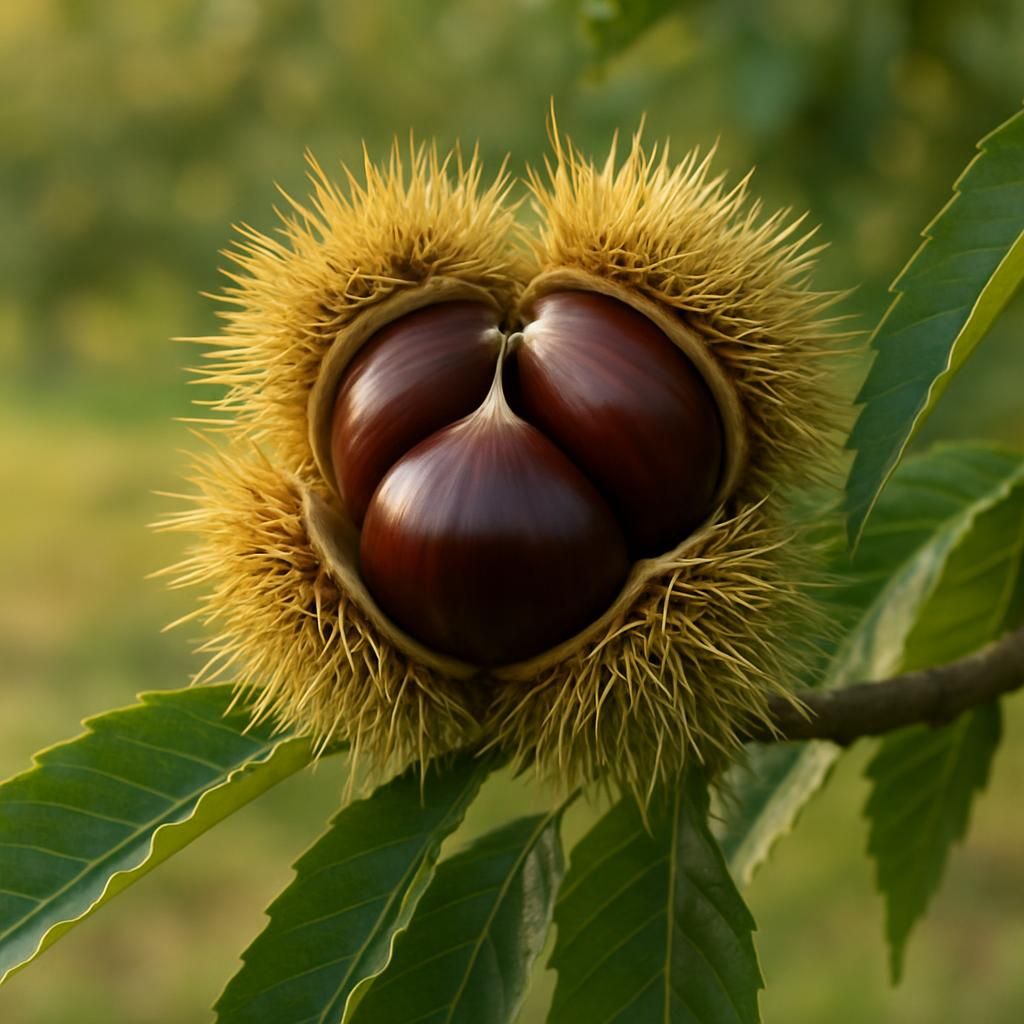
Introduction to Chestnut (Chinese - Dunstan)
The Dunstan chestnut represents one of the most successful blight-resistant hybrids developed for North American orchards. Created by crossing the Chinese chestnut (Castanea mollissima) with the American chestnut (Castanea dentata), this cultivar combines the disease resistance of its Asian parent with the nut quality and cold tolerance of its native counterpart. Growers appreciate its reliable annual bearing, large sweet nuts, and upright growth habit that simplifies mechanical harvest. With proper management, mature trees can produce 50–100 pounds of nuts per tree within 15–20 years, making it an excellent long-term investment for both commercial orchards and diversified farms.
Botanical Profile of Chestnut (Chinese - Dunstan)
Dunstan chestnuts are deciduous trees that reach 40–60 feet at maturity with a broad, rounded canopy. Leaves are simple, alternate, and oblong-lanceolate with coarsely toothed margins, emerging glossy green in spring and turning golden-yellow in autumn. The species is monoecious, producing both male catkins and female flowers on the same tree; pollination is primarily by wind, although bees also visit the abundant pollen. Nuts develop inside spiny burs that split open at maturity, typically containing two to three shiny, dark-brown nuts per bur. The hybrid exhibits strong apical dominance and forms a straight central leader, which supports high-density planting systems.
Soil, pH, and Climate Requirements for Chestnut (Chinese - Dunstan)
Dunstan chestnuts thrive in well-drained, loamy to sandy-loam soils with good aeration. They perform poorly in heavy clay or waterlogged sites. The ideal soil pH ranges from 5.5 to 6.5. Trees require full sun (minimum 6–8 hours daily) and at least 30 inches of annual precipitation or supplemental irrigation. They are hardy in USDA zones 5–9 and tolerate winter lows to –20 °F once established.
| Parameter | Ideal Range | Notes |
|---|---|---|
| Soil Texture | Loam to sandy loam | Avoid compacted clay |
| Soil pH | 5.5–6.5 | Adjust with sulfur or lime as needed |
| Drainage | Excellent | Raised beds or drainage tiles on heavy soils |
| Annual Rainfall | 30–50 inches | Supplemental irrigation in dry summers |
| USDA Hardiness Zones | 5–9 | Protect young trees first 2–3 winters |
| Sun Exposure | Full sun (6–8+ hours) | Partial shade reduces nut production |
| Temperature Tolerance | –20 °F to 95 °F | Heat stress mitigated by irrigation |
Step-by-Step Planting & Propagation
- Site Selection: Choose a south- or west-facing slope with good air drainage to reduce spring frost risk. Conduct a soil test and amend pH to 6.0 if necessary.
- Soil Preparation: Incorporate 2–3 inches of well-rotted compost or aged manure into the top 12 inches of soil. Avoid fresh manure that can burn roots.
- Propagation: Although seedlings are available, grafted Dunstan trees on blight-resistant rootstock ensure true-to-type production. Plant one-year-old whips in early spring before bud break.
- Spacing: Space trees 30–40 feet apart in rows 40 feet wide for standard orchards; high-density plantings use 20 × 20 feet with eventual thinning.
- Planting Depth: Set the graft union 2–3 inches above soil level. Backfill with native soil, water thoroughly, and apply a 3-inch mulch ring extending 3 feet from the trunk.
- Initial Pruning: Remove any branches below 4 feet and tip the leader to encourage lateral branching.
Care & Maintenance regimes for Chestnut (Chinese - Dunstan)
Consistent care during the first five years establishes a strong framework and maximizes future yields. Focus on weed suppression, balanced nutrition, and formative pruning.
| Season | Water Schedule | Fertilizer Application | Pruning Schedule |
|---|---|---|---|
| Spring | 1 inch/week until June; increase in drought | ½ lb 10-10-10 per tree at bud break | Remove dead/diseased wood; train central leader |
| Summer | Deep soak every 10–14 days | None unless leaf analysis shows deficiency | Minimal; pinch vigorous suckers |
| Fall | Reduce to harden off; stop by October | Apply 1 lb 5-10-10 or compost tea after harvest | Light structural pruning only |
| Winter | None required | None | Dormant pruning: remove crossing branches |
Mulch annually with 3–4 inches of wood chips to conserve moisture and suppress weeds. Scout leaf tissue every third year and adjust micronutrients (boron, zinc) accordingly.
Pests, Diseases & Organic Management
Dunstan chestnuts show excellent resistance to Chestnut Blight, but remain susceptible to several insects and secondary pathogens. Monitor for Chestnut weevils, Chestnut gall wasp, and occasional outbreaks of aphids. Implement integrated strategies:
- Sanitation: Remove and destroy fallen burs and nuts to break the weevil life cycle.
- Biological controls: Release Trichogramma wasps for gall wasp eggs and encourage predatory beetles.
- Organic sprays: Apply kaolin clay (Surround) at petal fall and again 14 days later to deter oviposition.
- Cultural practices: Maintain 6-foot weed-free strips under trees to reduce humidity that favors Phytophthora root rot.
Scout weekly from May through August; threshold for action is 5 % damaged burs.
Harvesting, Curing & Optimal Storage
Harvest begins when burs turn from green to brown and begin splitting naturally, usually mid-September through October. Collect daily to prevent mold and rodent damage. Cure nuts by spreading in a single layer in a cool (50–60 °F), dry, well-ventilated space for 7–10 days until kernel moisture reaches 8–10 %. Store cured nuts in mesh bags or perforated bins at 32–38 °F with 70–80 % relative humidity. Properly cured nuts maintain quality for 4–6 months. For longer storage, freeze at 0 °F in airtight containers for up to two years.
Companion Planting for Chestnut (Chinese - Dunstan)
Compatible understory species improve biodiversity and soil health without competing for resources. Plant low-growing legumes such as white clover or hairy vetch to fix nitrogen and provide habitat for beneficial insects. Interplant rows with aromatic herbs like thyme or rosemary to repel pests. Avoid shallow-rooted vegetables that require frequent tillage. In established orchards, maintain permanent sod alleys mowed to 4–6 inches to prevent erosion while allowing equipment access.