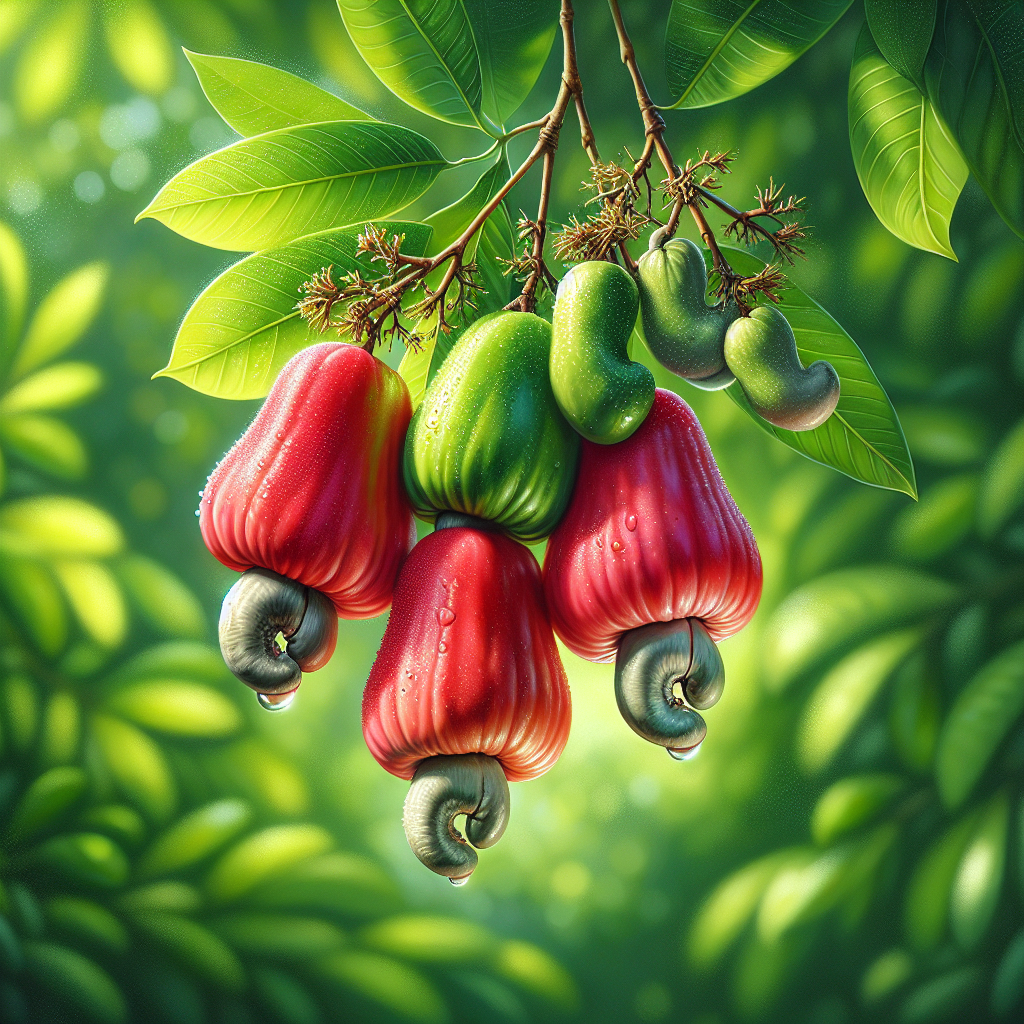
Introduction to Cashew Apple (Red)
The red cashew apple, the swollen, fleshy receptacle attached to the cashew nut, represents one of tropical agriculture's most intriguing crops. Scientifically part of Anacardium occidentale, this ruby-red fruit emerges from the same tree that produces the globally traded cashew nut, yet it remains largely underutilized outside its native Brazil and select tropical zones. Bursting with vitamin C—often exceeding oranges by fivefold—the red cashew apple delivers a astringent yet refreshing taste, perfect for fresh eating, juices, jams, or fermented beverages like cashew wine. Cashew (crop) cultivation inherently yields both nut and apple, but focusing on red varieties optimizes the apple's color, size, and antioxidant profile for niche markets.
Native to northeastern Brazil, red cashew apples thrive in similar equatorial belts worldwide, including India, Vietnam, and West Africa, where smallholder farmers integrate them into agroforestry systems. Their cultivation demands minimal inputs once established, yielding 10-20 kg of apples per mature tree annually alongside 5-10 kg of nuts. This dual harvest boosts farm profitability, with apples fetching premium prices in health food sectors for their anti-inflammatory properties and immune-boosting potential. However, challenges like perishability and processing needs underscore the importance of precise growing techniques. This comprehensive guide equips botanists, agronomists, and small-scale farmers with professional-grade strategies to cultivate superior red cashew apples, from site selection to post-harvest handling.
Botanical Profile of Cashew Apple (Red)
Cashew trees (Anacardium occidentale) are evergreen perennials in the Anacardiaceae family, reaching 6-12 meters in height with a spreading canopy. The 'red' cashew apple refers to selections like the Brazilian dwarf varieties or Indian red clones (e.g., 'Red Cashew' selections), distinguished by their deep crimson hue at maturity, larger size (7-12 cm long), and higher sugar content (up to 25° Brix) compared to yellow-green types. The apple is not a true fruit but a hypertrophied peduncle or pseudocarp, forming a pear-shaped or kidney-shaped structure below the true drupe—the cashew nut.
Leaves are obovate, leathery, 10-20 cm long, spirally arranged, with a glossy green surface aiding drought tolerance. Flowering occurs in panicles up to 30 cm long, with bisexual and male flowers; only 1 in 4000 flowers sets fruit due to self-incompatibility, necessitating cross-pollination by wind or insects like honeybees. The red apple develops 6-8 weeks post-flowering, accumulating anthocyanins for its vivid color, which signals peak ripeness. Trees exhibit cauliflory, bearing fruit directly on branches, enhancing harvest accessibility. Root systems are taproot-dominant with extensive laterals, enabling survival in poor soils but requiring protection from waterlogging. Grafted red varieties, propagated on dwarf rootstocks, mature in 2-3 years, contrasting with seed-grown trees taking 5+ years.
Nutritionally, red cashew apples boast 200-300 mg/100g vitamin C, polyphenols, carotenoids, and minerals like magnesium. Their astringency stems from tannins, mitigated by blanching or fermentation. As entomologists note, pollinator diversity boosts yields by 30-50%, while botanically, the urushiol resin in the nut's testa demands careful handling. For agricultural experts, red cashew apples exemplify a high-value byproduct, with yields peaking at 8-10 years before gradual decline.
Soil, pH, and Climate Requirements for Cashew Apple (Red)
Red cashew apples demand well-drained, sandy loam soils with 60-80% sand content to prevent root rot, thriving in pH 5.5-7.0. Avoid heavy clays or saline soils (>4 dS/m), as cashew's shallow feeder roots (top 0-50 cm) are sensitive to waterlogging. Incorporate 5-10 tons/ha organic matter pre-planting to enhance friability and nutrient retention. For optimal red pigmentation, select coastal or inland sites with low humidity during fruit swell (post-monsoon). Soil Health Mastery: 5 Proven Strategies for Small Farms to Build Fertile Ground Without Breaking the Bank
Climatically, red varieties excel in USDA zones 10b-12, requiring 25-32°C daytime averages, <20°C minima avoided to prevent chilling injury. Annual rainfall of 1000-2000 mm suits, with a distinct dry period (3-4 months) triggering flowering. Irrigation via drip (20-40 L/tree/week in dry spells) sustains yields in semi-arid tropics. Windbreaks using Gliricidia (crop) mitigate cyclone damage, as trees tolerate brief droughts but falter in frost or prolonged floods. Elevations <600 m ideal; humidity >80% fosters fungal issues, so site airflow is critical. Soil testing every 2 years guides liming (for pH <5.5) or gypsum (for sodic soils), ensuring micronutrients like zinc and boron—deficiencies common in tropics.
Step-by-Step Planting & Propagation
1. Variety Selection: Opt for red-fruited grafts like 'Pra 23-14' (Brazil) or 'NDC-Red' (India), yielding 15-25 apples/tree. Source virus-free scions from certified nurseries.
2. Propagation: Veneer grafting (90% success) onto 6-12 month rootstocks during rainy season. Air-layering for dwarfs: girdle branches, apply 5000 ppm IBA, wrap in polythene; roots form in 8-10 weeks.
3. Site Prep: Clear land, plow to 30 cm, form mounds (1x1x0.5 m) at 7x7 m spacing (200 trees/ha). Amend with 10 kg FYM + 100 g SSP/mound.
4. Planting: June-July (monsoon onset); dig 50x50x50 cm pits, plant grafts 10-15 cm above ground. Stake, mulch with leaves.
5. Initial Care: Irrigate weekly first year; prune to single leader at 0.8 m. Expect first apples year 3.
Yields escalate: 2 kg/tree (yr 3) to 15 kg (yr 7). Intercrop with peanuts (crop) years 1-3 for income.
Care & Maintenance regimes for Cashew Apple (Red)
Irrigation: Drip schedule: 30 L/tree/week dry season; cease pre-flowering to induce bloom.
Fertilization: Year 1: 100 g NPK 10-20-20/tree split 3x. Mature: 500 g N, 300 g P2O5, 300 g K2O/ha annually + 20 kg FYM. Foliar ZnSO4 (0.5%) corrects deficiencies.
Pruning: Annual post-harvest: remove deadwood, watersprouts; train to open center for light penetration, boosting red color.
Weed Control: Mulch + pre-emergent glyphosate; slash intercrops.
Training: Dwarf rootstocks limit height to 4-6 m, easing harvest.
Monitor via soil moisture probes; sustainable practices yield 20+ years productivity.
Pests, Diseases & Organic Management
Pests: Tea Mosquito Bug (Tea Mosquito Bug (pest)): Sticky traps + neem oil (3%). Stem Borers: Pheromone traps, entomopathogenic fungi. Why 90% of Small Farms Fail at Pest Management - And 8 Organic Fixes That Actually Work
Diseases: Anthracnose (Anthracnose (disease)): Copper oxychloride sprays. Phytophthora gummosis: Improve drainage, Trichoderma drenches.
Organic IPM: Release predatory birds, marigold (crop) borders repel nematodes. Scout weekly; thresholds: 5% infested panicles.
Harvesting, Curing & Optimal Storage
Harvest when apple base yellows, nut turns gray (42-45 days post-set). Twist peduncle; yield 70% first pick. Separate nuts immediately (urushiol hazard). For apples: Refrigerate at 8-10°C, 85-90% RH (7-10 days shelf life). Juice within 24 hrs or freeze puree. Dry at 60°C for preserves; curing enhances sweetness, reduces astringency.
Companion Planting for Cashew Apple (Red)
Pair with coconut (crop) for shade/nuts; pigeon pea (crop) fixes N. Avoid potato (crop)—allelopathic. Thyme (crop) deters borers; yarrow (crop) attracts pollinators. Agroforestry boosts biodiversity, yields 20%.