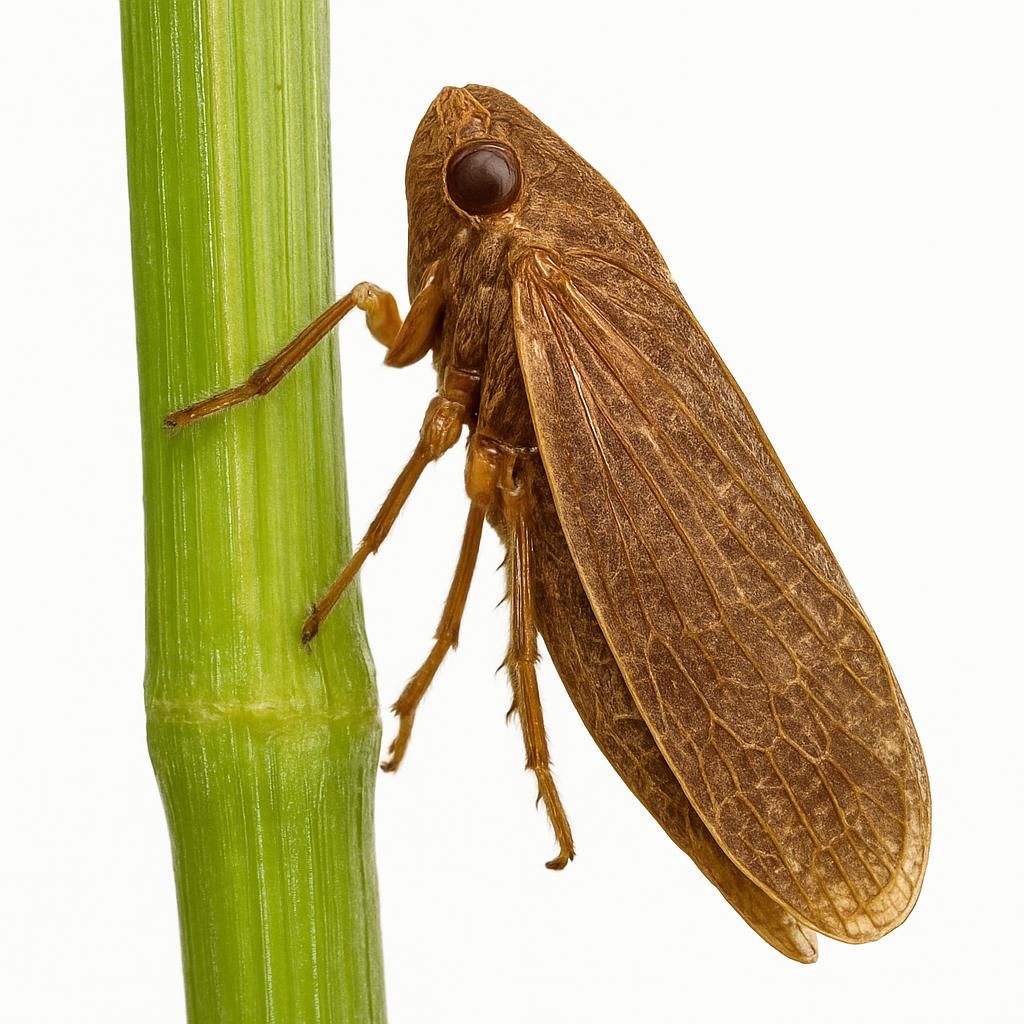
Introduction to brown plant hopper
The brown planthopper (Nilaparvata lugens) is one of the most destructive insect pests of rice worldwide, capable of causing complete crop failure within weeks when populations explode. Both nymphs and adults feed on phloem sap from the base of rice plants, removing vital nutrients and injecting toxic saliva that disrupts plant physiology. Heavy infestations lead to a characteristic symptom known as "hopperburn," where leaves turn yellow-orange and plants dry out rapidly from the base upward. Beyond direct feeding damage, the insect is a notorious vector of rice grassy stunt virus and rice ragged stunt virus, compounding yield losses across Asia and parts of Australia and the Pacific. Because of its short generation time and high reproductive capacity, outbreaks often coincide with the widespread use of susceptible high-yielding varieties and heavy nitrogen fertilization.
Identifying Symptoms & Damage
Early detection is critical because hopperburn can appear suddenly once nymph densities exceed 5–10 insects per tiller. Initial symptoms include yellowing of lower leaves and stunted tillers, often accompanied by the presence of white, waxy, honeydew secretions on leaf sheaths and surrounding soil. As feeding intensifies, plants exhibit progressive drying from the lower canopy upward, giving fields a scorched appearance. In severe cases entire patches turn brown and collapse within 7–10 days. Secondary signs include sooty mold growth on honeydew and the presence of macropterous adults capable of long-distance migration. Regular scouting at the base of plants using a sweep net or visual inspection of leaf sheaths is essential during the vegetative and reproductive stages.
Lifecycle and Progression of brown plant hopper (MUST INCLUDE A MARKDOWN TABLE OF LIFECYCLE STAGES)
The brown planthopper completes its life cycle in 20–25 days under optimal tropical conditions (25–30 °C), allowing up to 10–12 generations per year. Females lay 200–300 eggs in batches inside leaf sheaths; eggs hatch in 6–8 days into five nymphal instars that last 12–15 days total. Nymphs are wingless, creamy-white to brown, and highly mobile on the plant surface. Adults exist in two wing forms: brachypterous (short-winged) individuals that remain in the field and reproduce rapidly, and macropterous (long-winged) forms that migrate to new fields when populations become crowded or food quality declines.
| Stage | Duration | Key Characteristics | Temperature Optimum |
|---|---|---|---|
| Egg | 6–8 days | Laid inside leaf sheath, creamy-white | 25–30 °C |
| Nymph (5 instars) | 12–15 days | Wingless, increase in size and brown coloration | 25–30 °C |
| Brachypterous Adult | 10–20 days | Short wings, high fecundity, stay in field | 25–30 °C |
| Macropterous Adult | 10–20 days | Long wings, migrate long distances | 25–30 °C |
Environmental Triggers & Risk Factors
Outbreaks are strongly linked to excessive nitrogen application, dense planting, and continuous rice cropping without fallow periods. Warm temperatures (25–30 °C) combined with high humidity accelerate development and survival, while heavy monsoon rains can initially suppress populations through drowning but later promote resurgence by washing away natural enemies. Fields surrounded by weedy levees or adjacent to previously infested crops serve as reservoirs for migrating macropterous adults. Resistant rice varieties carrying the Bph1 or Bph3 genes can lose effectiveness when planthopper populations adapt, underscoring the need for gene rotation and integrated strategies.
Organic Control & Treatment Plans (MUST INCLUDE A MARKDOWN TABLE OF TREATMENT OPTIONS AND FREQUENCIES)
Organic management emphasizes conservation of predators such as spiders, mirid bugs, and dragonflies alongside targeted cultural practices. When action thresholds are reached (typically 5–10 nymphs per hill), approved botanical or microbial products can be integrated. The following table summarizes practical organic options and application schedules.
| Treatment Option | Active Ingredient / Organism | Application Frequency | Notes / Safety Window |
|---|---|---|---|
| Neem oil emulsion | Azadirachtin 0.15–0.3 % | Every 7–10 days at early infestation | Safe for beneficial insects after drying |
| Beauveria bassiana | Fungal spores 1×10^8 CFU/mL | 2–3 applications at 10-day intervals | Apply in evening; avoid midday heat |
| Metarhizium anisopliae | Fungal spores 1×10^8 CFU/mL | Same as Beauveria | Compatible with neem; rotate products |
| Yellow sticky traps | Physical capture | 20–30 traps/ha, replace weekly | Monitor adult influx during migration |
| Duck grazing | Biological predation | 150–200 ducks/ha for 5–7 days | Remove before panicle initiation |
Preventing brown plant hopper in the Future
Long-term prevention relies on breaking continuous rice monoculture through rotation with non-host crops such as wheat or legumes, planting resistant varieties, and synchronizing planting dates across neighboring farms. Reducing basal nitrogen by 20–30 % and splitting applications according to leaf color charts limits succulent growth favored by the pest. Maintaining 5–10 cm of standing water during the vegetative stage discourages egg laying on exposed stems, while alternate wetting and drying later in the season improves root health without favoring hopper development. Regular removal of volunteer rice and grassy weeds from bunds eliminates alternate hosts. Establishing flowering strips with nectar sources supports populations of predatory insects and parasitoids that naturally regulate planthopper numbers below economic thresholds.
Crops Most Affected by brown plant hopper
While rice remains the primary host, the brown planthopper occasionally infests corn and wild grasses when rice is unavailable. Secondary feeding has been recorded on sugarcane and certain millets under heavy migration pressure, but economic damage outside rice is rare. In mixed cropping systems, proximity to rice fields increases risk for adjacent sorghum and millet plots, making area-wide management essential.