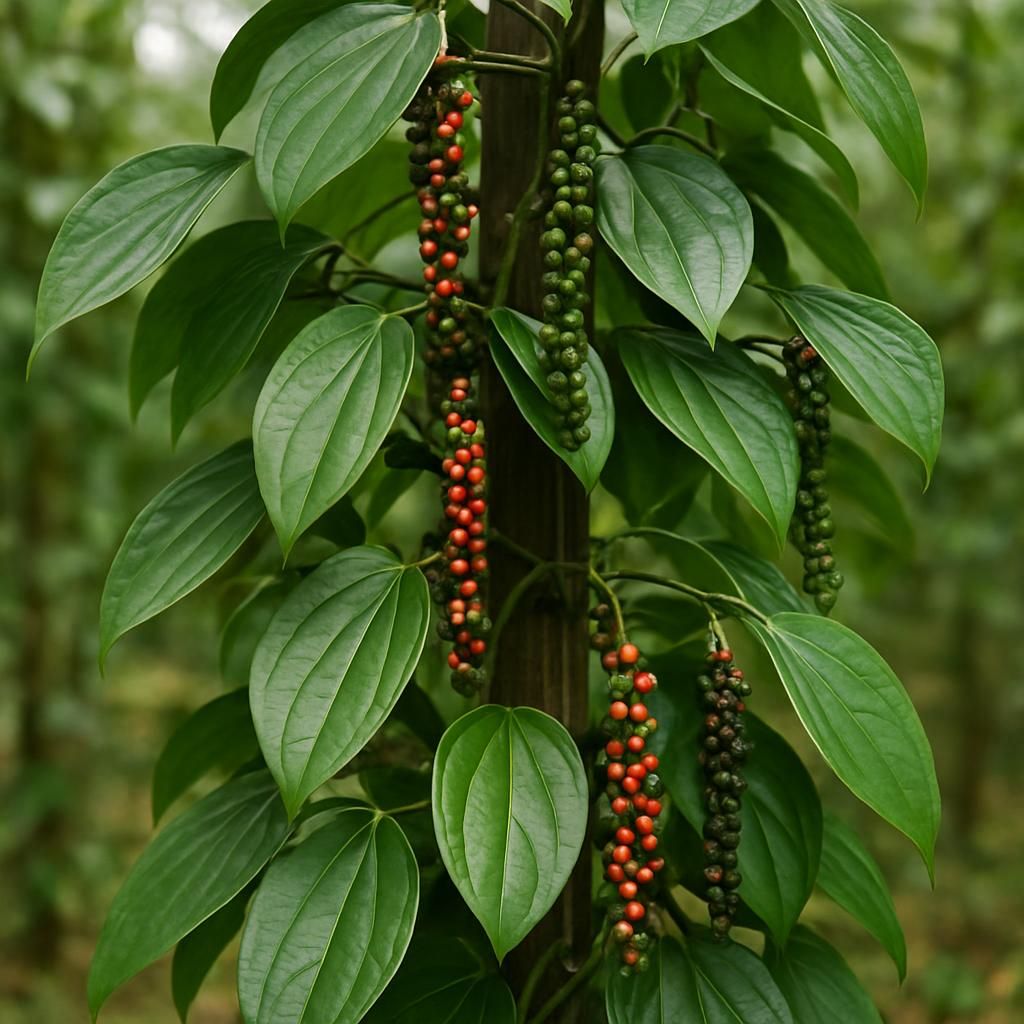
Introduction to Black Pepper (Malabar)
Black Pepper (Malabar) stands as the king of spices, cultivated for over 4,000 years along India's southwestern coast. The Malabar variety is prized globally for its bold pungency, high piperine content, and superior essential oil profile, commanding premium prices in international markets. As a perennial woody vine, it offers long-term economic returns when managed with scientific precision, making it an excellent choice for diversified tropical farms seeking sustainable income.
Successful commercial production requires understanding its unique climbing habit, shade tolerance, and precise environmental needs. Malabar pepper thrives when provided with living or artificial supports, consistent moisture, and protection from strong winds. This guide delivers actionable, research-backed advice for establishing and maintaining productive plantations.
Botanical Profile of Black Pepper (Malabar)
Piper nigrum is an evergreen perennial vine belonging to the Piperaceae family. It produces simple, alternate, ovate leaves with cordate bases and produces pendulous spikes (catkins) 7–15 cm long bearing 50–150 minute flowers. The fruits develop into single-seeded drupes known as peppercorns that turn from green to red upon ripening.
The Malabar cultivar is characterized by vigorous growth, large leaves, and high-yielding spikes with bold, aromatic berries rich in piperine (typically 4.5–5.5%). Vines can reach 10 meters in length when supported and begin bearing from the third year, with peak productivity between years 7 and 20. The root system is shallow and fibrous, making the plant sensitive to waterlogging and mechanical damage.
Soil, pH, and Climate Requirements for Black Pepper (Malabar)
Black Pepper (Malabar) demands well-drained, fertile soils rich in organic matter. Lateritic soils, forest loams, and volcanic soils with good structure perform best. The crop is highly sensitive to water stagnation; raised beds or slopes with 5–15% gradient are recommended for drainage.
| Parameter | Ideal Range | Notes |
|---|---|---|
| Soil Type | Laterite, forest loam, volcanic | Deep, friable, high organic content |
| Soil pH | 5.5 – 6.5 | Slightly acidic; liming if below 5.0 |
| Temperature | 20–34°C (day); 18–24°C (night) | Optimal 25–30°C average |
| Annual Rainfall | 1500–3000 mm | Well-distributed; 70–80% humidity ideal |
| Altitude | 0–1500 m | Lower elevations preferred for Malabar |
| Light | 50–70% shade | Partial shade from support trees or nets |
Consistent high humidity and protection from direct midday sun are critical for leaf health and berry development. Regions with distinct dry seasons require supplemental irrigation.
Step-by-Step Planting & Propagation
Propagation is achieved through stem cuttings or by layering. Select 2–3 node cuttings from healthy, high-yielding mother vines during the monsoon. Treat cuttings with 0.1% carbendazim or Trichoderma viride slurry before planting in nursery bags filled with equal parts sand, soil, and well-rotted manure.
Planting should coincide with the onset of monsoon rains. Prepare pits 60 × 60 × 60 cm filled with topsoil mixed with 10 kg compost, 500 g neem cake, and 100 g rock phosphate. Space vines 2 m × 2 m on flat land or 2 m between rows on contours. Provide living supports such as Gliricidia or Erythrina, or install 3–4 m concrete/wooden poles with coir ropes.
Plant rooted cuttings at the base of supports and train the main stem upward using jute twine. Mulch immediately with 10–15 cm of organic material to conserve moisture and suppress weeds.
Care & Maintenance regimes for Black Pepper (Malabar)
Regular care ensures vine health, disease resistance, and maximum spike production. Focus on balanced nutrition, moisture management, and canopy regulation.
| Operation | Schedule | Details |
|---|---|---|
| Watering | Weekly 20–30 L/vine in dry season | Drip irrigation preferred; avoid waterlogging |
| Fertilizer | 3 applications/year | Year 1: 50 g N, 25 g P₂O₅, 50 g K₂O + 5 kg FYM; increase annually |
| Pruning | Post-harvest & pre-monsoon | Remove dead wood, thin dense canopy, train 2–3 main stems |
| Mulching | Twice yearly | 10–15 cm organic mulch; renew before dry season |
| Weeding | 3–4 times/year | Hand weeding or shallow hoeing; maintain weed-free basin |
Apply fertilizers in split doses: first at the start of monsoon, second mid-monsoon, and third post-harvest. Foliar micronutrient sprays (zinc, boron, magnesium) during flowering improve berry set.
Pests, Diseases & Organic Management
Major pests include Scale insects, Mealybugs, and Spider mites. Scale and mealybugs cluster on stems and spikes, secreting honeydew that promotes sooty mold. Control with 2% neem oil or release of Cryptolaemus montrouzieri beetles.
Diseases of concern are Phytophthora foot rot, Anthracnose, and Fusarium wilt. Phytophthora is managed by improving drainage, applying Trichoderma harzianum at planting, and drenching with 1% Bordeaux mixture. Anthracnose appears as black lesions on leaves and spikes during humid periods; remove infected parts and spray copper-based fungicides sparingly.
Implement integrated pest management combining cultural practices, biological agents, and targeted organic sprays. Regular monitoring and sanitation are the foundation of a healthy plantation.
Harvesting, Curing & Optimal Storage
Malabar pepper is harvested when berries turn cherry red, typically 6–8 months after flowering. Selective hand-picking of mature spikes ensures uniform quality. For black pepper, sun-dry whole spikes 3–5 days until moisture reaches 10–12%. White pepper is produced by soaking ripe berries 4–5 days to remove the pericarp before drying.
Cured peppercorns should be stored in clean, ventilated jute bags or food-grade containers at 10–15°C and 60–70% relative humidity. Protect from light and pests. Properly cured Malabar pepper retains pungency and aroma for 18–24 months.
Companion Planting for Black Pepper (Malabar)
Intercropping with Ginger or Turmeric in the first two years maximizes land use before vines fully shade the ground. Leguminous support trees such as Gliricidia fix nitrogen and provide partial shade. Marigold borders repel nematodes and enhance biodiversity.
Avoid planting with heavy feeders or crops requiring full sun. Maintain 1.5 m distance from support tree trunks to prevent root competition. These pairings improve soil fertility, reduce pest pressure, and increase overall farm resilience.