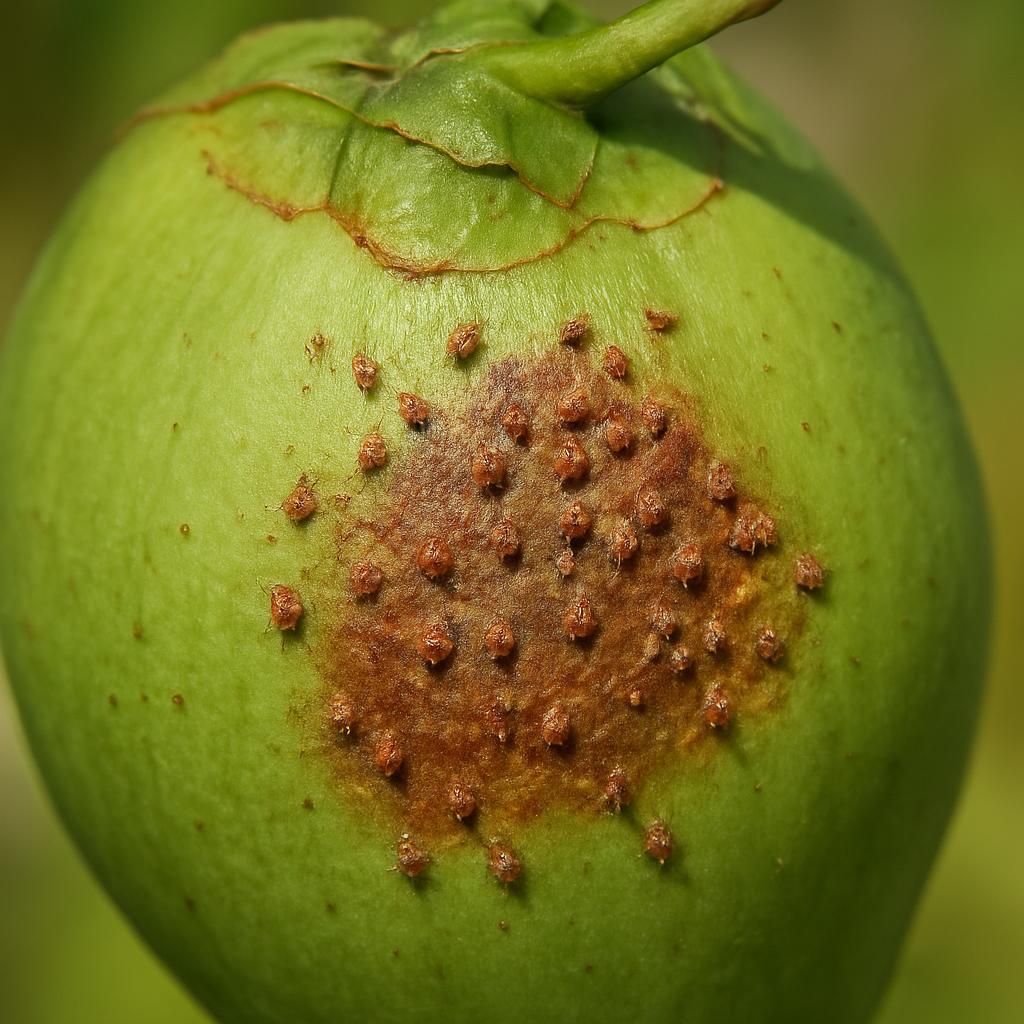
Introduction to Aceria guerreronis
Aceria guerreronis, commonly known as the coconut mite, is a microscopic eriophyid pest that exclusively targets coconut palms (Cocos nucifera). First described in Mexico in the 1960s, it has since spread throughout the tropics, causing significant economic losses in coconut-producing regions. Unlike larger spider mites, this species is invisible to the naked eye and resides beneath the perianth of developing nuts, making early detection challenging. Its rapid reproductive cycle and protected feeding sites allow populations to explode under favorable conditions, leading to bronzed, scarred, and deformed coconuts that fetch lower market prices.
Identifying Symptoms & Damage
The earliest visible sign is a subtle bronzing or silvery sheen on the surface of young green nuts, usually beginning 2–4 months after flowering. As feeding progresses, longitudinal fissures and corky scars develop around the perianth, often accompanied by a characteristic “fish-scale” pattern. Severe infestations cause premature nut drop, reduced nut size, and malformed kernels, directly lowering copra and oil yields. In extreme cases, entire bunches may abort, resulting in 30–70 % crop loss. Growers should inspect the basal 5 cm of nuts for white, thread-like mites using a 20× hand lens or by gently prying back the bracts.
Lifecycle and Progression of Aceria guerreronis
The coconut mite completes its entire life cycle on the host nut, sheltered from most contact insecticides. Eggs are laid in clusters under the perianth; larvae hatch within 2–3 days and immediately begin feeding. Two nymphal stages follow before adults emerge, with the full generation time ranging from 7–12 days at 28–32 °C.
| Lifecycle Stage | Duration | Key Characteristics | Location on Host |
|---|---|---|---|
| Egg | 2–3 days | Spherical, translucent, laid in batches of 20–50 | Under bracts/perianth |
| Larva | 1–2 days | Six-legged, highly mobile, begins feeding immediately | Nut surface beneath bracts |
| Nymph I | 1–2 days | Eight-legged, increased feeding damage | Protected crevices |
| Nymph II | 1–2 days | Pre-adult stage, rapid population growth | Same protected sites |
| Adult | 5–7 days | Elongated, white to cream, females lay 20–30 eggs | Deep under perianth |
Environmental Triggers & Risk Factors
Optimal development occurs at temperatures of 27–33 °C and relative humidity above 70 %. Prolonged dry spells followed by sudden rains often trigger outbreaks by stressing palms and reducing natural enemy populations. High-density monoculture plantations, poor sanitation, and lack of resistant varieties increase risk. Overuse of broad-spectrum insecticides can eliminate predatory mites and insects that normally suppress Aceria guerreronis. Palms under nutrient stress, particularly potassium or boron deficiency, show heightened susceptibility.
Organic Control & Treatment Plans
An integrated approach combining cultural, biological, and approved organic sprays is most effective. Begin with rigorous sanitation: remove and destroy all dropped and heavily infested nuts. Introduce predatory mites such as Neoseiulus baraki or Amblyseius largoensis at 5–10 individuals per palm. Apply horticultural oils or neem-based formulations during early infestation stages. Rotate products to prevent resistance.
| Treatment Option | Active Ingredient / Agent | Frequency | Application Notes |
|---|---|---|---|
| Predatory mite release | Neoseiulus baraki | Every 4–6 weeks during active growth | Release at dusk, 5–10 mites per palm |
| Horticultural oil | 1–2 % summer oil emulsion | Every 10–14 days for 3 applications | Thorough coverage under bracts; avoid >32 °C |
| Neem oil | 0.5–1 % azadirachtin | Every 7–10 days for 4 sprays | Add surfactant; target young bunches |
| Sulfur dust | Wettable sulfur 80 % | Every 14 days | Use when humidity <80 %; avoid during flowering |
| Biopesticide | Beauveria bassiana | Every 10 days | Apply in evening; compatible with predatory mites |
Preventing Aceria guerreronis in the Future
Plant only certified mite-free seedlings and avoid introducing infested nuts from external sources. Maintain balanced nutrition, especially potassium and boron, to strengthen palm defenses. Implement wide spacing (9–10 m) to improve airflow and reduce humidity microclimates. Intercrop with Coconut companion species such as Clover or Marigold to support beneficial insects. Monitor monthly with a 20× lens and maintain sanitation by removing old bunches. Record-keeping of infestation dates helps predict seasonal peaks.
Crops Most Affected by Aceria guerreronis
While the mite is highly host-specific, economic damage is almost exclusively reported on coconut palms. Related palm species such as Tall Coconut and Dwarf Coconut show varying susceptibility, with dwarf varieties often suffering higher infestation rates. No significant damage has been documented on Mango, Banana, or Avocado under field conditions.