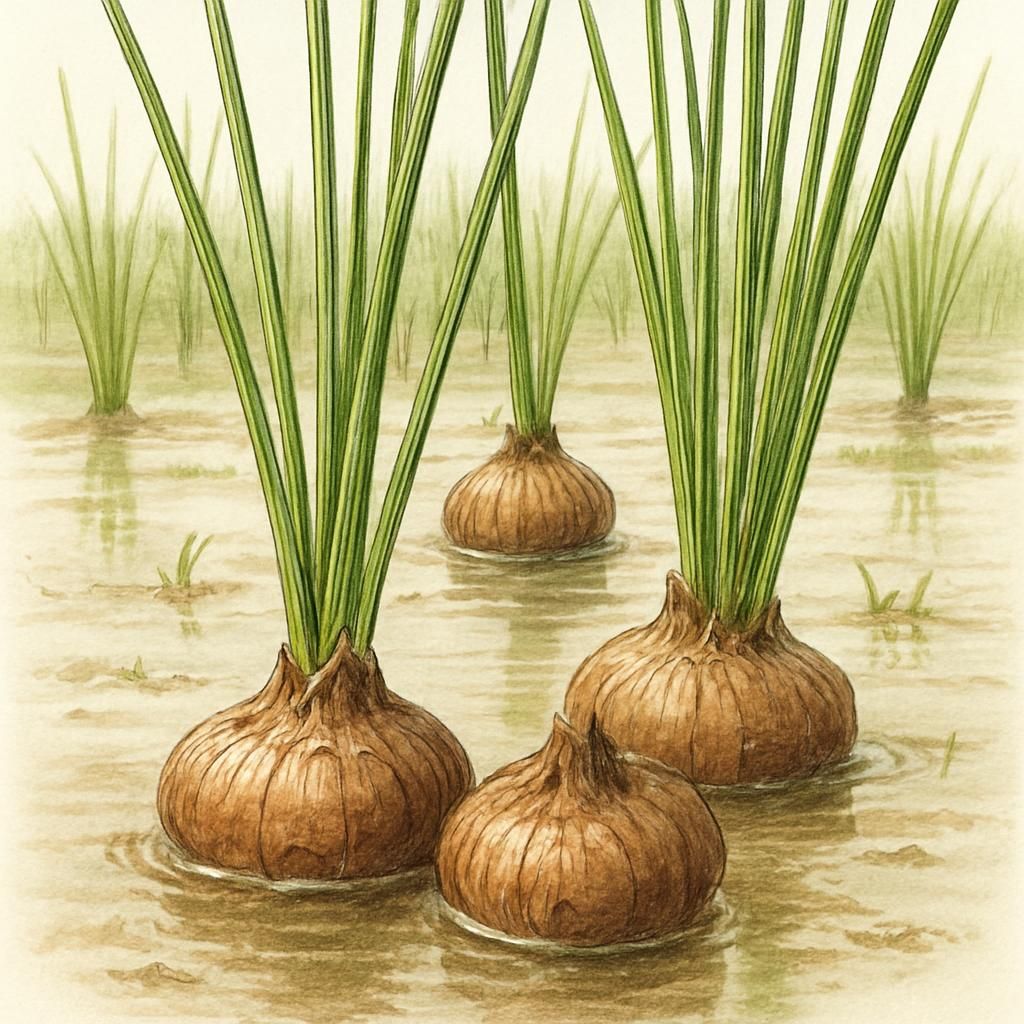
Introduction to Water Chestnut (Eleocharis dulcis)
Water Chestnut (Eleocharis dulcis) is a tropical and subtropical aquatic sedge cultivated primarily for its sweet, crunchy underground corms. Unlike the unrelated European water chestnut (Trapa natans), Eleocharis dulcis belongs to the Cyperaceae family and thrives in standing water similar to Rice. Commercial production is concentrated in China, Taiwan, Thailand, and parts of Australia and the southern United States.
The crop offers high value per hectare because corms store well and command premium prices in fresh and processed markets. Small-scale growers can integrate water chestnut into existing paddy infrastructure or purpose-built shallow ponds. The plant also provides ecological services by filtering nutrients and stabilizing soil in wetland systems.
Successful cultivation depends on maintaining consistent shallow flooding, fertile organic soils, and protection from aquatic weeds and rodents. This guide delivers professional-grade practices for commercial and serious home production.
Botanical Profile of Water Chestnut (Eleocharis dulcis)
Eleocharis dulcis is a rhizomatous perennial that produces slender, cylindrical, leafless culms 30–100 cm tall. The plant spreads via creeping rhizomes that terminate in swollen corms. Each corm is globose to ovoid, 2–5 cm in diameter, with a thin brown skin and white, crisp flesh.
The inflorescence is a small terminal spikelet bearing bisexual flowers that are wind-pollinated. After flowering, the culms senesce while the corms enter dormancy. Corms remain viable for several months when kept moist and cool. The species is highly adapted to anaerobic conditions and can tolerate temporary flooding depths of 5–15 cm.
Soil, pH, and Climate Requirements for Water Chestnut (Eleocharis dulcis)
Water chestnut performs best in heavy clay or clay-loam soils that retain water and supply stable anaerobic conditions. Organic matter content should exceed 4 % to support microbial activity and nutrient retention.
| Parameter | Ideal Range | Notes |
|---|---|---|
| Soil Texture | Clay to clay-loam | High water-holding capacity required |
| Soil pH | 5.5–7.0 | Slightly acidic to neutral |
| Organic Matter | >4 % | Incorporate well-rotted compost or manure |
| Temperature (Growing) | 20–35 °C day / 15–25 °C night | Frost-free period minimum 180 days |
| Water Depth | 5–15 cm constant | Maintain throughout active growth |
| Salinity Tolerance | <2 dS/m | Sensitive to brackish conditions |
The crop requires a frost-free season of at least 180 days. Daytime temperatures above 20 °C promote rapid culm elongation and corm enlargement.
Step-by-Step Planting & Propagation
- Site Selection: Choose a level field or construct shallow ponds with impermeable clay liners. Ensure reliable irrigation and drainage infrastructure.
- Soil Preparation: Plow to 20 cm depth, incorporate 20–30 t/ha well-decomposed organic matter, and level precisely to avoid water ponding.
- Corm Selection: Use disease-free, firm corms 3–4 cm in diameter stored at 10–15 °C until planting.
- Planting Time: In tropical regions plant at the onset of the warm rainy season; in temperate zones start indoors 4–6 weeks before last frost.
- Planting Method: Press corms 5–8 cm deep on a 20 cm × 20 cm grid. Flood immediately to 5 cm depth.
- Initial Flooding: Maintain 5 cm water for the first 30 days to encourage establishment, then raise to 10–15 cm.
Care & Maintenance regimes for Water Chestnut (Eleocharis dulcis)
Consistent water management and balanced nutrition are critical. Monitor dissolved oxygen and pH weekly during peak growth.
| Growth Stage | Water Depth | Fertilizer (NPK kg/ha) | Pruning / Weeding Schedule |
|---|---|---|---|
| Establishment (0–30 days) | 5 cm constant | 40-20-30 basal | Hand weed weekly; remove floating algae |
| Vegetative (30–90 days) | 10–15 cm | 60-30-45 split at 45 days | Spot treat Aphids with insecticidal soap |
| Corm Bulking (90–150 days) | 10–15 cm | 30-15-60 potassium emphasis | Maintain water clarity; minimal pruning |
| Pre-harvest (150–180 days) | 5 cm | Stop nitrogen 30 days prior | Drain field gradually over 10–14 days |
Mulch exposed banks with rice straw to suppress weeds and reduce evaporation. Avoid over-fertilization to prevent excessive vegetative growth at the expense of corm size.
Pests, Diseases & Organic Management
Major pests include Rodents, water birds, and occasional Aphids. Rodents can be controlled with perimeter traps and encouraging natural predators. Birds are deterred by reflective tape and netting.
Diseases are primarily fungal and bacterial rots favored by poor water quality. Maintain clean water inflow and avoid overcrowding. Copper-based sprays or beneficial microbes can suppress early infections. Regular monitoring and removal of infected plants limit spread.
Harvesting, Curing & Optimal Storage
Corms reach maturity 150–180 days after planting when culms yellow and water is drained. Lift corms by hand or mechanical harvester, taking care not to bruise the skin. Wash immediately in clean water and grade by size.
Cure at 25–28 °C with high humidity for 5–7 days to heal minor wounds. Store at 4–10 °C and 85–90 % relative humidity; corms remain marketable for 4–6 months. Avoid freezing temperatures.
Companion Planting for Water Chestnut (Eleocharis dulcis)
Water chestnut integrates well with Rice in rotation systems, breaking pest cycles and improving soil structure. Floating aquatic plants such as water spinach can be grown on the surface to provide additional income and shade that moderates water temperature. Avoid planting near heavy feeders that compete for nutrients in the shared water column.
Border plantings of Marigold deter insects while providing habitat for beneficial predators. Deep-rooted species are unsuitable because they disrupt the anaerobic soil profile required by water chestnut.