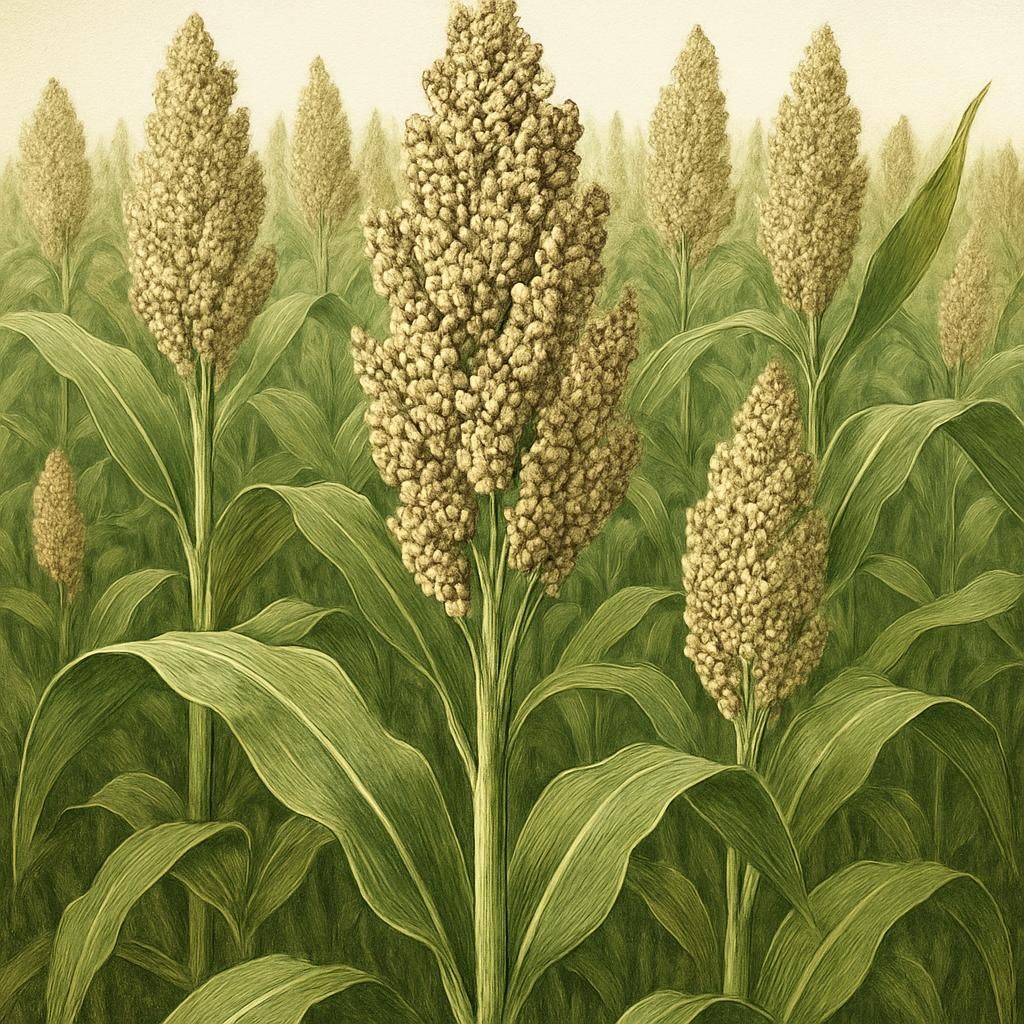
Introduction to Sorghum (White Kafir)
Sorghum, specifically the White Kafir variety, is a versatile grain crop prized for its drought resistance and adaptability to various soil types. Often cultivated in arid and semi-arid regions, this crop is crucial for food security and animal fodder. Its uses span from human consumption in the form of flour and porridge to livestock feed.
Botanical Profile of Sorghum (White Kafir)
White Kafir sorghum, scientifically known as Sorghum bicolor, is part of the Poaceae family. It's a C4 cereal grain similar in appearance to maize, with tall stalks and large seed heads. The plant's height can range from 0.5 to 4 meters, with inflorescences that contain hundreds to thousands of small seeds. This variety is mainly grown for its high starch content, contributing to its popularity in the food industry.
Soil, pH, and Climate Requirements for Sorghum (White Kafir)
White Kafir sorghum is suitable for regions with high temperatures and semi-arid conditions. It is adaptable to different soil types but thrives best in well-drained loamy soil.
| Parameter | Ideal Condition |
|---|---|
| Soil Type | Loamy, Sandy Loam |
| Soil pH | 5.5 - 7.5 |
| Rainfall | 400 - 800 mm annually |
| Temperature Range | 25°C - 30°C |
Step-by-Step Planting & Propagation
- Site Selection: Choose a site that receives full sunlight and has well-draining soil.
- Soil Preparation: Till the soil to a depth of 30 cm, incorporating organic matter or compost to enhance fertility.
- Seed Sowing: Sow seeds 2-5 cm deep in rows spaced 45-90 cm apart, with seeds 5-15 cm apart within the rows.
- Watering: Irrigate immediately after sowing; maintain soil moisture until germination.
- Thinning: After 2-3 weeks, thin seedlings to ensure adequate spacing.
Care & Maintenance Regimes for Sorghum (White Kafir)
White Kafir requires minimal maintenance, making it an excellent choice for sustainable and resource-efficient farming.
| Activity | Schedule |
|---|---|
| Watering | As needed; weekly in dry spells |
| Fertilization | Twice: At planting and mid-growth |
| Weeding | As necessary, especially early in the season |
| Pest Control | Regular monitoring for Spider Mites and Aphids |
Pests, Diseases & Organic Management
White Kafir sorghum is susceptible to several pests and diseases, including spider mites, aphids, and grain mold. Regular monitoring and integrated pest management (IPM) strategies, such as introducing natural predators and rotating crops, can help mitigate these issues. For more on sustainable pest management practices, read 7 Summer Pest Traps That Sabotage Small Farm Harvests.
Harvesting, Curing & Optimal Storage
Sorghum is ready to harvest when grains are hard and can no longer be dented by a fingernail. Cut the stalks and allow them to dry for a few days. Thresh the grains and store them in a cool, dry, and pest-free environment to prevent spoilage and maintain quality.
Companion Planting for Sorghum (White Kafir)
Companion planting with crops such as legumes or Millet can enhance soil fertility by fixing atmospheric nitrogen, thereby reducing the need for nitrogen fertilizers. For additional insights on companion planting, read Summer Companion Planting: 10 Organic Pairings to Boost Small Farm Resilience.