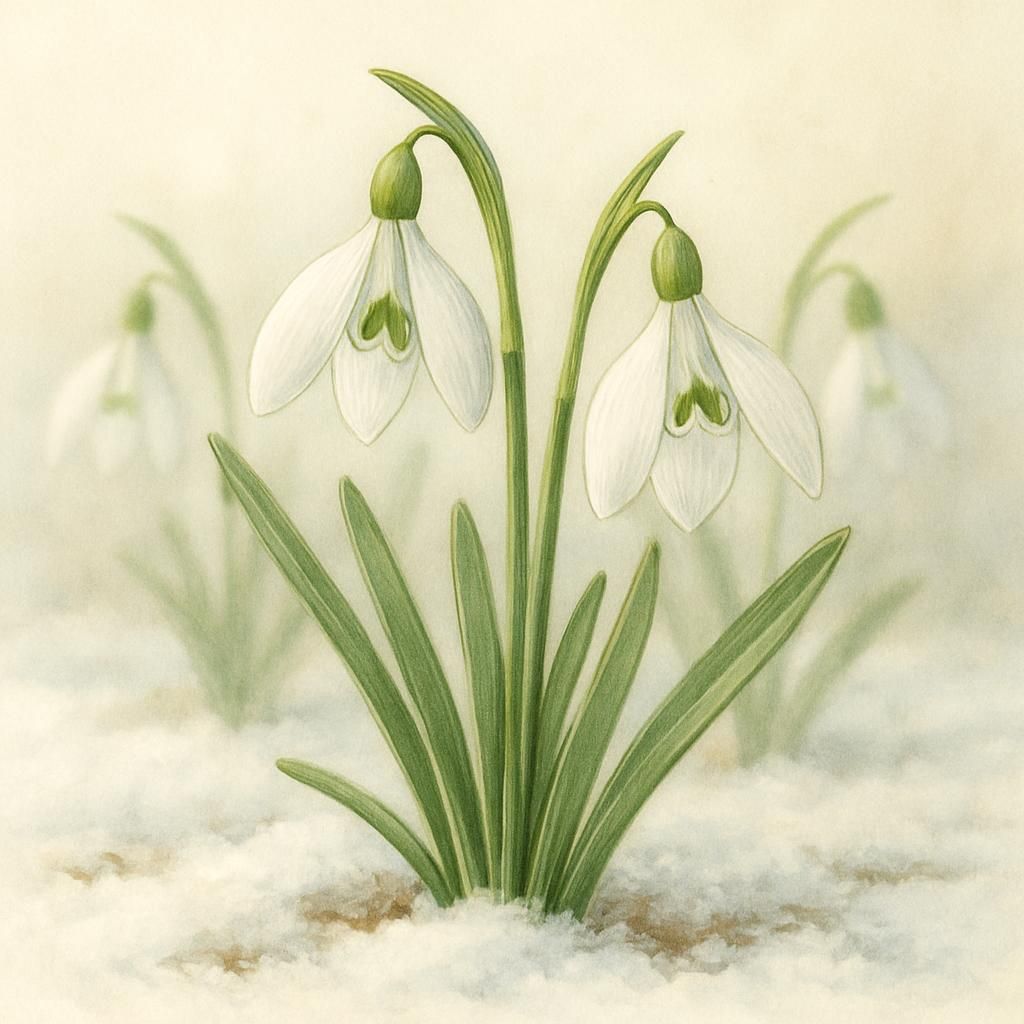
Introduction to snowdrops
Snowdrops (Galanthus nivalis) are among the earliest heralds of spring, producing nodding white flowers often while snow still blankets the ground. These hardy perennial bulbs belong to the Amaryllidaceae family and thrive in deciduous woodlands, shaded borders, and naturalized meadows. Gardeners value them for their low maintenance, deer resistance, and ability to naturalize into expansive drifts over time. Their emergence provides critical early-season nectar for pollinators awakening from dormancy.
Botanical Profile of snowdrops
Snowdrops produce narrow, strap-shaped leaves that emerge in late winter, followed by solitary flowers on slender scapes 10–20 cm tall. Each bloom consists of six tepals: three outer ones that are pure white and three inner ones marked with green apical notches. The bulbs are tunicate, storing energy in fleshy scales, and the plant reproduces both by seed and offset bulblets. Genetic diversity exists across more than 20 recognized species and numerous cultivars, with variations in flower size, marking patterns, and flowering times.
Soil, pH, and Climate Requirements for snowdrops
Snowdrops require well-drained yet moisture-retentive soil rich in organic matter. They prefer neutral to slightly alkaline conditions and cool, temperate climates with distinct seasons. Avoid waterlogged or compacted sites that promote bulb rot.
| Parameter | Ideal Range/Value | Notes |
|---|---|---|
| Soil Type | Loamy, humus-rich, well-drained | Incorporate leaf mold or compost |
| Soil pH | 6.5–7.5 | Slightly alkaline preferred |
| Temperature Range | -15°C to 20°C (5°F to 68°F) | Hardy to USDA zones 3–7 |
| Light Requirements | Partial shade to full sun | Best under deciduous trees or north-facing |
| Moisture | Evenly moist in growth, drier in summer | Mimics woodland floor conditions |
| Spacing | 8–10 cm (3–4 in) apart | Plant in groups of 10–25 for natural effect |
Step-by-Step Planting & Propagation
Plant snowdrop bulbs in autumn when soil temperatures drop below 15°C (59°F). Choose plump, firm bulbs free of mold or damage. Dig holes or trenches 8–10 cm deep and space 8–10 cm apart. Position bulbs with the pointed end upward and cover with soil amended with well-rotted leaf mold. Water thoroughly after planting to settle the medium. For propagation, divide established clumps immediately after flowering while foliage remains green; replant offsets at the same depth. Seeds require cold stratification and may take 3–4 years to reach flowering size. Always source virus-indexed stock to prevent transmission of Narcissus yellow stripe virus.
Care & Maintenance regimes for snowdrops
Snowdrops require minimal intervention once established. Allow foliage to senesce naturally to recharge bulbs. Remove weeds by hand to avoid disturbing shallow roots. In very poor soils, apply a thin top-dressing of compost in early autumn. Divide congested clumps every 4–6 years to maintain vigor.
| Task | Schedule | Details |
|---|---|---|
| Watering | Weekly during active growth | Provide 2–3 cm (1 in) if rainfall insufficient; reduce after flowering |
| Fertilizer | Early autumn and post-bloom | Apply balanced organic fertilizer or well-rotted manure at 50 g/m² |
| Pruning | After foliage yellows (late spring) | Cut back spent leaves; do not remove green foliage |
Pests, Diseases & Organic Management
Snowdrops are generally pest-resistant but can suffer from Narcissus bulb fly larvae that tunnel into bulbs. Slugs and snails may damage emerging shoots in damp springs. Fungal issues include Botrytis and basal rot caused by Fusarium species. Practice strict sanitation by removing infected material. Use floating row covers or diatomaceous earth for slug control. Improve drainage and rotate planting sites every 5–7 years to reduce disease pressure. Encourage beneficial nematodes and ground beetles as biological controls.
Harvesting, Curing & Optimal Storage
Snowdrops are primarily grown as ornamentals; harvesting occurs when flowers are fully open but before pollen shed for cut-flower use. Cut stems at the base early in the morning. For bulb lifting, wait until foliage has completely died back in late spring. Gently lift clumps with a fork, shake off soil, and separate offsets. Cure bulbs in a shaded, well-ventilated area at 18–20°C for 7–10 days. Store in paper bags or mesh nets with slightly moist peat moss at 10–15°C until replanting in autumn. Inspect regularly and discard any soft or moldy bulbs.
Companion Planting for snowdrops
Snowdrops pair beautifully with other early-season bulbs such as Crocus and winter aconite. Underplant beneath deciduous shrubs like Cornus or pair with evergreen ferns for textural contrast. Their shallow roots make them compatible with shallow-rooted perennials including Viola and primroses. Avoid planting near aggressive spreaders that may outcompete young colonies. In vegetable gardens, interplant rows with snowdrops to provide early pollinator support without shading later crops.