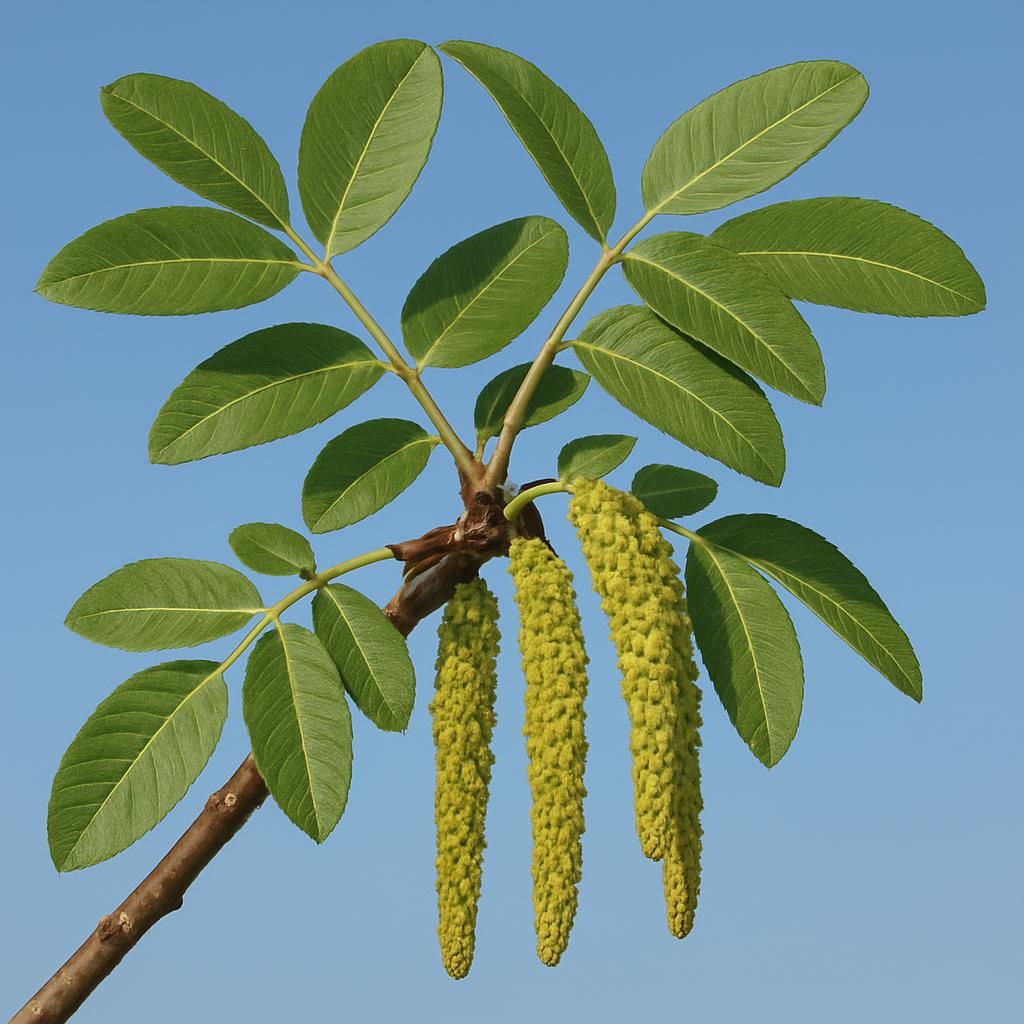
Introduction to Pistachio (Peters - Pollinator)
Pistachio (Peters - Pollinator) is the most widely planted male cultivar used to fertilize female pistachio trees, particularly Kerman Pistachio. One Peters tree can service 8–12 female trees, making it essential for commercial orchards. The cultivar produces abundant, viable pollen over an extended bloom window that overlaps with the flowering period of most female varieties. Because pistachios are dioecious and wind-pollinated, strategic placement and density of Peters trees directly influence nut yield and quality. In addition to its pollination value, Peters exhibits strong vigor, cold hardiness, and compatibility with common rootstocks such as Pistacia atlantica and UCB-1.
Botanical Profile of Pistachio (Peters - Pollinator)
Pistacia vera 'Peters' belongs to the Anacardiaceae family. Male trees produce catkins 5–10 cm long that release billions of pollen grains over 7–14 days. Unlike female trees, Peters does not set fruit but allocates energy into robust vegetative growth and pollen production. The tree develops an open, spreading canopy reaching 6–9 m in height with a similar spread. Leaves are pinnately compound with 3–5 leaflets, dark green above and paler beneath. Bark is gray-brown and becomes deeply furrowed with age. Peters is deciduous and enters dormancy in winter, requiring 800–1,000 chilling hours below 7 °C for proper spring bud break.
Soil, pH, and Climate Requirements for Pistachio (Peters - Pollinator)
Pistachios thrive in deep, well-drained soils with low salinity. The following table summarizes ideal growing conditions:
| Parameter | Ideal Range | Notes |
|---|---|---|
| Soil Type | Sandy loam to loam | Excellent drainage critical |
| Soil pH | 7.0–8.2 | Tolerates slight alkalinity |
| Soil Salinity (EC) | < 4 dS/m | Sensitive to chloride and boron |
| Annual Rainfall | 200–400 mm | Supplemental irrigation required |
| Temperature Range | −10 °C to 45 °C | Needs hot, dry summers |
| Chill Hours | 800–1,000 hours below 7 °C | Required for uniform bloom |
| USDA Zones | 7b–10 | Frost-free period > 200 days |
Step-by-Step Planting & Propagation
- Select certified disease-free Peters scions grafted onto vigorous rootstocks such as UCB-1 or Pistacia atlantica.
- Prepare planting holes 60–80 cm wide and deep; amend with 20 % well-aged compost if soil organic matter is below 1 %.
- Plant in late winter while trees are dormant. Set the graft union 5–10 cm above soil level.
- Space Peters trees every third row or every 8–10 female trees within rows at 5–6 m between rows and 4–5 m within rows.
- Water immediately after planting and apply a 10 cm layer of organic mulch, keeping mulch 15 cm from the trunk.
- Stake young trees for the first two seasons to protect against wind.
Care & Maintenance regimes for Pistachio (Peters - Pollinator)
Consistent irrigation, balanced nutrition, and annual pruning are essential for sustained pollen production. The following table provides a seasonal schedule:
| Season | Water (mm/week) | Fertilizer (per tree) | Pruning Action |
|---|---|---|---|
| Winter | 0 | Apply 0.5 kg 15-15-15 + micronutrients | Remove dead wood; shape scaffold branches |
| Spring | 25–35 | 0.25 kg urea at bud swell | Tip-prune new growth to encourage lateral branching |
| Summer | 40–50 | Foliar zinc and boron at full leaf | Minimal; remove water sprouts |
| Autumn | 20 | 0.3 kg potassium sulfate | Light thinning to improve light penetration |
Monitor leaf nutrient levels annually and adjust rates based on tissue analysis. Maintain a weed-free strip 1.5 m wide around each trunk.
Pests, Diseases & Organic Management
Peters trees are generally hardy but can host common pistachio pests and diseases. Key threats include Navel Orangeworm, Spider Mites, and Verticillium Wilt. Implement integrated pest management: install pheromone traps for navel orangeworm, release predatory mites for spider mite control, and avoid over-irrigation to reduce verticillium risk. Copper sprays at dormancy help suppress bacterial canker. Maintain orchard sanitation by removing mummified nuts and fallen leaves.
Harvesting, Curing & Optimal Storage
Although Peters produces no nuts, pollen shedding occurs in late spring. Monitor catkin color change from green to tan; shake branches gently over white paper to assess pollen release. Collect and store surplus pollen at 4 °C in sealed containers for up to 30 days if bloom overlap is poor. For female orchards, time supplemental pollen applications during peak female receptivity. Store harvested pollen in desiccated conditions to maintain >80 % viability.
Companion Planting for Pistachio (Peters - Pollinator)
Peters benefits from nitrogen-fixing companions such as Clover and Hairy Vetch sown in orchard alleys. These cover crops improve soil structure, suppress weeds, and attract beneficial insects. Avoid planting shallow-rooted crops within 2 m of trunks to prevent competition. Marigold borders can deter nematodes and enhance biodiversity without interfering with wind pollination.