Introduction to lychee
The lychee erinose mite, scientifically known as Aceria litchii (Keifer), is one of the most destructive pests affecting lychee (Litchi chinensis) orchards worldwide. This tiny eriophyid mite, often simply referred to as the 'lychee mite' or 'lychee erinose mite,' measures less than 0.2 mm in length, making it invisible to the naked eye. First identified in China in 1965, it has since invaded major lychee-producing areas including Australia, Florida, Hawaii, India, and parts of Africa and South America. The mite's feeding punctures plant cells, triggering a hypersensitive response that results in the formation of dense, felt-like erinose (hairy galls) on leaves, buds, and young shoots. This not only disfigures the tree but also reduces photosynthetic capacity, weakens vigor, and drastically cuts fruit yields—losses can exceed 80% in untreated infestations. Young trees and flushes are particularly vulnerable, with repeated attacks leading to tree decline and death over 2-3 years. In commercial settings, this pest can render fruit unmarketable due to stunted growth and secondary infections. Early diagnosis is critical, as chemical controls are limited due to the mite's protected habitat within erinose. For growers, understanding this pest's biology is key to implementing integrated pest management (IPM) strategies that preserve beneficial insects while protecting high-value lychee crops. Tropical and subtropical climates favor its proliferation, making vigilance essential in regions like Guangdong, Vietnam, and Queensland.
Identifying Symptoms & Damage
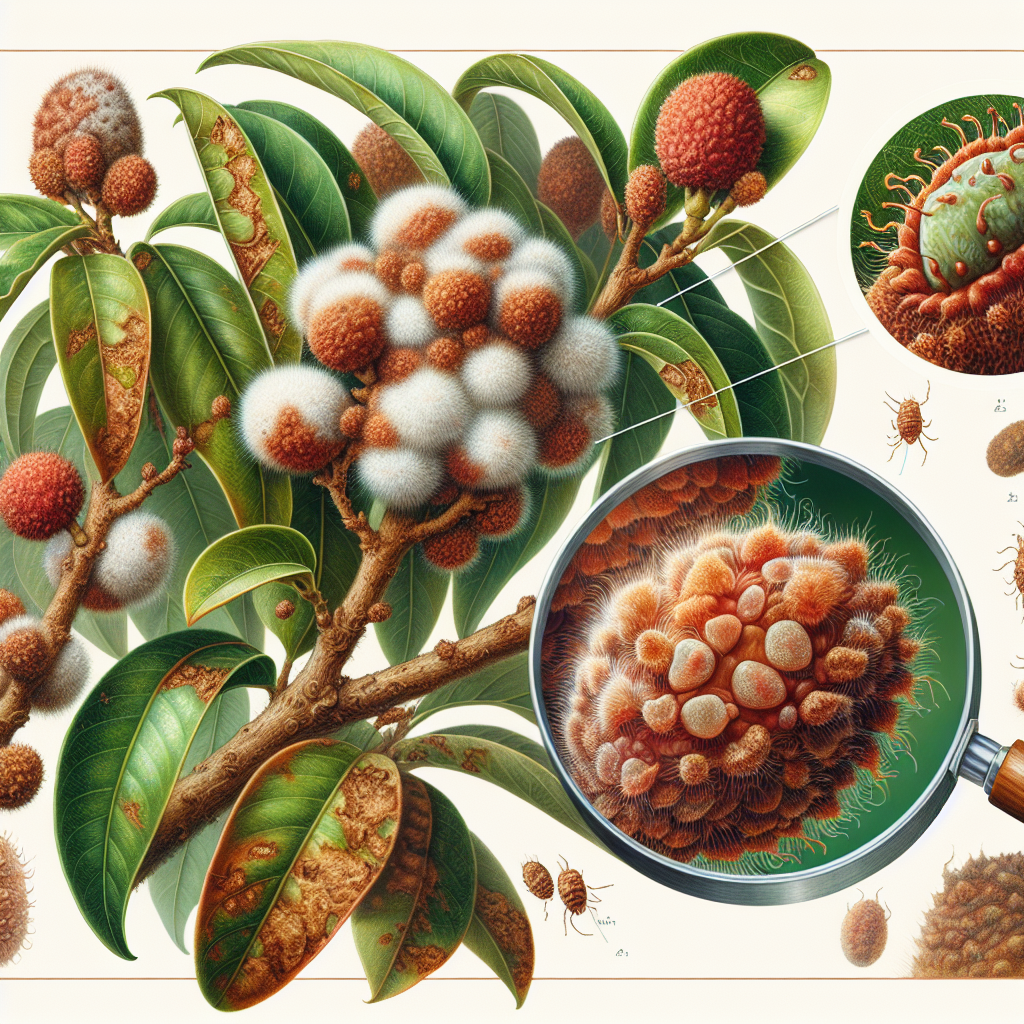
Recognizing lychee erinose mite damage starts with inspecting new growth. Initial symptoms appear on tender leaves and buds as silvery or rusty patches that quickly develop into white, woolly erinose—dense tufts of hairs up to 2-3 mm long covering the entire leaflet surface. Affected leaves curl, crinkle, and become brittle, often dropping prematurely. On shoots, erinose forms rust-colored felts that girdle stems, causing dieback. Buds swell abnormally and fail to open, leading to bushy, stunted terminals. Severe infestations produce bronzed, necrotic leaves with black sooty mold from honeydew-like secretions, though mites themselves don't produce honeydew. Differentiate from fungal erineum or powdery mildew by rubbing: erinose doesn't powder off but reveals mites under magnification (use 20x hand lens). Damage progresses from lower canopy upward during flushes. Yield impact: deformed panicles set fewer, smaller fruits. Secondary pests like mealybugs or aphids often follow, complicating diagnosis. Scout weekly during spring flush; clip samples for lab confirmation if unsure. Economic threshold: 10% infested leaves triggers action.
Lifecycle and Progression of lychee
Aceria litchii completes its lifecycle in 10-14 days under optimal conditions (25-30°C, high humidity). Females overwinter in bark cracks, bud scales, and fallen leaves. In spring (February-April in tropics), they migrate to new flushes, laying 20-50 eggs per female inside developing tissues. Eggs hatch in 2-3 days into larvae that feed immediately, inducing erinose within 7 days. Larvae mature to protonymphs and deutonymphs, then adults—all stages cause damage. There are 10-20 overlapping generations per year, peaking during wet seasons. Dispersal occurs via wind, splashing rain, or infested pruning tools. Progression: Week 1 post-infestation—speckling; Week 2—erinose formation; Month 1—leaf drop and shoot dieback; Year 2—defoliation and reduced flowering. Populations explode post-rain, declining in dry heat (>35°C). Males are rare; parthenogenetic reproduction ensures rapid buildup. Monitor with sticky traps or beat sheets for motile stages.
Environmental Triggers & Risk Factors
Warm, humid conditions (80-90% RH, 24-32°C) are prime triggers, aligning with lychee flush cycles in monsoon regions. Overhead irrigation or heavy dews exacerbate spread by dislodging mites onto new growth. Poor air circulation in dense canopies traps humidity, favoring outbreaks. Risk factors include: susceptible varieties like 'Brewster' or 'Kwai Mi'; young transplants (<3 years); excessive nitrogen promoting succulent flushes; nearby unmanaged lychee or longan (alternative host); imported infested stock. Drought-stressed trees recover poorly from attacks. Hurricane-prone areas see post-storm surges from wind dispersal. Soil type irrelevant, but waterlogged roots weaken resistance. Climate change extends wet seasons, intensifying pressure. Check mango orchards nearby, as shared vectors exist. For more on hyper-local weather impacts, see Why 80% of Small Farms Battle Weather Disasters - And How Hyper-Local AI Forecasts Can Save Your Harvest.
Organic Control & Treatment Plans
Organic management emphasizes cultural, biological, and minimal chemical tactics. Cultural: Prune infested terminals (burn debris) pre-flush to reduce inoculum; space trees 8-10m for airflow; avoid excess N, balance with K for toughness. Drip irrigate to minimize wet foliage. Biological: Release predatory mites (Phytoseiulus persimilis, Amblyseius spp.) at 10/leaf; conserve native predators like ladybugs. Neem oil (2-3 ml/L) or garlic-chili sprays smother all stages—apply 3x weekly during flush, evenings to spare bees. Dormant oil (3-5%) in winter targets overwinterers. Sulfur (80% wettable, 5g/L) burns mites in erinose but test for phytotoxicity. Soap sprays (potassium salts, 20ml/L) weekly. Treatment Plan: Scout weekly; at 5% erinose, clip/prune + neem; >20%, add predators + oils. Rotate modes to prevent resistance. Integrate with thrips controls if co-occurring. Avoid broad-spectrum sprays. Success rates: 70-90% with IPM vs. 40% singles.
Preventing lychee in the Future
Prevention hinges on exclusion and resilience. Inspect nursery stock under magnification; quarantine new plants 6 months. Sanitize tools with 10% bleach. Plant resistant cultivars like 'Mauritius' or hybrids. Mulch to suppress weeds hosting predators' prey. Calendar sprays: dormant oil Jan-Feb, sulfur pre-flush. Monitor with delta traps baited for motile mites. Promote biodiversity: interplant marigold for nematode suppression, yarrow for predators. Avoid overhead water; use fans in greenhouses. Annual clean-up: remove mummies, debris. Resistant rootstocks under trial. Educate workers on hygiene. Long-term: scout neighbors, buffer zones. Combine with AI scouting for early detection—see Spring Pest Patrol: Organic AI Strategies to Shield Your Crops from Common Invaders. Threshold-based IPM sustains yields >20kg/tree.
Crops Most Affected by lychee
Primarily lychee (Litchi chinensis), with longan (Dimocarpus longan) as key alternative host—mites thrive equally, causing similar erinose. Limited reports on rambutan (Nephelium lappaceum) and soapberry (Sapindus spp.), but not economic threats. No damage to mango, citrus, or avocado. Focus protection on lychee/longan blocks near natives. In mixed orchards, isolate susceptible crops.