Introduction to Locust Bean Gum
Locust bean gum (LBG), also known as carob gum, is a natural thickening and stabilizing agent derived from the endosperm of seeds of the evergreen carob tree, Ceratonia siliqua. Global demand continues to rise in food, pharmaceutical, and textile industries because LBG provides superior viscosity, heat stability, and synergy with other hydrocolloids such as xanthan and kappa-carrageenan. Professional growers target seed yields of 2.5–4.0 t/ha from mature orchards to meet the 8–12 % endosperm recovery typical of commercial processing lines.
Botanical Profile of Locust Bean Gum
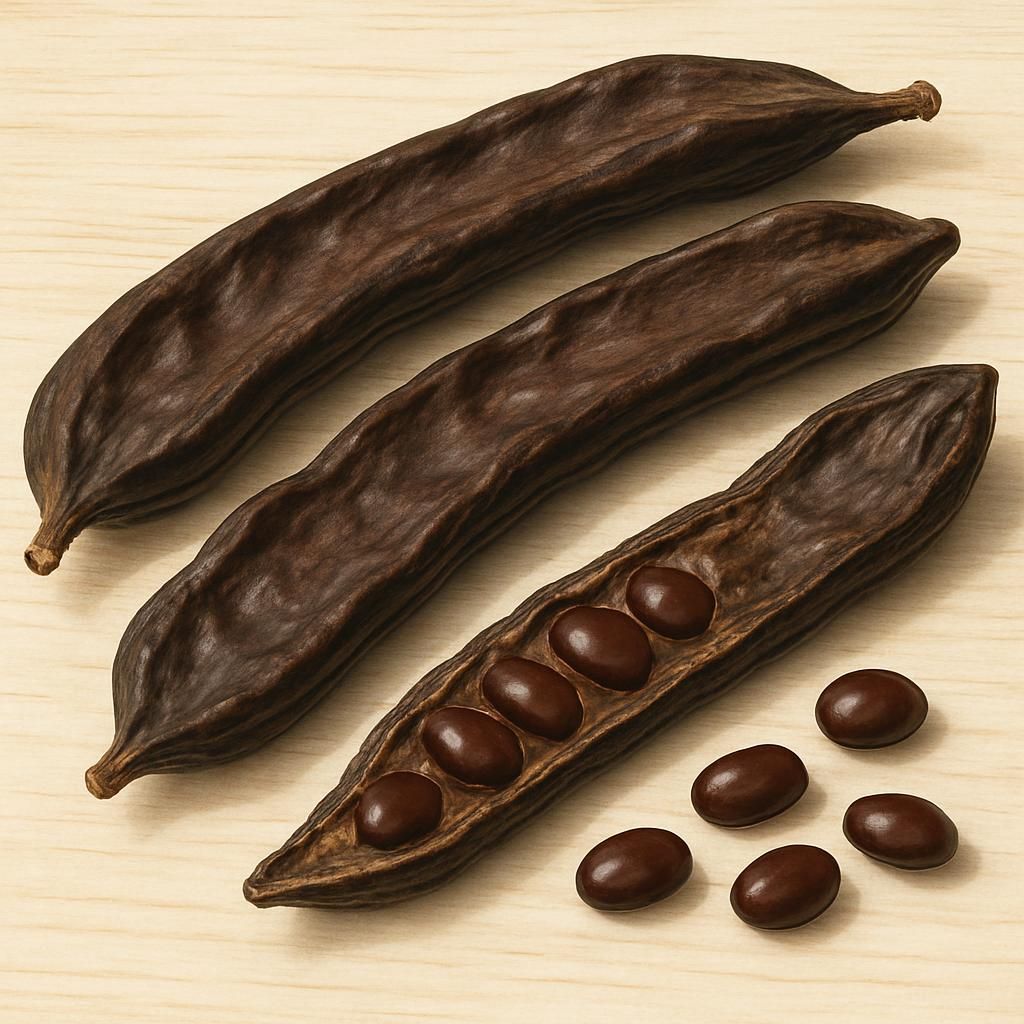
Ceratonia siliqua is a dioecious, slow-growing evergreen legume reaching 10–15 m in height with a broad, spreading canopy. Leaves are pinnate, leathery, and dark green; flowers are small, reddish, and apetalous, appearing in late summer to autumn on both male and female trees. Female trees produce indehiscent pods 10–20 cm long containing 8–12 hard, brown seeds. The endosperm constitutes 30–35 % of seed weight and is the sole commercial source of galactomannan gum. Trees begin bearing economically at 6–8 years and can remain productive for 80–100 years under good management.
Soil, pH, and Climate Requirements for Locust Bean Gum
Carob tolerates marginal soils but performs best on well-drained, calcareous substrates. The following table summarizes ideal conditions for commercial production.
| Parameter | Ideal Range | Notes |
|---|---|---|
| Soil Type | Sandy loam to loam, >50 cm depth | Avoid heavy clays and waterlogged sites |
| Soil pH | 7.0–8.5 | Slightly alkaline preferred |
| Temperature Range | 15–30 °C daytime, >–5 °C minimum | Frost-sensitive when young |
| Annual Rainfall | 250–600 mm | Supplemental irrigation needed below 400 mm |
| Altitude | 0–800 m | Coastal Mediterranean climates optimal |
| Sunlight | Full sun, >2 000 h year⁻¹ | Partial shade reduces pod set |
Step-by-Step Planting & Propagation
- Site selection and soil testing should precede any planting. Amend with 2–3 t/ha agricultural lime if pH <6.8.
- Use certified, grafted female scions (cultivars ‘Rojal’, ‘Matalafera’, or ‘Negra’) on 3-year-old seedling rootstocks for uniform orchards.
- Plant at 6 m × 6 m spacing (278 trees/ha) or 7 m × 5 m (286 trees/ha) depending on machinery width.
- Dig planting holes 60 × 60 × 60 cm; backfill with native soil mixed 1:1 with well-rotted compost.
- Install drip irrigation with two 4 L/h emitters per tree during the first three seasons.
- Mulch a 1 m radius circle with 8–10 cm of organic mulch to conserve moisture and suppress weeds.
Care & Maintenance regimes for Locust Bean Gum
Mature orchards require minimal intervention once established. The table below outlines seasonal schedules.
| Season | Water (mm/week) | Fertilizer (kg N-P-K/tree) | Pruning Schedule |
|---|---|---|---|
| Spring | 15–20 | 0.4-0.2-0.4 at bud break | Light thinning of crossing branches |
| Summer | 25–30 | None (foliar micronutrients only) | Remove suckers and water sprouts |
| Autumn | 10–15 | 0.3-0.15-0.3 post-harvest | Structural pruning every 3–4 years |
| Winter | 5–8 (if no rain) | None | Sanitation pruning of dead wood |
Pests, Diseases & Organic Management
Major threats include carob moth (Ectomyelois ceratoniae), black scale (scale insects), and root-knot nematodes. Implement mating-disruption dispensers for carob moth and release Cryptolaemus montrouzieri against scale. Maintain soil health with compost tea drenches and cover crops to suppress nematodes. Avoid overhead irrigation to reduce Botrytis pod rot.
Harvesting, Curing & Optimal Storage
Harvest when pods turn dark brown and rattle (late August–October in Mediterranean climates). Collect with trunk shakers or manual beating onto tarps. Air-dry pods to <12 % moisture on raised racks for 7–10 days. Remove seeds mechanically, then store at 10–15 °C and <60 % RH in jute or multi-wall paper bags. Seed viability remains >90 % for 3–5 years under these conditions.
Companion Planting for Locust Bean Gum
Interplant early-season clover or hairy vetch between rows to fix nitrogen and improve orchard biodiversity. Thyme and rosemary planted on berms deter scale insects while providing additional income from essential-oil harvests. Maintain 2 m buffers between carob and avocado to avoid competition for deep soil moisture.