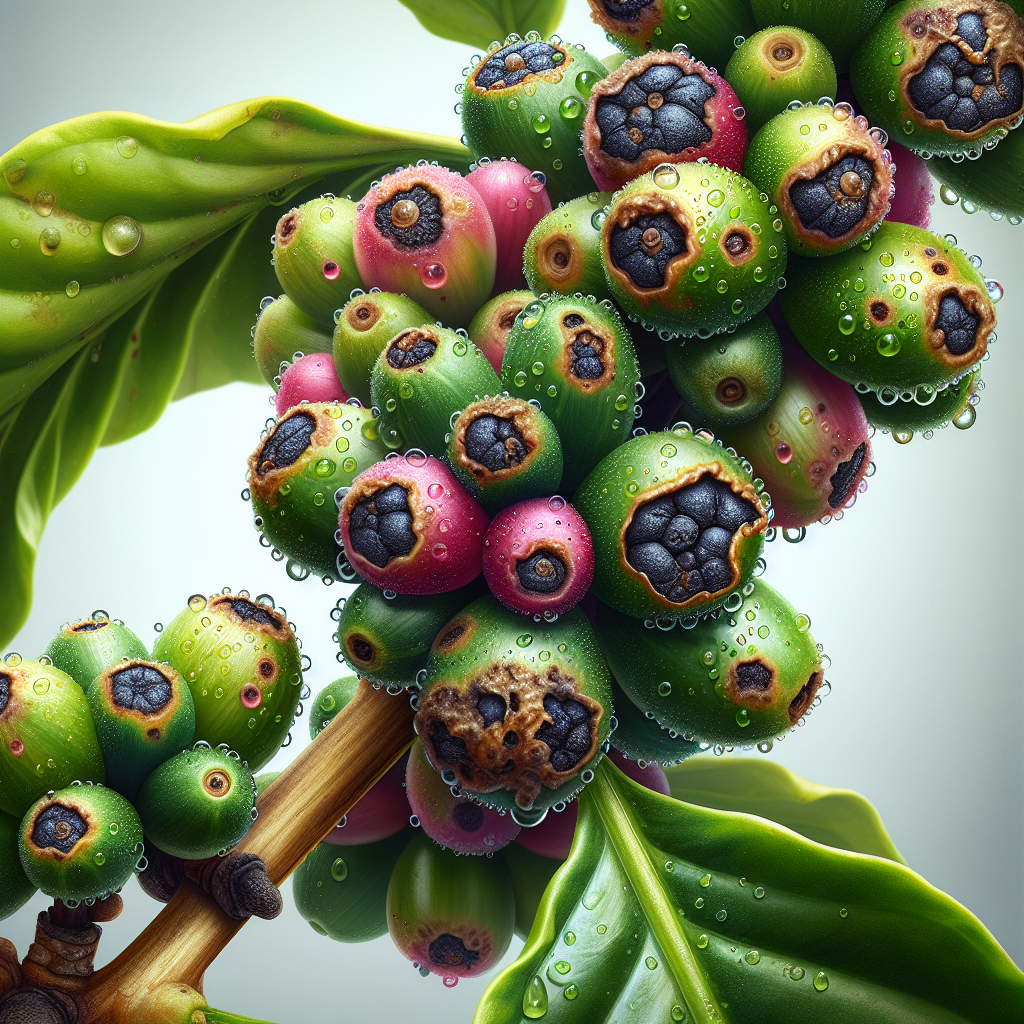
Introduction to Coffee berry disease
Coffee berry disease (CBD), caused by the fungus Colletotrichum kahawae, stands as one of the most destructive pathogens to Coffee (crop) production worldwide, particularly devastating Arabica coffee varieties in equatorial highlands. First identified in Kenya in the 1920s, CBD has since spread across major coffee-growing regions in East and Central Africa, causing annual losses estimated at 40-80% of potential yields without intervention. This disease targets developing coffee berries, leading to rot, lesion formation, and complete crop failure in severe epidemics. Understanding CBD is crucial for coffee farmers, as it thrives in cool, humid conditions typical of premium Arabica zones between 1,500-2,100 meters elevation. Unlike broader fungal issues like anthracnose, CBD is highly specific to coffee berries, making it a specialized threat that demands targeted management. Successful control hinges on integrated cultural practices, resistant varieties, and timely organic interventions, as synthetic fungicides are often impractical in remote highlands. This definitive guide equips growers with professional-grade diagnostics, lifecycle insights, and proven strategies to safeguard harvests and sustain profitability in coffee farming.
Identifying Symptoms & Damage
Early detection of Coffee berry disease is paramount, as symptoms progress rapidly from subtle signs to catastrophic berry loss. Initial infections appear as small, water-soaked spots on young green berries, typically 3-6 weeks post-flowering. These lesions expand into sunken, dark brown to black areas with a characteristic pinkish spore mass under humid conditions—hence the disease's berry-rot signature. Active lesions often show concentric rings or zonate patterns, distinguishing CBD from Phytophthora rots, which are more uniformly water-soaked.
As the disease advances, infected berries develop a velvety black coating of fungal spores, leading to premature ripening, shriveling, and drop. 'Active rot' lesions feature creamy-pink sporulation, while 'quiescent' lesions remain dormant until humidity triggers activation. Severe infections cause 'berry blight,' where entire clusters rot, with berries mummifying on the tree. Damage assessment reveals 100% berry loss in untreated plots during peak epidemics. Secondary symptoms include twig dieback and leaf spots, though berry infection dominates. Differentiate from Botrytis by CBD's firmer rot texture and lack of gray mold. Use a hand lens to confirm acervuli (spore-bearing structures) for definitive diagnosis. Economic impact is profound: a single outbreak can wipe out 500-1,000 kg/ha yields, underscoring the need for vigilant scouting every 7-10 days during wet seasons.
Lifecycle and Progression of Coffee berry disease
Colletotrichum kahawae follows a polycyclic lifecycle optimized for coffee's flowering-to-harvest cycle. Conidia (spores) germinate on berry surfaces in free water (dew or rain) at 20-25°C, penetrating via wounds or natural openings within 24-48 hours. Optimal infection occurs at 15-22°C with >90% humidity, common in misty highlands. Inside the berry, the fungus colonizes tissues, producing toxins that kill cells and form lesions in 5-7 days.
Sporulation follows under moist conditions, releasing secondary conidia in pink masses for splash dispersal up to 1 meter. The pathogen overwinters in mummified berries, fallen debris, and cankers on branches. Disease progression aligns with rainy seasons: primary inoculum from debris infects pinhead berries (1-5mm), escalating through 'bloom' to 'pea' stages. A single lesion can produce 10^6 spores daily, fueling 10-20 infection cycles per season. Unlike Fusarium, CBD lacks a soil phase, relying on aerial spread via rain and wind. Lifecycle peaks June-October in Kenya, with quiescent infections activating during wet spells. Understanding this enables precise timing for interventions, breaking the cycle at sporulation stages.
Environmental Triggers & Risk Factors
CBD epidemics are driven by cool, wet microclimates ideal for C. kahawae. Key triggers include prolonged leaf wetness (>12 hours) at 18-22°C, frequent rains (>50mm/month), and high relative humidity (85-100%). Elevations above 1,500m amplify risk due to persistent cloud cover and reduced sunlight. Dense canopies trap moisture, elevating disease pressure—plantings >3m tall without pruning see 3x infection rates.
Risk factors encompass susceptible varieties like Arabica Coffee (Typica), poor air circulation from overcrowding (spacing <1.5m), and excessive nitrogen favoring lush growth. Rain-fed farms without drainage face 50% higher incidence than irrigated ones. Climate change extends wet seasons, boosting outbreaks. Secondary risks: wounds from leaf-feeding caterpillars or hail create entry points. Soil pH <5.5 stresses plants, reducing defenses. For more on hyper-local weather impacts, see Why 80% of Small Farms Battle Weather Disasters - And How Hyper-Local AI Forecasts Can Save Your Harvest. Mapping these triggers via farm audits prevents surprises.
Organic Control & Treatment Plans
Organic management of CBD emphasizes cultural, biological, and resistant variety integration for sustainable control. Pruning and Sanitation: Remove infected berries weekly, destroy debris (burn or bury >50cm deep) to cut inoculum by 70%. Open canopies via selective pruning (20-30% removal) enhances drying, reducing wetness periods by 40%.
Resistant Varieties: Plant Catimor, Ruiru 11, or Batian—yielding 30-50% less loss than Typica. Intercrop with shade trees like Grevillea for moderated humidity.
Biological Controls: Apply Trichoderma asperellum or Bacillus subtilis sprays (10^9 CFU/L) every 14 days post-rain; efficacy reaches 60% in trials. Neem oil (5ml/L) + copper oxychloride (organic-approved, 2g/L) alternates provide contact protection.
Treatment Timeline: Scout at pinhead stage; apply first spray at 10% incidence, repeat 3x at 14-day intervals. Foliar calcium (2kg/ha) bolsters berry resistance. Mulch with dry grass suppresses splash dispersal. Integrated plans yield 80% control vs. 20% untreated. Monitor via traps for early alerts.
Preventing Coffee berry disease in the Future
Long-term prevention builds resilient systems. Site Selection: Avoid valleys with frost pockets; opt for 1,600-1,900m slopes with good drainage. Planting Strategies: Use 1.65x1.65m spacing, disease-free seedlings from certified nurseries. Annual Practices: Prune post-harvest (remove 25% old wood), apply compost (5t/ha) for vigor without excess N. Rotate copper sprays pre-rainy season.
Monitoring Tech: Deploy rain gauges and wetness sensors; threshold: prune if >72 hours wetness. Breed/plant hybrids yearly. Farm hygiene: footbaths, clean tools. Community efforts like regional clean-up campaigns cut inoculum 90%. Climate-resilient practices, per Soil Health Mastery: 5 Proven Strategies for Small Farms to Build Fertile Ground Without Breaking the Bank, enhance tolerance. Yields stabilize at 1,500-2,000kg/ha with diligence.
Crops Most Affected by Coffee berry disease
CBD is highly host-specific, primarily devastating Coffea arabica (Coffee (crop)), with negligible impact on Robusta (C. canephora). Arabica varieties like Typica, Caturra, and SL28 suffer most, losing 50-100% berries in epidemics. Highland regions (Kenya, Ethiopia, Cameroon, Tanzania) bear the brunt, producing 70% of global Arabica. Minor reports on C. liberica, but resistance limits spread. No crossover to Tea (crop) or Cacao (crop) despite shared habitats. Focus protection on Arabica for global supply security.