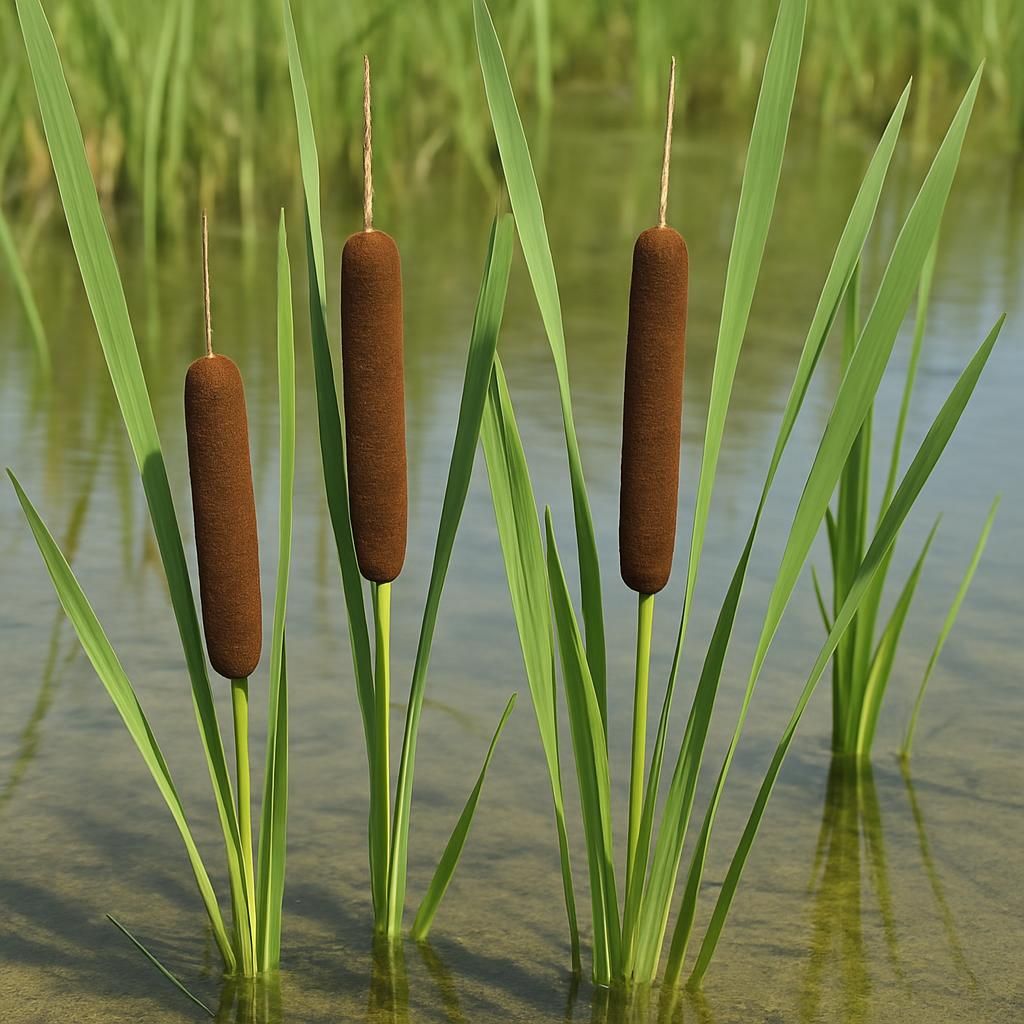
Introduction to cattails
Cattails (Typha spp.) rank among the most productive emergent wetland plants on Earth. Their dense rhizome mats stabilize shorelines, filter agricultural runoff, and create habitat for amphibians and waterfowl. On the farm, growers harvest the starchy spring shoots, protein-rich pollen, and insulating fluff for value-added crafts. Because cattails tolerate fluctuating water levels and heavy metals, they serve as low-cost bio-remediation tools for dairy lagoons and irrigation return flows.
Botanical Profile of cattails
Typha latifolia and Typha angustifolia dominate temperate production systems. Both species produce erect, pith-filled stems 1.5–3 m tall topped by a cylindrical brown inflorescence. Rhizomes spread laterally 30–60 cm per year, forming monotypic stands that outcompete many invasive reeds. Leaves are long, linear, and two-ranked, providing mechanical support and photosynthetic surface above water.
Soil, pH, and Climate Requirements for cattails
Cattails flourish in saturated or shallowly inundated soils. They tolerate a wide pH range but perform best in circumneutral conditions.
| Parameter | Ideal Range | Notes |
|---|---|---|
| Soil Type | Loam to heavy clay | High organic matter improves rhizome vigor |
| Soil pH | 6.0–7.5 | Tolerates 4.5–8.5 but growth slows outside optimum |
| Water Depth | 5–30 cm standing water | Survives seasonal drawdown to mudflats |
| Temperature | 15–30 °C daytime | Rhizomes overwinter to –20 °C |
| Salinity | <4 dS/m | Sensitive to prolonged brackish exposure |
Step-by-Step Planting & Propagation
- Site selection: Choose a low-lying area or pond margin with reliable water supply and full sun.
- Soil preparation: Remove competing woody vegetation; incorporate aged compost if organic matter is <3 %.
- Propagation material: Use 10–15 cm rhizome sections with at least two buds, collected in late winter.
- Planting density: Space rhizomes 30 cm apart in a grid; stagger rows 45 cm for rapid canopy closure.
- Initial flooding: Maintain 5 cm of water until new shoots reach 20 cm, then allow depth to increase gradually.
Care & Maintenance regimes for cattails
Consistent hydrology and moderate fertility sustain high biomass. Over-fertilization encourages excessive leaf growth at the expense of rhizome carbohydrate reserves.
| Task | Schedule | Rate / Method |
|---|---|---|
| Water level | Maintain 10–20 cm year-round | Adjust seasonally; lower in autumn for harvest |
| Fertilizer | Early spring (March–April) | 20 kg N/ha as blood meal or fish emulsion |
| Pruning | Late fall after first frost | Cut stems to 10 cm above waterline to recycle nutrients |
Pests, Diseases & Organic Management
Cattails host few serious pests under flooded conditions. Occasional Aphids colonize inflorescences; strong water flow and lady-beetle releases provide control. Fungal leaf spots appear in stagnant, overcrowded stands—thin stands to 20 stems per square meter and improve circulation. Root rot caused by Pythium is rare when dissolved oxygen remains above 2 mg/L.
Harvesting, Curing & Optimal Storage
- Shoots: Harvest when 20–40 cm tall; peel outer leaves and use fresh or blanch-freeze.
- Pollen: Collect golden spikes in early summer; sieve and dry at 35 °C for 48 h; store in airtight glass at 4 °C.
- Rhizomes: Dig in late autumn; wash, slice, and dehydrate or ferment into flour.
- Fluff: Separate from mature spikes; store in paper bags for insulation projects.
Companion Planting for cattails
Pair cattails with Rice in paddy-style systems to increase nutrient uptake and suppress algae. Thyme planted on adjacent berms repels mosquitoes while providing aromatic harvest. Avoid woody species that shade the water surface and reduce cattail photosynthesis.