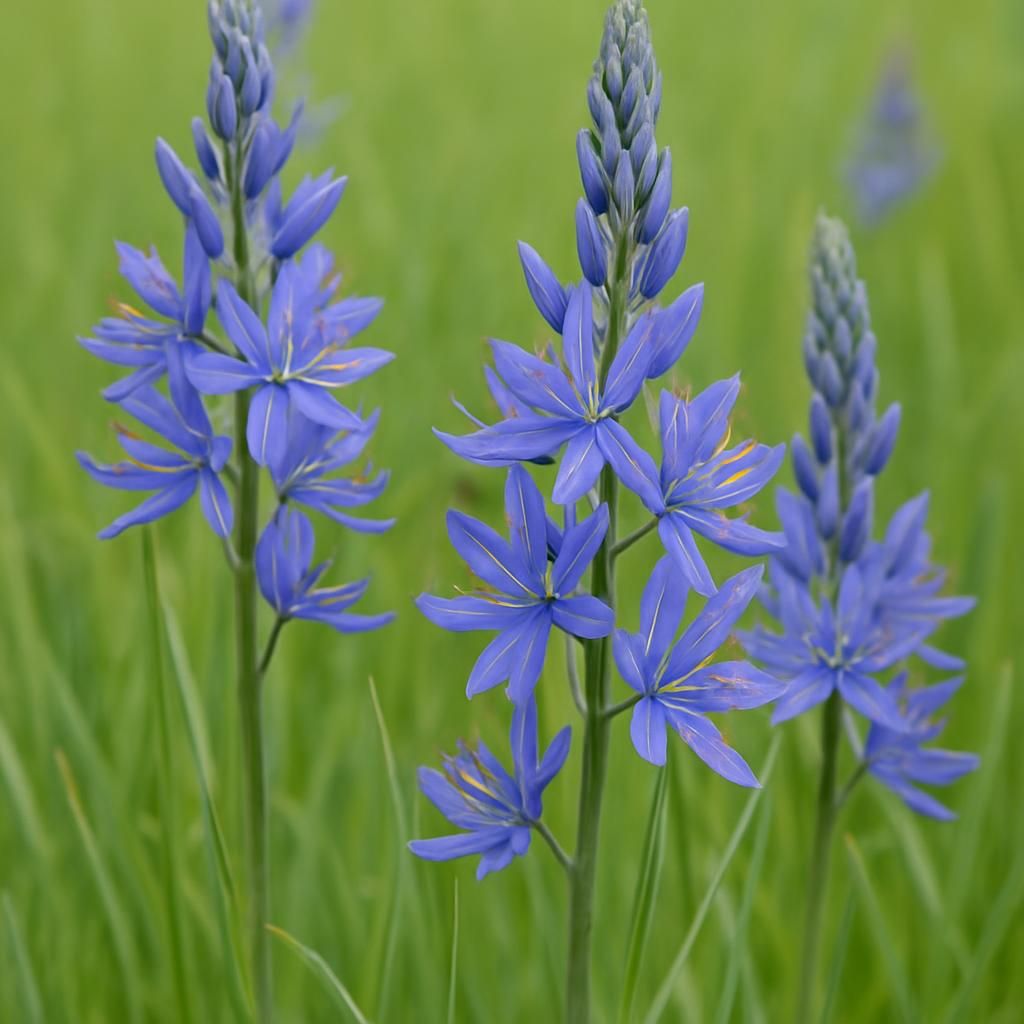
Introduction to Camas (Camassia quamash)
Camas (Camassia quamash) is a bulb-forming perennial native to western North America that has sustained Indigenous communities for millennia. The plant produces striking spikes of star-shaped blue to violet flowers in late spring and stores its energy in an edible bulb traditionally harvested in summer. Modern growers value Camas both as an ornamental and a low-maintenance native crop that thrives in moist meadows and prairie restorations.
Botanical Profile of Camas (Camassia quamash)
Camassia quamash belongs to the Asparagaceae family. It grows 30–80 cm tall with linear basal leaves and a leafless flowering stalk bearing 10–40 flowers. Each bulb is tunicate, 2–5 cm in diameter, and contains high levels of the complex carbohydrate inulin. The species reproduces both by seed and by offsets that form around the parent bulb.
Soil, pH, and Climate Requirements for Camas (Camassia quamash)
Camas prefers heavy soils that retain moisture yet drain adequately during summer dormancy. The following table summarizes ideal conditions:
| Parameter | Ideal Range | Notes |
|---|---|---|
| Soil Texture | Clay loam to silty clay | Avoid pure sand unless heavily amended |
| Soil pH | 5.5 – 7.0 | Tolerates mildly acidic to neutral soils |
| Organic Matter | 4–8 % | Incorporate well-rotted compost or leaf mold |
| Moisture Regime | Moist spring, drier summer | Mimics seasonal wet meadows |
| USDA Hardiness | Zones 4–8 | Requires winter chill for flowering |
| Temperature Range | 5–25 °C active growth | Bulbs dormant above 30 °C or below −15 °C |
Step-by-Step Planting & Propagation
- Site Selection: Choose a location that receives full sun to partial shade and remains moist from snowmelt through early summer.
- Soil Preparation: Loosen soil to 25 cm depth and incorporate 5–8 cm of organic matter. Test and adjust pH if outside the 5.5–7.0 range.
- Bulb Planting: Plant bulbs 10–15 cm deep and 15–20 cm apart in autumn (September–November) so roots establish before winter.
- Seed Propagation: Sow fresh seed 0.5 cm deep in flats; stratify 8–12 weeks at 4 °C. Seedlings reach flowering size in 3–5 years.
- Division: Every 4–5 years, lift clumps after foliage yellows, separate offsets, and replant immediately.
Care & Maintenance regimes for Camas (Camassia quamash)
Camas requires minimal intervention once established. The table below outlines seasonal tasks:
| Season | Watering | Fertilizer | Pruning / Cleanup |
|---|---|---|---|
| Spring | Keep evenly moist; 2–3 cm/week | Apply balanced organic fertilizer (5-5-5) at 500 g/10 m² when shoots emerge | Remove spent flower stalks after seed set if desired |
| Summer | Withhold water after foliage yellows | None | Allow foliage to senesce naturally |
| Autumn | Light irrigation if dry | Top-dress with 2 cm compost | Divide overcrowded clumps |
| Winter | Rely on natural precipitation | None | Protect young plantings with light mulch |
Pests, Diseases & Organic Management
Camas is generally pest-resistant. Occasional threats include aphids, slugs and snails, and root-knot nematodes. Cultural controls such as crop rotation, good drainage, and encouraging beneficial insects are usually sufficient. Remove and destroy heavily infested foliage; apply neem oil or insecticidal soap for aphids when populations exceed 10 per leaf.
Harvesting, Curing & Optimal Storage
Harvest bulbs after flowering when leaves begin to yellow, typically June–July. Use a digging fork to lift clumps carefully. Shake off soil, trim tops to 2 cm, and cure in a shaded, well-ventilated area at 15–20 °C for 7–10 days. Store cured bulbs in mesh bags or paper sacks at 4–10 °C with 60–70 % humidity. Properly cured bulbs remain viable for 6–9 months.
Companion Planting for Camas (Camassia quamash)
Camas pairs well with moisture-loving natives such as Yarrow, Thyme, and sedges. Avoid aggressive competitors like Clover that may outcompete young seedlings. Interplanting with shallow-rooted bulbs such as Saffron Crocus can extend seasonal interest and improve soil structure without competing for resources.