Introduction to Shellac Resin
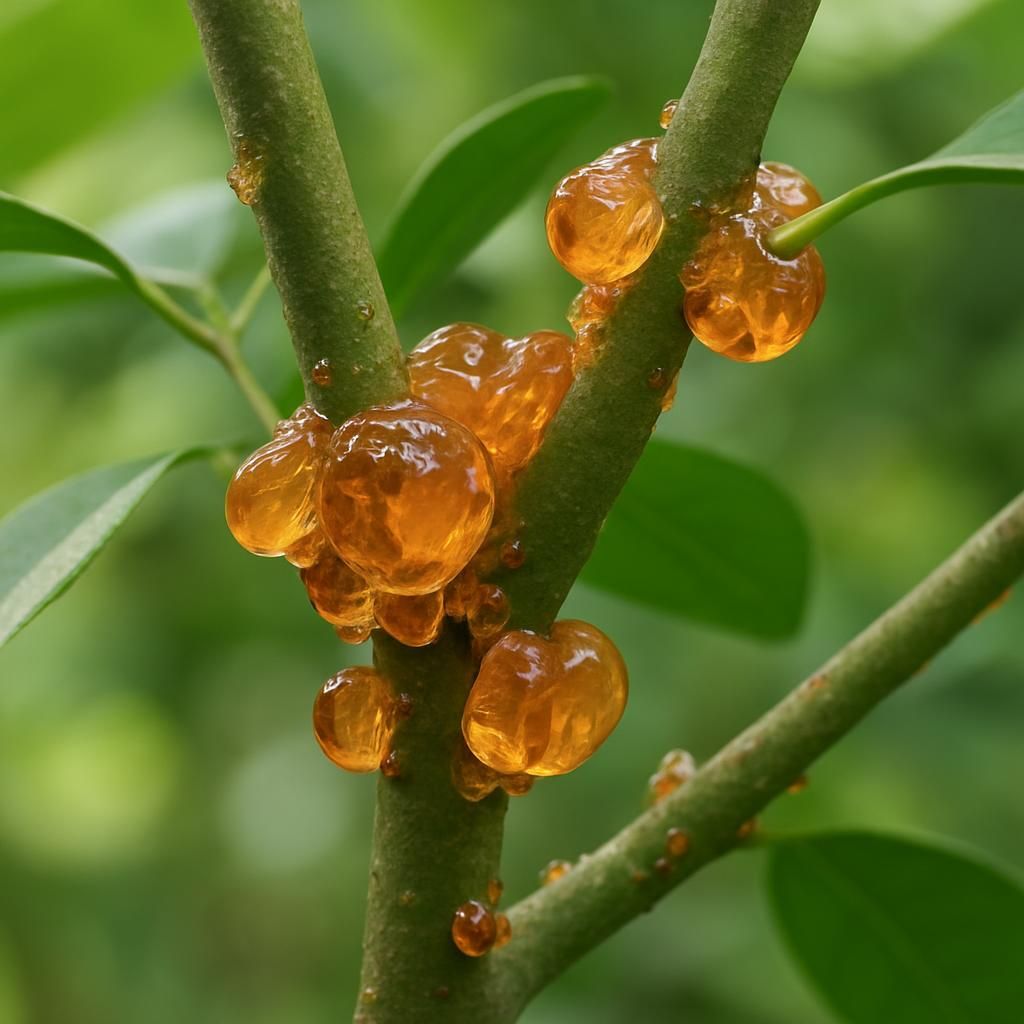
Shellac resin is a purified natural polymer secreted by the female lac insect, Kerria lacca, as a protective coating on host trees. The resin is harvested, processed, and sold worldwide for use in food, pharmaceuticals, woodworking, and industrial coatings. Commercial production is concentrated in India, Thailand, Myanmar, and parts of Southeast Asia where suitable host trees and climate conditions exist.
Botanical Profile of Shellac Resin
The lac insect Kerria lacca is a scale insect belonging to the family Kerriidae. Females attach to young branches of host trees and secrete a hard, amber-colored resin that encrusts the twigs. The resin is harvested as sticklac, crushed, washed, and melted into seedlac or shellac flakes. The insect completes two to three life cycles per year depending on temperature and host availability.
Soil, pH, and Climate Requirements for Shellac Resin
Lac cultivation depends on healthy host trees rather than direct soil planting. Ideal host species include Schleichera oleosa (kusum), Ziziphus mauritiana (ber), Butea monosperma (palash), and Flemingia semialata. The following table summarizes optimal conditions:
| Parameter | Ideal Range | Notes |
|---|---|---|
| Soil Type | Loamy to sandy loam | Well-drained; avoid waterlogging |
| Soil pH | 6.0–7.5 | Slightly acidic to neutral |
| Annual Rainfall | 1000–2000 mm | Even distribution preferred |
| Temperature Range | 20–35 °C | Avoid prolonged exposure below 15 °C |
| Relative Humidity | 60–85 % | Supports insect settlement and resin flow |
| Altitude | 0–800 m | Lower to mid elevations optimal |
Step-by-Step Planting & Propagation
- Select vigorous host trees 3–5 years old with healthy, young branches.
- Prune selected branches to 1–1.5 cm diameter to encourage new growth.
- Inoculate with broodlac (twigs containing mature female insects) during the swarming season (June–July or October–November depending on region).
- Tie broodlac bundles to host branches using natural fiber string; allow 3–4 weeks for settlement.
- Remove broodlac bundles after settlement to prevent overcrowding.
- Monitor for second-generation emergence 4–5 months later.
Care & Maintenance regimes for Shellac Resin
Routine care focuses on host tree health and insect population management. The table below outlines recommended schedules:
| Activity | Frequency | Details |
|---|---|---|
| Watering | Weekly during dry spells | Deep irrigation of host tree root zone; avoid water stress |
| Fertilizer | Twice per year | Apply 5–10 kg well-rotted manure + 200 g NPK (10-26-26) per mature tree |
| Pruning | Annually after harvest | Remove dead wood; maintain 30–40 % canopy for light penetration |
Pests, Diseases & Organic Management
Common threats include scale insects, mealybugs, and spider mites. Fungal issues such as sooty mold can develop on honeydew secretions. Organic controls include neem oil sprays (0.5 % concentration), introduction of predatory lady beetles, and maintaining good airflow through proper pruning. Regular monitoring every 15 days during active growth periods is essential.
Harvesting, Curing & Optimal Storage
Harvest sticklac 4–6 months after inoculation when resin encrustation is complete. Cut infested twigs, scrape resin, and sun-dry for 3–5 days. Crush and wash to produce seedlac, then melt and filter into shellac flakes. Store finished shellac in cool (below 25 °C), dry conditions inside airtight containers away from direct sunlight. Properly stored shellac retains quality for 12–18 months.
Companion Planting for Shellac Resin
Interplant host trees with nitrogen-fixing species such as pigeon pea or gliricidia to improve soil fertility and provide additional income. Avoid planting heavy feeders like corn that compete for nutrients. Marigold borders help repel certain sucking insects while attracting beneficial pollinators.