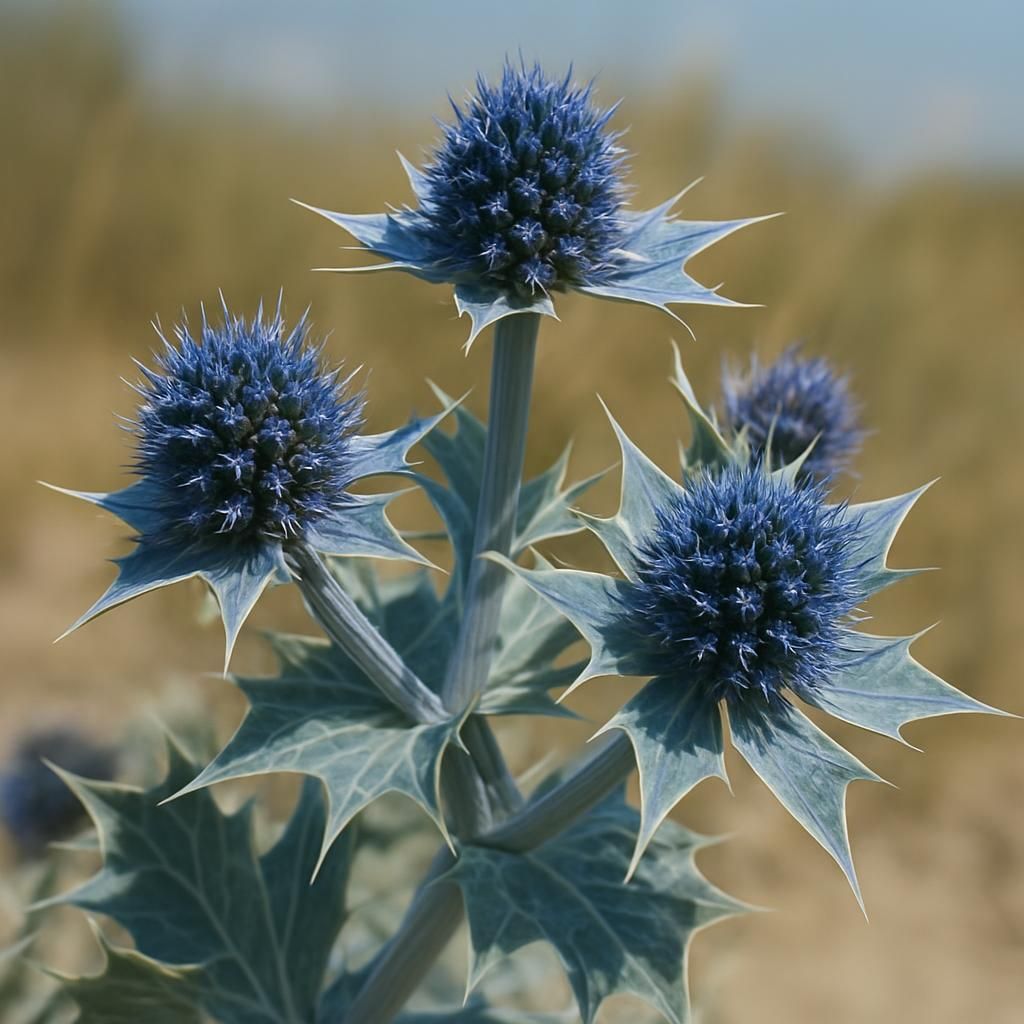
Introduction to Sea Holly (Eryngium maritimum)
Sea Holly (Eryngium maritimum) is a hardy, salt-tolerant perennial native to European coastal dunes. Its spiny, glaucous foliage and steel-blue inflorescences deliver striking architectural interest while thriving in poor, sandy soils where many crops fail. Professional growers value Sea Holly for cut-flower production, pollinator support, and low-maintenance xeriscaping.
Botanical Profile of Sea Holly (Eryngium maritimum)
Eryngium maritimum belongs to the Apiaceae family. Plants form basal rosettes of thick, leathery, spiny-margined leaves that are grey-green with a waxy bloom. In the second year, branched stems 30–60 cm tall rise, each topped by an egg-shaped flower head surrounded by spiny, metallic-blue bracts. Individual flowers are small, hermaphroditic, and insect-pollinated. The deep taproot anchors the plant against wind and extracts moisture from subsoil layers.
Soil, pH, and Climate Requirements for Sea Holly (Eryngium maritimum)
| Parameter | Ideal Range/Value | Notes |
|---|---|---|
| Soil Type | Sandy, well-drained, low fertility | Avoid heavy clay; amend with coarse sand |
| Soil pH | 6.5–8.0 | Slightly alkaline preferred |
| Temperature Range | 15–28 °C daytime; tolerates –15 °C | Full sun essential |
| Annual Rainfall | 300–600 mm, well-distributed | Supplemental irrigation only during establishment |
| Spacing | 40–50 cm between plants; 60 cm rows | Good airflow reduces disease risk |
Step-by-Step Planting & Propagation
- Site selection: Choose full-sun locations with excellent drainage.
- Soil preparation: Incorporate 5–10 cm of coarse sand or grit into the top 20 cm.
- Propagation: Sow fresh seed in autumn or stratify 4–6 weeks at 4 °C; germination occurs in 14–30 days at 15–20 °C.
- Division: Established clumps can be divided in early spring every 3–4 years.
- Transplant seedlings when they have 4–6 true leaves; water once and then withhold moisture.
Care & Maintenance regimes for Sea Holly (Eryngium maritimum)
| Task | Schedule | Details |
|---|---|---|
| Watering | Establishment: weekly; Mature: none | Deep soak only if drought exceeds 4 weeks |
| Fertilizer | Early spring only | 1–2 cm compost or low-nitrogen slow-release |
| Pruning | Late autumn or early spring | Cut spent stems to 5 cm above crown |
Pests, Diseases & Organic Management
Sea Holly is largely pest-resistant. Occasional aphids or spider mites appear during prolonged drought; a strong water spray or insecticidal soap suffices. Fungal leaf spots are rare in well-spaced, sunny plantings. Maintain airflow and avoid overhead irrigation. Root rot can occur in waterlogged soils—ensure drainage.
Harvesting, Curing & Optimal Storage
Harvest stems when 50 % of florets are open. Cut at the base early morning. Strip lower leaves and place in 5 cm of water with floral preservative for 24 h. For drying, hang bundles upside-down in a dark, ventilated space at 20–25 °C for 10–14 days. Store dried stems in sealed boxes away from light.
Companion Planting for Sea Holly (Eryngium maritimum)
Pair Sea Holly with drought-tolerant companions such as Thyme, Yarrow, and Rosemary to create a Mediterranean-style planting that conserves water and deters pests. Avoid moisture-loving neighbors like Lettuce. For more strategies on pairing plants, see the article Summer Companion Planting: 10 Organic Pairings to Boost Small Farm Resilience.