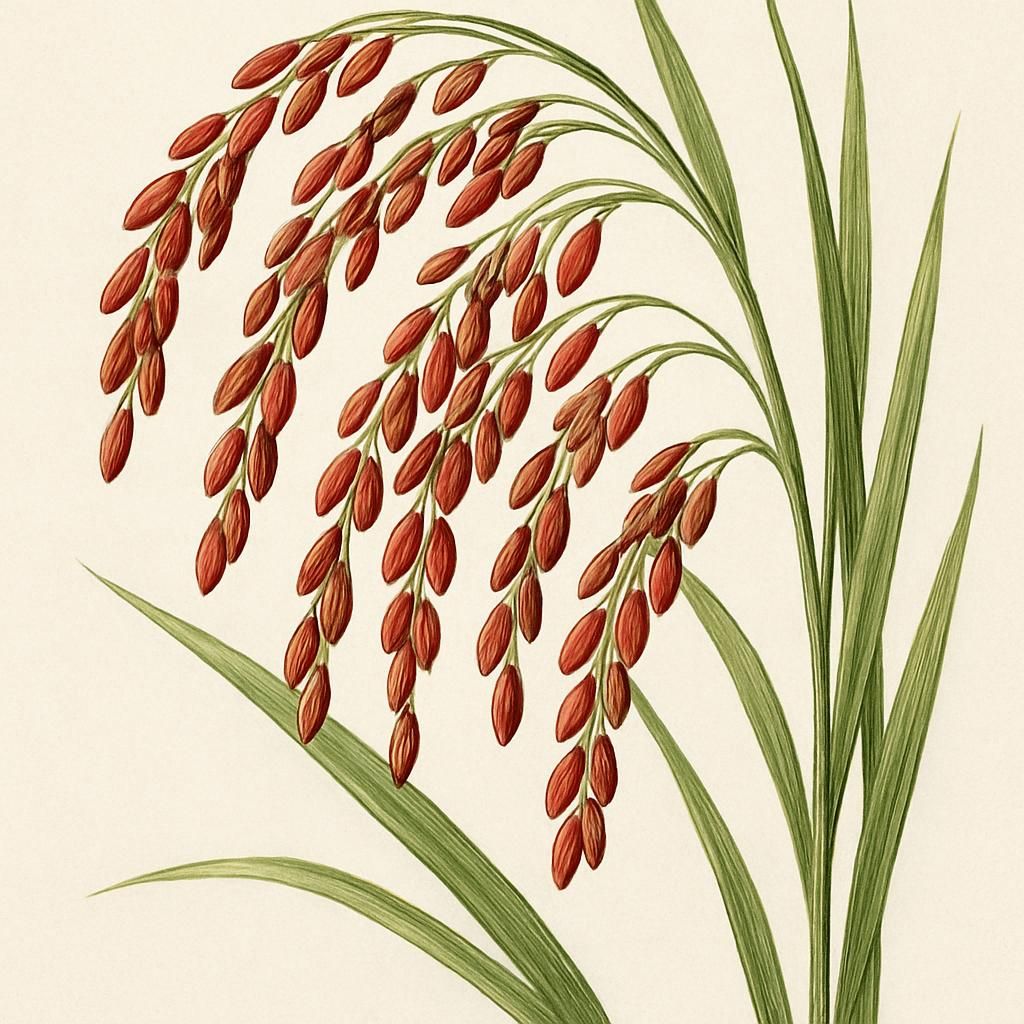
Introduction to Red Rice (Camargue Red)
The Camargue Red Rice, a unique variety hailing from the Rhône Delta in Southern France, is renowned for its striking reddish-brown hue and subtly nutty flavor. It's especially recognized for its nutritional profile, offering a higher fiber content than its white rice counterparts. As this rice is cultivated organically, it supports biodiversity and integrates well into sustainable agricultural practices.
Botanical Profile of Red Rice (Camargue Red)
Botanically referred to as Oryza sativa L., Camargue Red Rice belongs to the grass family Poaceae. It stands out for its reddish bran cover and nutritious endosperm. This variety is annual and hydrophytic, relying on waterlogged conditions to grow optimally.
Soil, pH, and Climate Requirements for Red Rice (Camargue Red)
Camargue Red Rice thrives in specific environmental conditions, from soil type to climate:
| Condition | Ideal Range |
|---|---|
| Soil Type | Loam, sandy loam |
| pH Level | 5.5 - 6.5 |
| Climate | Warm semi-arid, mild Mediterranean |
| Temperature | 20-35°C during the growing season |
| Rainfall | 800-1200 mm annually, supplemented by irrigation as required |
Step-by-Step Planting & Propagation
- Seed Selection: Choose certified Camargue Red Rice seeds to ensure purity and disease resistance.
- Soil Preparation: Plow and level the field to ensure proper irrigation. Apply organic matter to enhance fertility.
- Sowing: Sow seeds directly into the field in early spring, ensuring an even distribution. Use 80-100 kg seeds per hectare.
- Water Management: Maintain a 5-10 cm water level in the field during germination and tillering phases.
- Thinning: Thin out seedlings to maintain the recommended spacing of 15-20 cm between plants.
Care & Maintenance Regimes for Red Rice (Camargue Red)
Proper care is crucial for optimizing yield and quality. Below is a recommended schedule:
| Aspect | Schedule |
|---|---|
| Watering | Maintain consistent water levels, reduce during dry grain phase |
| Fertilization | Apply nitrogen-rich compost at planting and potassium during tillering |
| Pruning | Not applicable |
Pests, Diseases & Organic Management
Camargue Red Rice is susceptible to various pests and diseases, including Spider Mites and fungal infections like Pyricularia oryzae. Organic management involves:
- Integrated Pest Management: Use of companion plants and beneficial insects.
- Fungal Control: Apply copper-based fungicides and maintain proper air circulation to minimize humidity. More on organic strategies can be read in the Crop Diseases Under the Microscope: 9 Organic Fixes for Small Farm Resilience.
Harvesting, Curing & Optimal Storage
Harvest at full maturity when grains are firm. Use mechanical harvesters for larger areas.
- Curing: Dry grains thoroughly to around 12% moisture content.
- Storage: Store in a cool, dry environment, ideally airtight containers to manage humidity and pests.
Companion Planting for Red Rice (Camargue Red)
Effective companion planting can deter pests and enrich the soil. Consider pairing with:
- Soybeans for nitrogen fixation.
- Marigold to deter nematodes. For more on companion planting, visit the relevant blog post: Summer Companion Planting: 10 Organic Pairings to Boost Small Farm Resilience.