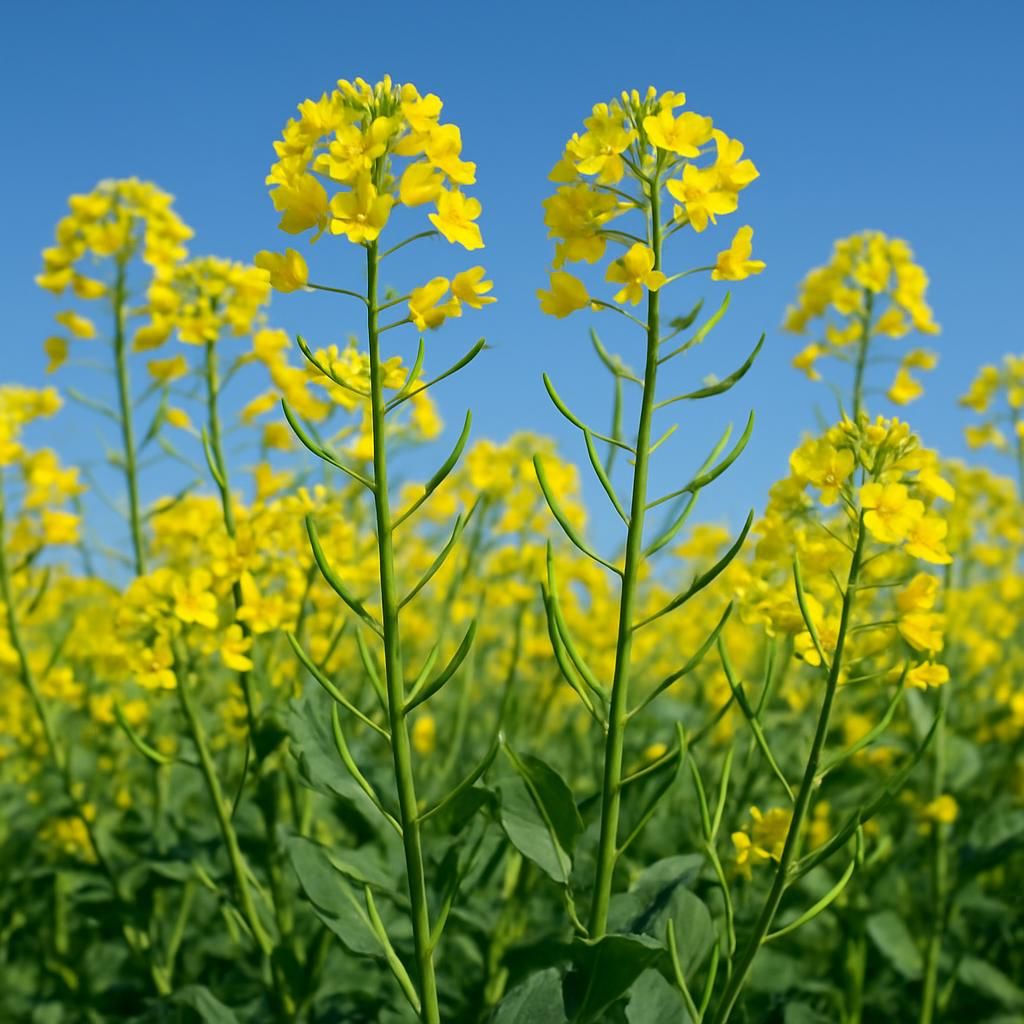
Introduction to Rape Seed (Canola)
Rape seed (Brassica napus), marketed globally as canola, is one of the world’s most important oilseed crops. The term “canola” denotes varieties bred for low erucic acid and low glucosinolate content, making the oil safe for human consumption and the meal suitable for livestock feed. Originally developed in Canada in the 1970s, canola now ranks as the third-largest source of vegetable oil after palm and soybean. Its rapid growth cycle, high oil content (38–44 %), and nitrogen-scavenging ability make it an attractive break crop in cereal-dominated rotations.
Farmers grow canola for both edible oil and industrial uses including biodiesel and lubricants. The crop’s short season allows double-cropping opportunities in many regions, while its early flowering supports pollinator populations. Because canola residues decompose quickly, they improve soil structure and reduce disease pressure for subsequent wheat or barley crops. Rapeseed is the broader botanical category that includes both edible canola and high-erucic industrial types.
Botanical Profile of Rape Seed (Canola)
Canola belongs to the Brassicaceae family and is an amphidiploid species derived from crosses between Brassica rapa and Brassica oleracea. Plants exhibit a rosette growth habit early in the season before bolting to produce a central flowering stem reaching 80–150 cm. Bright yellow flowers are perfect and predominantly self-pollinating, although bees can increase seed set by 10–15 %. Seeds are small (1.5–2.5 mm), round, and range in color from black to reddish-brown, containing approximately 40 % oil and 22 % protein.
The root system is a deep taproot with extensive lateral branches that can reach 1.5 m, improving water and nutrient uptake. Leaves are glaucous, waxy, and lobed, providing some drought tolerance. Canola completes its life cycle in 85–120 days depending on variety and latitude. Winter types require vernalization and are sown in autumn, while spring types are planted after the last frost.
Soil, pH, and Climate Requirements for Rape Seed (Canola)
Canola performs best on well-drained loamy or clay-loam soils with good structure. It tolerates a wide pH range but yields decline sharply below pH 5.5. The crop requires 350–450 mm of moisture during the growing season and is moderately tolerant of salinity (ECe < 4 dS/m). Cold tolerance varies by type: winter canola survives –15 °C with snow cover, whereas spring types are damaged below –4 °C at the rosette stage.
| Parameter | Ideal Range | Notes |
|---|---|---|
| Soil Type | Loam to clay loam | Avoid compacted or waterlogged soils |
| Soil pH | 6.0 – 7.5 | Liming recommended below 5.8 |
| Temperature (day) | 15 – 25 °C | Optimal flowering at 20 °C |
| Temperature (night) | 5 – 15 °C | Frost below –4 °C damages buds |
| Annual Rainfall | 350 – 600 mm | Supplemental irrigation in dry spells |
| Growing Degree Days | 1,200 – 1,600 GDD | Base temperature 5 °C |
| Salinity Tolerance | ECe < 4 dS/m | Yield loss above 6 dS/m |
Step-by-Step Planting & Propagation
- Soil testing and preparation: Sample to 30 cm depth and apply lime 3–6 months before sowing if pH < 5.8. Incorporate 20–30 kg N/ha as starter fertilizer.
- Seedbed: Create a firm, fine tilth with good seed-to-soil contact. Minimum tillage systems reduce erosion and conserve moisture.
- Sowing window: Spring canola is planted when soil temperature reaches 5–7 °C; winter canola is sown 4–6 weeks before first frost.
- Seeding rate: 4–6 kg/ha for hybrid spring types aiming for 60–80 plants/m²; increase to 8 kg/ha on heavy soils.
- Depth and spacing: Sow 1.5–2.5 cm deep in 15–30 cm rows. Use precision drills to ensure uniform emergence.
- Inoculation and seed treatment: Treat seed with fungicides for damping-off and insecticides if flea beetle pressure is expected. Rhizobial inoculants are unnecessary for canola.
- Rolling: Light rolling after sowing improves contact and reduces wind erosion.
Care & Maintenance regimes for Rape Seed (Canola)
Canola requires careful nutrient and water management to achieve 2.5–4.0 t/ha seed yields. Nitrogen is the most limiting nutrient; split applications reduce lodging risk. Boron deficiency causes “brown heart” and is common on sandy soils. Weed control in the first 4–5 weeks is critical because canola is a poor competitor.
| Growth Stage | Irrigation Schedule | Fertilizer Application | Pruning / Other Operations |
|---|---|---|---|
| Pre-sowing | None | 30–40 kg N, 20 kg P, 30 kg K, 1 kg B | Soil incorporation of residues |
| Emergence to rosette | Maintain top 5 cm moist | 40–60 kg N at 4–6 leaf stage | Scout for flea beetles; apply insecticide if needed |
| Stem elongation | 25–30 mm/week if rainfall < 15 mm | 50–70 kg N; 15 kg S | Monitor for lodging; consider growth regulator |
| Flowering | Avoid water stress | Foliar B (0.5 kg/ha) if deficiency suspected | Fungicide for sclerotinia if risk high |
| Pod fill to maturity | Withhold 2–3 weeks before harvest | None | Swathing or desiccation at 30–40 % seed color change |
Pests, Diseases & Organic Management
Major insect pests include flea beetles, cabbage seedpod weevil, and diamondback moth. Flea beetles cause shot-hole damage on cotyledons; economic threshold is 25 % defoliation. Cabbage seedpod weevil larvae consume developing seeds inside pods. Diamondback moth larvae skeletonize leaves and can defoliate entire fields.
Key diseases are blackleg (Leptosphaeria maculans), sclerotinia stem rot, and alternaria black spot. Blackleg is seed- and stubble-borne; resistant hybrids and 3–4 year rotations are essential. Sclerotinia infects during flowering under prolonged leaf wetness; apply foliar fungicides or use biological agents such as Coniothyrium minitans. Clubroot (Plasmodiophora brassicae) has become a serious soil-borne threat in many canola regions.
Organic management relies on cultural practices: diverse rotations, resistant varieties, timely sowing to escape peak pest pressure, and mechanical weed control. Border strips of flowering plants such as buckwheat attract beneficial insects. Neem-based sprays and Bacillus thuringiensis provide moderate control of lepidopteran larvae. Regular monitoring with yellow sticky traps and sweep nets allows early intervention.
Harvesting, Curing & Optimal Storage
Canola is ready for direct combining when seed moisture reaches 8–10 % and 90 % of pods have turned brown. Swathing at 30–40 % seed color change accelerates drying and reduces shattering losses by 5–8 %. Combine settings should use low cylinder speed (400–600 rpm) and wide concave clearance to minimize seed cracking.
Post-harvest, aerate seed to 8 % moisture within 48 hours. Store at 10–15 °C and < 65 % relative humidity. Use sealed silos with phosphine fumigation only when insect activity is detected. Seed viability declines after 18 months; test germination before replanting. Oil quality remains stable for 12 months when stored below 20 °C in dark conditions.
Companion Planting for Rape Seed (Canola)
Canola benefits from association with deep-rooted legumes that fix nitrogen and improve soil structure. Clover and hairy vetch sown as understories or in rotation supply 40–80 kg N/ha to the following crop. Brassica trap crops such as mustard can lure flea beetles away from the main planting. Flowering companions including marigold and buckwheat attract parasitoid wasps that attack diamondback moth.
Avoid planting canola near other brassicas (cabbage, broccoli) to reduce shared disease and pest pressure. Intercropping with cereals such as wheat or barley in alternate rows can suppress weeds and improve land-use efficiency. After harvest, volunteer canola should be controlled to prevent it becoming a weed in subsequent rotations.