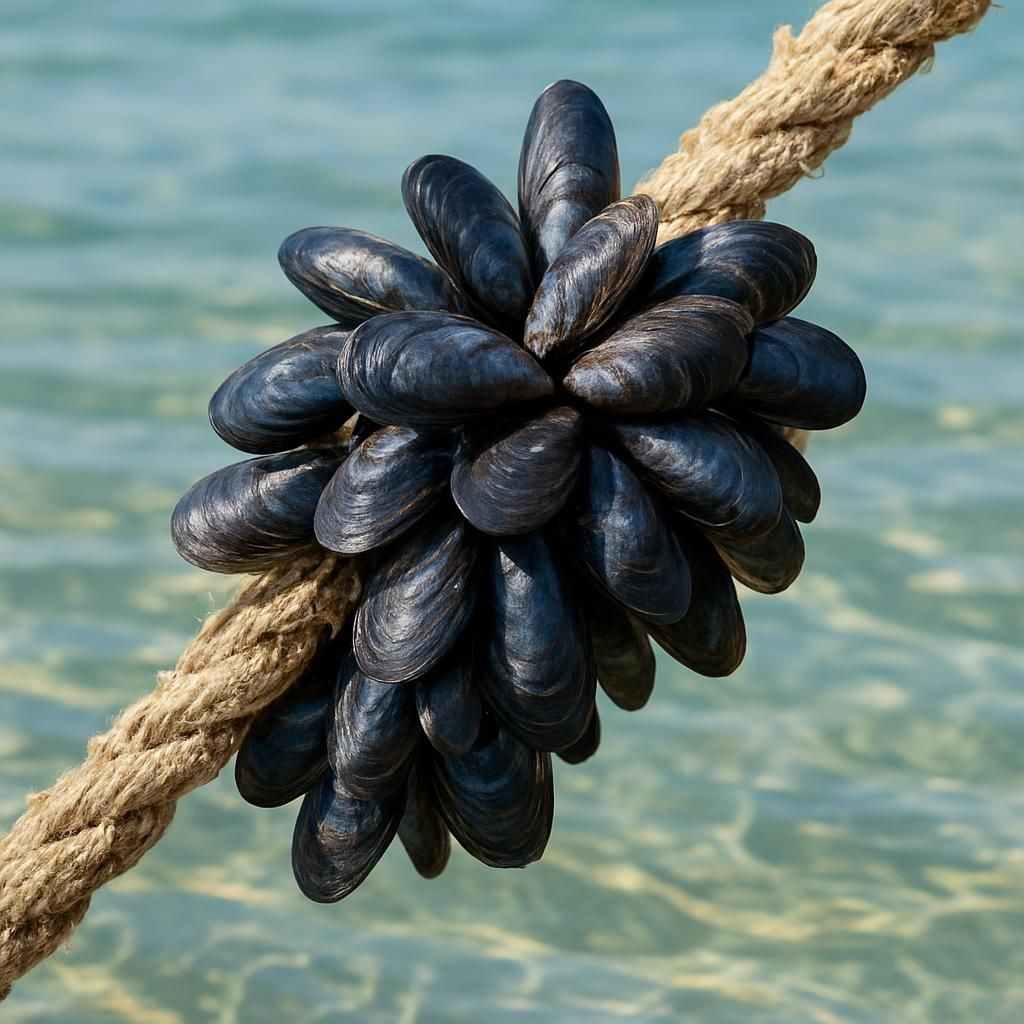
Introduction to mussels
Mussels represent one of the most sustainable forms of animal protein production in aquaculture. They require no feed inputs, improve water quality through filter feeding, and can be grown in both nearshore and offshore environments. Commercial production focuses primarily on blue mussels (Mytilus edulis) and green mussels (Perna viridis), with global output exceeding 2 million metric tons annually. Successful cultivation depends on understanding larval settlement patterns, predator exclusion, and water quality parameters.
Botanical Profile of mussels
Mussels are marine bivalves belonging to the family Mytilidae. Their soft body is enclosed by two hinged shells composed of calcium carbonate. The byssal threads, commonly called the beard, allow attachment to substrates. They are filter feeders that process phytoplankton, detritus, and organic particles from the water column. Growth rates vary by species, temperature, and food availability, with individuals reaching market size (40–60 mm) in 12–24 months depending on location.
Soil, pH, and Climate Requirements for mussels (MUST INCLUDE A MARKDOWN TABLE OF IDEAL CONDITIONS)
Mussels thrive in coastal marine waters rather than terrestrial soil. Optimal conditions include stable salinity, moderate temperatures, and sufficient phytoplankton. The table below summarizes ideal parameters.
| Parameter | Ideal Range | Notes |
|---|---|---|
| Salinity | 25–35 ppt | Lower salinity reduces growth and survival |
| Temperature | 10–20 °C (optimal 12–18 °C) | Higher temps increase disease risk |
| pH | 7.8–8.4 | Marine pH range; avoid acidification |
| Dissolved Oxygen | >5 mg/L | Critical during summer stratification |
| Chlorophyll-a | 2–10 µg/L | Indicates adequate food availability |
| Current Speed | 0.1–0.5 m/s | Supplies food and removes waste |
| Depth | 5–20 m | Balance between light and predator access |
Step-by-Step Planting & Propagation
- Site selection begins with water quality testing and current modeling. Choose areas with consistent phytoplankton blooms and protection from excessive wave action.
- Collect wild seed using collector ropes or purchase hatchery spat. Settlement occurs on fibrous substrates during spring and autumn peaks.
- Prepare culture structures: longlines, rafts, or bouchot poles. Ensure lines are tensioned and buoys are correctly sized for expected biomass.
- Deploy seed collectors 2–4 weeks before expected settlement. Monitor larval counts using plankton nets.
- Thin and transfer seed to grow-out ropes when mussels reach 10–15 mm. Maintain stocking densities of 200–400 individuals per meter.
- Install predator nets or socks around young mussels to reduce crab and starfish predation.
Care & Maintenance regimes for mussels (MUST INCLUDE A MARKDOWN TABLE OF WATER, FERTILIZER, AND PRUNING SCHEDULES)
Mussels require minimal intervention compared with finfish. Maintenance focuses on biofouling removal, line tension checks, and monitoring for predators. No fertilizer is applied; natural productivity supplies nutrition.
| Activity | Frequency | Method | Notes |
|---|---|---|---|
| Water Quality Check | Weekly | Salinity, temperature, oxygen probes | Record data in farm logbook |
| Biofouling Removal | Every 4–6 weeks | High-pressure spray or manual brushing | Prevents reduced water flow |
| Line Tension Check | Monthly | Adjust buoy depth and anchor lines | Prevents tangling and line failure |
| Predator Inspection | Bi-weekly during summer | Visual dive surveys or lift checks | Target crabs, starfish, and birds |
| Thinning | Once at 20–25 mm | Reduce density to final grow-out spacing | Improves meat yield and shell strength |
Pests, Diseases & Organic Management
Common pests include starfish, shore crabs, and ducks. Starfish can be removed manually or deterred with exclusion nets. Diseases are rare but include mussel edwardsiellosis and vibriosis during warm periods. Maintain good water exchange and avoid overcrowding to reduce stress. Organic management relies on mechanical removal, timed harvests, and site rotation rather than chemical treatments.
Harvesting, Curing & Optimal Storage
Harvest when mussels reach 45–60 mm shell length, typically 18–24 months after settlement. Lift longlines or bouchots and detach clusters. Rinse with clean seawater to remove mud and byssus. Grade by size and place in mesh bags or totes. Cool rapidly to 4 °C within 2 hours of harvest. Store live mussels in aerated seawater or on ice for up to 7 days. For longer storage, cook and freeze or process into value-added products.
Companion Planting for mussels
Mussels integrate well with other aquaculture species in polyculture systems. Pairing with seaweed such as kelp improves nutrient cycling and provides additional revenue. Oyster Mushroom cultivation on land can utilize mussel processing waste as a substrate component. Avoid proximity to finfish farms that may increase organic loading beyond carrying capacity.